I needed a professional consultation explanation of procedure for safe removal of Asbestos in my apartment complex. Without having an account yet, I was very impressed with the caring, knowledgeable and generous advice offered by Jessica, and will look forward to doing business in the future. Thank you so much! I feel much more informed about a sometimes scary endeavor. Peace. Nancy Silva Mineola, NY.
Mia Munoz
Used this company to clean up some water flood in my house. They were fast and easy to work with.very professional, Would recommend to anyone!
Nini Valle
Great company, had a flood and they responded quickly and efficiently. Billed my insurance company directly. I highly recommend this company!
joe colapietro, jr
I had pipe freeze in my basement right before a snow storm and they made to within an hour to help start the clean up process. They we by our side throughout the entire process and even helped with the insurance company. They did such a great job with the cleanup, repair, remidiation, I contracted them to perform the repairs and finishes in the basement. They came with enough manpower and material to get the job done. Leo and Jessica were nothing but a pleasure to deal with!!
Cristian Arredondo c
I had some water damage in my home and Green Island was able to take care of my issue quickly and effectively. I am very pleased with the work they did. They responded quickly and were very professional.
Michael M
Outstanding service! From the office to the field crew everyone was friendly, helpful and responsive. I highly recommend Green Island Group.
What a Finished Kitchen Actually Means on the North Shore
A kitchen renovation in Cove Neck isn’t the same conversation you’d have in most of Nassau County. The homes here are older, the lots are larger, and the expectations are higher. When the project is done right, you’re not just looking at new cabinets and countertops — you’re looking at a kitchen that finally matches the scale and character of the home around it.
Cove Neck’s peninsula location on Oyster Bay Harbor creates real, ongoing wear on kitchen interiors that most homeowners don’t connect to the source. Salt air accelerates cabinet finish deterioration. Humidity causes grout failure, warped doors, and moisture buildup behind walls that goes unnoticed for years. A renovation that doesn’t account for the waterfront environment you’re actually living in isn’t going to hold up the way it should.
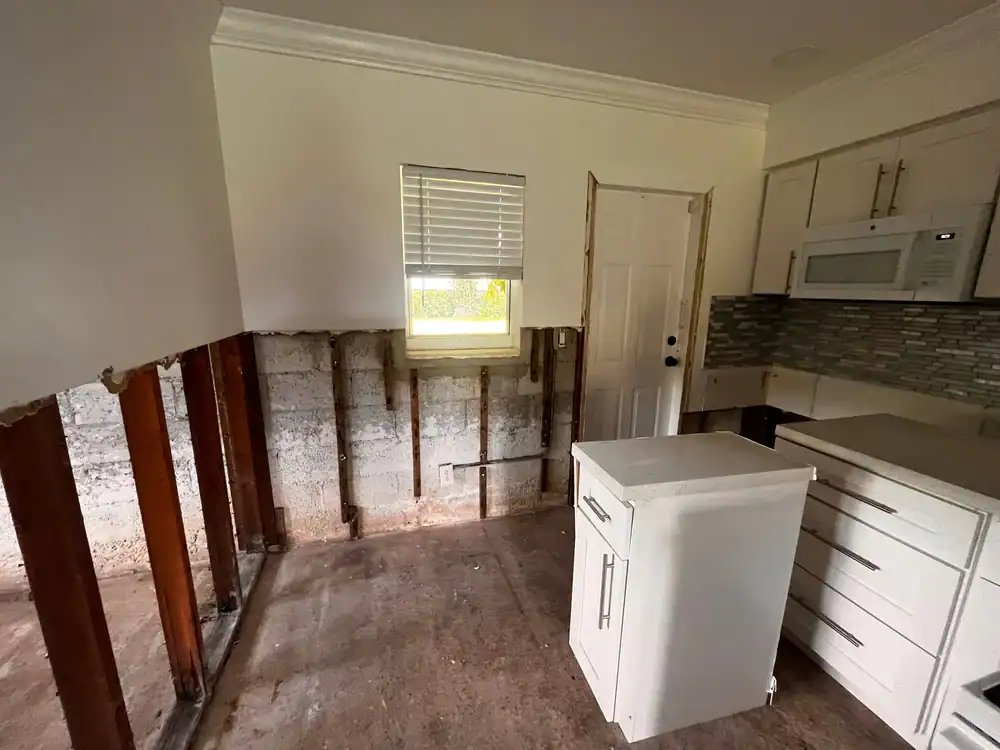
Many of the homes on Cove Neck Road and Sagamore Hill Road haven’t had a kitchen touched in decades — sometimes longer. When the walls finally open up, there’s often more to address than the original plan accounted for. That’s where having a contractor who handles mold remediation, water damage, and lead abatement alongside the renovation itself makes a real difference. You don’t have to stop the project and start over. The work continues.
Long Island Roots, Built for North Shore Standards
We’re based in Bohemia, NY and serve Nassau and Suffolk counties — which means when we show up in Cove Neck, we already know the territory. We know the North Shore housing stock, we know how Nassau County permitting works, and we know what it takes to renovate a home that’s been in a family for generations without treating it like a standard job.
What sets our work apart here isn’t just the craftsmanship — it’s the range. Kitchen remodeling, mold remediation, water damage restoration, lead abatement, demolition — it all runs under one roof. For a waterfront village like Cove Neck, where what’s behind the walls can be just as important as what’s in front of them, that full-service capability isn’t a bonus. It’s the only approach that makes sense.
We’re also EPA Lead-Safe Certified, which matters directly in a community where a significant number of homes predate 1978. That certification means your family is protected during the renovation process — not just from construction dust, but from the real risks that come with disturbing older materials in historic homes.
No Surprises — Here's Exactly How the Project Runs
It starts with a walkthrough. Before anything is priced or planned, we want to see the kitchen you have — the layout, the condition, what’s working, what isn’t, and what the rest of the home tells us about where the renovation needs to go. For Cove Neck homes, that first visit often reveals things a phone consultation never would: moisture near the exterior walls, cabinetry that’s been painted over multiple times, or a layout that was functional in 1975 but doesn’t serve the way you actually use the space today.
From there, we handle the permitting. Cove Neck has its own Building Department and a Site and Architectural Review Board that must approve alterations to single-family dwellings before work begins. That process requires documentation, and it takes time if you don’t know how it works. We manage it — the application, the review, the inspections — so you’re not the one chasing down the village Building Inspector trying to figure out where your permit stands.
Once approvals are in place, the project moves in a clear sequence: demolition, any structural or mechanical work, rough inspections, then the finish trades — cabinets, countertops, tile, lighting, appliances. Your project manager is your single point of contact from start to final walkthrough. Nothing gets handed off without accountability attached to it.
Every Detail Chosen for the Home You Actually Have
Kitchen remodeling in Cove Neck covers the full scope — layout reconfiguration, custom cabinetry, countertop selection and installation, tile backsplash, lighting, plumbing fixtures, appliance integration, and finish carpentry. The material choices we guide you through are specific to this environment. In a waterfront home subject to salt air and elevated humidity, the difference between a cabinet finish that holds and one that fails in three years isn’t cosmetic — it’s functional. We steer clients toward materials that perform in this climate, not just materials that photograph well.
For homes with pre-1978 construction — which covers a meaningful portion of Cove Neck’s housing stock — the renovation process includes lead-safe protocols from day one. That means proper containment, certified handling, and documented cleanup. It’s a federal requirement, and it’s one that a lot of contractors quietly skip. We don’t.
If the project uncovers moisture damage, mold, or deteriorated subfloor material during demo — which happens more often than most homeowners expect in a waterfront village — we address it under the same contract, with the same team, on the same timeline. You’re not calling a second company, waiting for a second estimate, and watching your project stall for three weeks. The renovation continues. For an estate-level home in a community like Cove Neck, where the investment is significant and the standards are high, that kind of continuity matters.
Do I need a permit for a kitchen remodel in Cove Neck, NY?
Yes — and in Cove Neck specifically, the permitting process involves more than a standard Nassau County building permit. The village has its own Building Department and a Site and Architectural Review Board that must review and approve alterations to single-family dwellings before any work begins. This applies to kitchen renovations that involve structural changes, electrical upgrades, plumbing relocation, or any modification to the home’s exterior appearance.
The Architectural Review Board process requires documentation of the proposed work and can involve revisions before approval is granted. It’s not a rubber-stamp step. Contractors who aren’t familiar with Cove Neck’s specific process can cause significant delays — or worse, start work without the required approvals, which creates liability for the homeowner down the line. We manage the full permit process on your behalf, from the initial application through the required inspections at completion.
How much does a kitchen remodel typically cost in Cove Neck, NY?
For a full kitchen renovation in Cove Neck — meaning a complete layout, new cabinetry, countertops, appliances, tile, lighting, and plumbing fixtures — you’re realistically looking at a range of $80,000 to $200,000 or more, depending on the size of the space, the materials selected, and what’s discovered once the walls open up. Estate-scale kitchens on larger properties can run higher, particularly when structural modifications or significant mechanical upgrades are part of the scope.
The homes in Cove Neck are not comparable to mid-range suburban properties in other parts of Nassau County. They carry significant architectural and financial weight, and the renovation investment should reflect that. A kitchen that looks out of place in a historic Shingle-style estate is not a value — it’s a liability at resale. Remodeling Magazine’s Cost vs. Value data consistently shows that kitchen renovations in the Northeast return 85 to 96 cents on the dollar, and in a market where homes sell for $1 million to $13 million, a well-executed renovation pays for itself in competitive positioning alone.
What happens if mold or water damage is found during the kitchen renovation?
It’s more common than most homeowners expect, especially in Cove Neck. The village sits on a peninsula surrounded by Oyster Bay Harbor on three sides, and the combination of salt air, elevated humidity, and older construction means moisture has often been working its way into walls, subfloors, and cabinet cavities for years before anyone opens them up. A kitchen that looks dated on the surface can have real structural moisture issues underneath.
When that happens during a renovation, most contractors stop the job, refer you to a remediation company, and wait. That means a second estimate, a second contract, and weeks of delay while your kitchen sits half-demolished. We hold full mold remediation and water damage restoration capabilities in-house. If we find it, we address it — under the same contract, with the same team — and the renovation continues on schedule. There’s no gap in accountability and no project stall while you coordinate between two separate companies.
How long does a full kitchen remodel take from start to finish?
For a full kitchen renovation in a Cove Neck home, a realistic timeline from signed contract to completed project is typically 10 to 16 weeks. That range accounts for the village’s permitting and Architectural Review Board process, which adds time upfront that a standard Nassau County permit pull wouldn’t require. Custom cabinetry lead times — often 6 to 8 weeks from order to delivery — are usually the longest single variable in the schedule, and those orders go in as soon as permits are approved.
The actual construction phase, once materials are on-site and approvals are in place, typically runs 4 to 6 weeks for a full renovation depending on scope. If the project involves structural work, significant plumbing reconfiguration, or electrical panel upgrades — all of which are common in older Cove Neck homes — that window extends accordingly. We build a detailed project schedule before work begins so you know what’s happening each week and when the kitchen will be functional again.
Can a kitchen renovation be designed to fit a historic or older Cove Neck home?
Yes — and for most Cove Neck homes, that’s exactly the right question to be asking. Many of the estates and older residences in the village have strong architectural character: Shingle-style proportions, Victorian-era detailing, custom millwork that’s been in place for a century. A kitchen renovation that ignores that context — that drops in a generic contemporary design without any consideration for the home around it — tends to look wrong, and it tends to affect resale.
Good design in this context means working with the home’s existing proportions and materials, not against them. That might mean inset cabinetry rather than full-overlay, a painted finish that reads as period-appropriate, or hardware choices that complement original fixtures elsewhere in the home. It also means knowing when a more contemporary approach is actually appropriate — some Cove Neck homes have been updated over the decades in ways that welcome a cleaner, more modern kitchen. The design guidance we provide is based on what the home actually calls for, not a default template.
How do I know if a kitchen remodeling contractor is properly licensed to work in Cove Neck?
Any contractor doing home improvement work in Cove Neck needs to be registered with the Nassau County Department of Consumer Affairs — that’s the baseline credential, and it’s verifiable. Beyond that, they need to carry general liability insurance and workers’ compensation coverage. Ask for a Certificate of Insurance before signing anything. In a village where properties carry the kind of value Cove Neck homes do, an uninsured worker on your job site is a liability exposure you don’t want.
For homes built before 1978 — which covers a meaningful portion of Cove Neck’s housing stock — the contractor also needs to hold EPA Lead-Safe Certification under the federal RRP Rule. This certification requires specific training and protocols for containing and handling lead paint debris during renovation. It’s not optional, and it’s not something every contractor holds. We carry Nassau County contractor registration, full general liability and workers’ compensation insurance, and current EPA Lead-Safe Certification. All of it is available for review before a contract is signed.