North Fork Kitchens Built for the Life You Actually Live Here
If your kitchen hasn’t kept up with everything else you love about Cutchogue, we handle the full renovation permits, demolition, design, and whatever surprises show up inside the walls of an older North Fork home.
I needed a professional consultation explanation of procedure for safe removal of Asbestos in my apartment complex. Without having an account yet, I was very impressed with the caring, knowledgeable and generous advice offered by Jessica, and will look forward to doing business in the future. Thank you so much! I feel much more informed about a sometimes scary endeavor. Peace. Nancy Silva Mineola, NY.
Mia Munoz
Used this company to clean up some water flood in my house. They were fast and easy to work with.very professional, Would recommend to anyone!
Nini Valle
Great company, had a flood and they responded quickly and efficiently. Billed my insurance company directly. I highly recommend this company!
joe colapietro, jr
I had pipe freeze in my basement right before a snow storm and they made to within an hour to help start the clean up process. They we by our side throughout the entire process and even helped with the insurance company. They did such a great job with the cleanup, repair, remidiation, I contracted them to perform the repairs and finishes in the basement. They came with enough manpower and material to get the job done. Leo and Jessica were nothing but a pleasure to deal with!!
Cristian Arredondo c
I had some water damage in my home and Green Island was able to take care of my issue quickly and effectively. I am very pleased with the work they did. They responded quickly and were very professional.
Michael M
Outstanding service! From the office to the field crew everyone was friendly, helpful and responsive. I highly recommend Green Island Group.
What Changes When Your Kitchen Finally Works for You
A kitchen renovation in Cutchogue isn’t the same as one in a cookie-cutter suburb. Homes here sit between the Long Island Sound and Peconic Bay, and that dual coastal exposure does real damage over time to cabinet boxes, to hardware, to anything that wasn’t chosen with salt air and seasonal humidity in mind. When the renovation is done right, you stop replacing hinges every few years, your countertops hold up through summer entertaining season, and your kitchen stops feeling like the one room that doesn’t match the rest of what you’ve built here.
For homeowners in Nassau Point, Fleet’s Neck, or anywhere along the bay, there’s also the reality of what a well-executed kitchen does to your property’s value. The North Fork market hit a median sales price of $999,000 in Q2 2025 up 14% from the year before and Cutchogue specifically led all North Fork hamlets in sales volume growth in early 2025. A kitchen that reflects the quality of this market doesn’t just feel better to live in. It performs when it counts.
And if your home was built before 1980, which describes a lot of the housing stock in Cutchogue, a renovation done by a contractor who can handle what’s actually behind your walls mold, moisture damage, asbestos in old floor tile or drywall compound means the project finishes instead of stalling the moment something unexpected turns up.
12 Years In, 5,000 Projects Deep We've Seen What Long Island Hides
We’ve been operating out of Suffolk County since 2012. That’s over a decade of working inside Long Island homes learning what the climate does to materials, what older construction tends to hide, and what it actually takes to get a permit through a demanding building department like Southold Town’s without delays or surprises. For homeowners in Cutchogue and across the North Fork, that experience translates directly into kitchens that are built to last in this specific environment.
We carry a Home Improvement Contractor license plus five additional licenses covering environmental remediation and asbestos abatement credentials that matter in Cutchogue, where mid-century homes and waterfront exposure are the norm, not the exception. With more than 5,000 completed projects across New York State and a New York State M/WBE certification, we’ve handled everything from straightforward kitchen redesigns to full gut renovations where the demo revealed damage that needed to be resolved before a single cabinet went in.
If you’re in Cutchogue whether you’re a year-round resident, a second-home owner managing the project from the city, or someone preparing to list the process is built around making this easy for you.
From First Call to Final Walkthrough No Loose Ends
It starts with a conversation about how you actually use your kitchen how you cook, who you’re cooking for, what the current layout makes frustrating, and what you’d want to change if you could change anything. From there, we put together a 3D design rendering so you can see the finished kitchen before a single wall comes down. That matters especially if you’re managing the project remotely from Manhattan and can’t be on-site for every decision.
Once the design is locked in, we handle the permit filing with the Southold Town Building Department before any work begins. This isn’t a step that gets skipped or rushed. Southold Town enforces a documented double-fee penalty for construction started without the required permits meaning if your contractor pulls permits after the fact, you’re paying for it. All permit coordination, inspector scheduling, and compliance documentation is handled in-house.
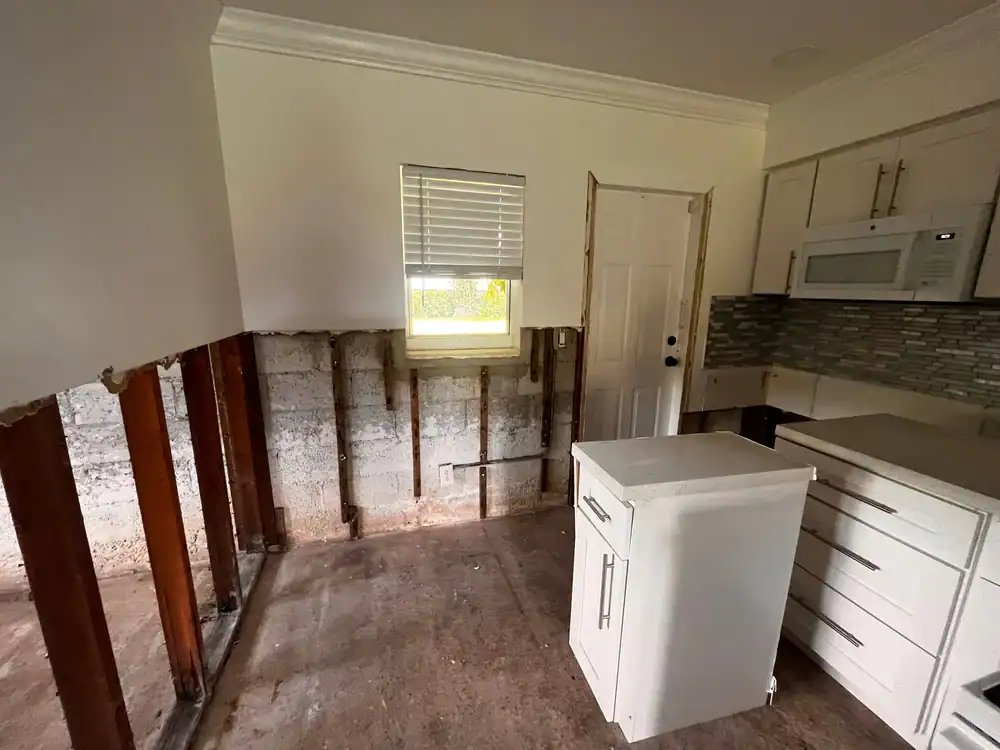
Demolition comes next, and this is where experience matters most in Cutchogue. Older homes on the North Fork regularly turn up asbestos in floor tiles, mold behind walls that have been holding moisture through years of coastal humidity, or water damage from a winter storm the home sat through while unoccupied. Because we hold active remediation and abatement licenses, those discoveries get handled on the spot not handed off to a subcontractor while your project sits on pause. Construction, installation, and final inspection follow, and the job isn’t closed until everything passes and you’ve walked through it yourself.
A kitchen remodel with us covers the full scope layout redesign, custom cabinetry, countertop selection and installation, flooring, lighting, plumbing modifications, electrical upgrades, and finish work. There’s no portion of the job that gets handed off to a separate company and no coordination you have to manage on your own.
For Cutchogue homes specifically, material selection gets real attention. Quartz countertops are recommended over marble or porous natural stone in coastal environments because they don’t absorb moisture or react to the salt air that comes off Peconic Bay and the Sound year-round. Cabinet construction is evaluated for humidity resistance solid wood with proper sealing outperforms particleboard in a home that gets closed up seasonally and reopens to significant moisture swings. These aren’t upsells. They’re recommendations based on what actually holds up in this environment versus what looks good in a showroom and fails within a few years.
If your property is on or near the water Nassau Point, Fleet’s Neck, or anywhere along the bay the permit process also includes an LWRP (Local Waterfront Revitalization Program) form required by Southold Town for properties within 100 feet of wetlands. That gets handled as part of the standard permit process, not as a surprise add-on after work has already started. The goal from day one is a kitchen that’s built right, permitted correctly, and designed to last in the specific environment you’re living in.
Do I need a permit for a kitchen remodel in Cutchogue, NY?
Yes and in Cutchogue, this is more consequential than in many other towns. Cutchogue falls under the jurisdiction of the Southold Town Building Department, which enforces a documented double-fee penalty for any construction that begins without the required permits. That means if a contractor starts work before pulling permits and you need to correct it later, every associated permit fee gets doubled automatically. That’s a real financial exposure, not a technicality.
Any kitchen remodel that involves structural changes, electrical upgrades, plumbing modifications, or gas line work requires permits before the first wall comes down. We file all permits in-house and coordinate directly with the Southold Town Building Department before any work begins. If your property is waterfront or within 100 feet of wetlands which applies to a significant number of homes in Nassau Point, Fleet’s Neck, and along the bay an LWRP form is also required as part of the permit submission. All of that is handled as part of the process, not an afterthought.
How much does a kitchen remodel typically cost in Cutchogue, NY?
Kitchen remodel costs in New York range widely depending on scope from around $10,000 for a cosmetic refresh to $100,000 or more for a full gut renovation with custom cabinetry, new layout, and high-end finishes. In Cutchogue specifically, where homes frequently sell above $1 million and the buyer expectation for quality is high, most serious renovations fall somewhere in the $40,000–$100,000 range depending on kitchen size, material selections, and whether structural or systems work is involved.
Labor typically accounts for 50–60% of total project cost, which is why the contractor you choose has a direct impact on your final number. A contractor who discovers mold or asbestos mid-project and has to bring in a separate remediation company will add time and cost that wasn’t in the original estimate. Because we handle remediation in-house, those discoveries don’t turn into budget surprises. The investment also carries strong financial logic in this market industry data puts minor kitchen remodel ROI at up to 113%, and 54% of real estate professionals recommend a kitchen upgrade before listing.
What should I know about kitchen materials for a coastal North Fork home?
The coastal environment in Cutchogue sitting between the Long Island Sound to the north and Peconic Bay to the south creates year-round conditions that affect how kitchen materials perform. Salt air accelerates corrosion on metal hardware and appliance components. Seasonal humidity, especially in homes that are closed for part of the year, causes particleboard and MDF cabinet boxes to swell, warp, and degrade over time. These aren’t edge cases. They’re common failure points in North Fork kitchens that weren’t designed with the local environment in mind.
For countertops, quartz is generally the better choice over marble or unsealed natural stone in this environment it’s non-porous, doesn’t absorb moisture, and holds up through the humidity swings that come with seasonal occupancy. For cabinetry, solid wood construction with proper sealing outperforms engineered wood products in high-humidity conditions. Hardware should be selected for corrosion resistance, not just aesthetics. These are the kinds of material recommendations that come from actually working in Long Island homes for over a decade not from a showroom catalog.
What happens if mold or asbestos is found during my kitchen demolition?
This is one of the most important questions to ask any kitchen contractor before you hire them, especially on the North Fork. Cutchogue has a significant amount of older housing stock many homes were built in the mid-20th century, and some predate that considerably. Homes built before 1980 commonly contain asbestos in floor tiles, ceiling materials, pipe insulation, and drywall joint compound. Coastal moisture exposure and seasonal occupancy patterns also make mold a common discovery behind kitchen walls and under sinks.
Most kitchen remodelers are not licensed to handle these materials. When they find something, they stop the project, bring in a separate remediation company, and your timeline extends by weeks while the coordination gets sorted out. We hold active environmental remediation and asbestos abatement licenses, which means those discoveries get handled in-house without stopping the project. The work gets documented, remediated properly, and the renovation continues on schedule. If you’re renovating an older home in Cutchogue or a property that’s been seasonally occupied and closed up through multiple winters this isn’t a hypothetical risk. It’s a real one, and it’s worth knowing how your contractor handles it before work begins.
I own a second home in Cutchogue can you manage the renovation while I'm in the city?
Yes, and this is a situation we handle regularly. A significant portion of Cutchogue’s homeowners are Manhattan-based or hybrid commuters who use their North Fork property as a weekend and seasonal retreat. Managing a renovation remotely requires a contractor who communicates proactively, doesn’t need you on-site for every decision, and handles the administrative side permits, inspector scheduling, supplier coordination without putting that burden back on you.
Our process is built around a single point of contact from design through final walkthrough. The 3D design rendering step is particularly useful for remote owners you can review the full layout, material selections, and finishes before any work begins, and request changes without making a trip out to Cutchogue. Permit filings with the Southold Town Building Department are handled in-house, so you’re not navigating a local government process from a Manhattan office. We communicate directly and consistently throughout the project, and the job isn’t closed until you’ve done a final walkthrough and signed off on the result.
How long does a kitchen remodel in Cutchogue typically take from start to finish?
Timeline depends on the scope of the project, but most kitchen renovations run between four and twelve weeks from permit approval to final inspection. Simpler cabinet and countertop replacements without structural changes tend to move faster. Full gut renovations especially in older Cutchogue homes where demo can reveal issues that need to be addressed before construction continues take longer and benefit from more planning time upfront.
One of the most common causes of timeline extension in Cutchogue specifically is permit delays caused by incomplete submissions to the Southold Town Building Department. Waterfront properties that require an LWRP form, or projects where the initial application is missing required documentation, can sit in review for weeks. Because we handle permit filing in-house with full knowledge of Southold Town’s requirements, submissions go in complete the first time. The other common delay discovering mold, moisture damage, or asbestos during demo is handled without stopping the project because remediation is done in-house. If you’re working toward a specific timeline, the best starting point is a conversation about scope so the estimate reflects your actual project, not a generic one.