Dix Hills Kitchens Built for the Home You've Invested In
Your kitchen should match what your home is worth and what your family actually needs from it. We deliver full kitchen remodels in Dix Hills, NY, backed by 12 years of licensed construction experience and a process that removes the guesswork entirely.
I needed a professional consultation explanation of procedure for safe removal of Asbestos in my apartment complex. Without having an account yet, I was very impressed with the caring, knowledgeable and generous advice offered by Jessica, and will look forward to doing business in the future. Thank you so much! I feel much more informed about a sometimes scary endeavor. Peace. Nancy Silva Mineola, NY.
Mia Munoz
Used this company to clean up some water flood in my house. They were fast and easy to work with.very professional, Would recommend to anyone!
Nini Valle
Great company, had a flood and they responded quickly and efficiently. Billed my insurance company directly. I highly recommend this company!
joe colapietro, jr
I had pipe freeze in my basement right before a snow storm and they made to within an hour to help start the clean up process. They we by our side throughout the entire process and even helped with the insurance company. They did such a great job with the cleanup, repair, remidiation, I contracted them to perform the repairs and finishes in the basement. They came with enough manpower and material to get the job done. Leo and Jessica were nothing but a pleasure to deal with!!
Cristian Arredondo c
I had some water damage in my home and Green Island was able to take care of my issue quickly and effectively. I am very pleased with the work they did. They responded quickly and were very professional.
Michael M
Outstanding service! From the office to the field crew everyone was friendly, helpful and responsive. I highly recommend Green Island Group.
Most Dix Hills kitchens were built in the late 1960s and early 1970s designed for a different era, a different lifestyle, and a different standard. Galley layouts, limited counter space, cabinets that haven’t been touched in decades. The kitchen might be functional in the loosest sense, but it’s not working for you. That gap between what you have and what you actually want is exactly what a well-executed kitchen remodel closes.
When the project is done right, the difference isn’t just visual. You get a layout that actually fits how your household moves in the morning. Storage that makes sense. Surfaces that hold up to real use. And a space that feels like it belongs in a home worth over a million dollars because yours does. In Dix Hills, where median home sale prices have crossed $1.1 million, a kitchen that looks like it was last updated in 1987 doesn’t just bother you it shows up in your home’s value.
There’s also the practical side that most contractors gloss over. Homes in Dix Hills built before 1980 frequently contain asbestos in floor tile adhesive, pipe insulation, and wall materials. That’s a documented reality of Long Island’s construction history. When a remodel opens those walls, you need a contractor who can handle what’s inside legally and without stopping the job. We hold the New York State licensing required to assess and abate those materials on-site, without bringing in a separate company or halting your timeline.
Licensed Kitchen Remodel Contractors, Suffolk County
12 Years, 5,000 Projects, No Shortcuts
We started in 2012 as a restoration and remediation company asbestos abatement, mold removal, water and fire damage recovery. Kitchen remodeling grew out of that foundation, which means the team that walks into your Dix Hills home understands construction from the inside out, not just the surface level. That background changes how a remodel gets planned, executed, and finished.
Operating out of Bohemia, NY, we’re about 20 minutes from Dix Hills via I-495 this isn’t a Nassau County firm stretching its service area east, or a New York City contractor unfamiliar with Town of Huntington permitting. We’ve been working in Suffolk County for over a decade, across thousands of homes with exactly the kind of construction history yours likely has. If you live in Dix Hills, we know your neighborhood’s building patterns, the typical layout challenges, and the specific environmental issues that come up during renovation work here.
Fully licensed, IICRC certified, and New York State M/WBE certified every credential is verifiable, not just listed. If you look them up, they’ll check out.
From First Conversation to Finished Kitchen No Surprises
It starts with a consultation where we focus on understanding how you actually use your kitchen not just what you want it to look like. From there, our design phase produces a full 3D model of your new kitchen using the real dimensions of your space and your chosen materials. You see exactly what you’re getting before anything is touched. Changes happen on screen, not mid-construction.
Once the design is approved, we pull permits through the Town of Huntington Building and Housing Department. That process applications, engineering review, inspector coordination is handled in-house. You don’t need to learn the Town of Huntington permit system or make calls to the Building Department at 100 Main Street. That’s already covered.
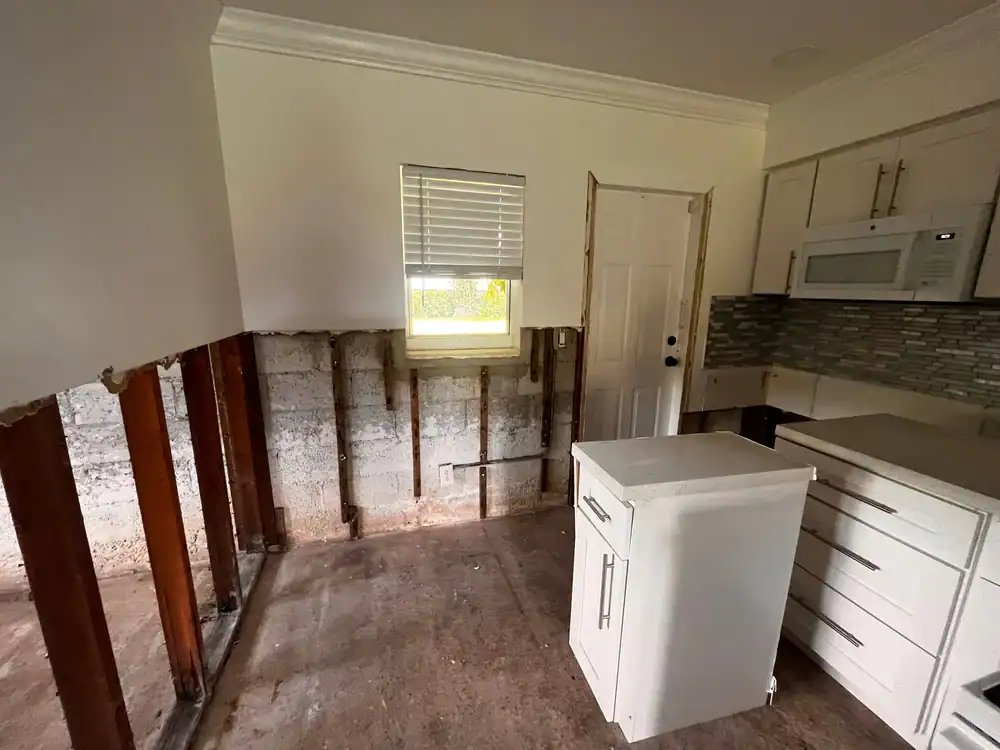
Construction begins with demolition, and this is where the age of Dix Hills homes becomes relevant. Pre-1980 construction means there’s a real chance of encountering asbestos-containing materials during demo. We hold the New York State licensing required to assess and abate those materials on-site, without stopping the project or bringing in a separate company. After demo, the build-out follows a clear sequence structural work, plumbing and electrical rough-in, cabinetry, countertops, flooring, lighting, and final finishes. One team, one point of contact, start to finish.
Every Scope Covered, From Cabinet Refresh to Full Redesign
Not every kitchen remodel in Dix Hills is the same project. Some homeowners want a full gut renovation new layout, new cabinetry, new countertops, new flooring, updated lighting, the whole picture. Others are working with a kitchen that has good bones but needs a meaningful upgrade: cabinet replacement or refacing, new countertop surfaces, refreshed fixtures, and better storage solutions. We handle both ends of that range and everything in between.
For full kitchen renovations, the scope typically includes custom or semi-custom cabinetry, countertop installation in granite, quartz, or other premium materials, flooring, lighting, and full coordination of plumbing and electrical work. For cabinet-focused remodels, the options include full cabinet replacement, door and drawer refacing, and interior storage system upgrades. In either case, material selections are guided by Long Island’s climate realities the humidity levels here accelerate warping and delamination in lower-quality cabinetry, so material specification matters beyond just aesthetics.
For homes in Dix Hills’s north-of-LIE sections where properties often sit on an acre or more and kitchens tend to be larger in scale, our design work reflects that square footage. For homes on the south side of the expressway with tighter footprints, we focus on smart layout and maximizing every inch. The approach adapts to the home it’s not a single template applied everywhere.
Do I need a permit for a kitchen remodel in Dix Hills, NY?
In most cases, yes. Dix Hills falls under the Town of Huntington’s jurisdiction, and the Town’s Building and Housing Department requires permits for any kitchen remodeling work that involves structural changes, modifications to plumbing or gas lines, or electrical work. That covers the vast majority of full kitchen renovations. The application process goes through the Department of Engineering Services and requires notarized permit applications, surveys by a licensed land surveyor, and construction drawings prepared by a licensed professional.
The only work that typically doesn’t require a permit is purely cosmetic swapping out fixtures or replacing finishes without touching any systems or structural elements. If you’re doing anything beyond that, a permit is required. We manage the entire Town of Huntington permit process in-house, from application preparation through inspector coordination, so you don’t have to navigate that system on your own.
How much does a kitchen remodel cost in Dix Hills, NY?
The range is wide, and the honest answer is that it depends on the scope. In the New York market, a focused kitchen update new cabinets, countertops, and fixtures without moving walls typically starts around $25,000 to $40,000. A mid-range full renovation runs $50,000 to $100,000. A high-end custom remodel with premium materials, layout changes, and full systems work can run $120,000 to $200,000 or more.
In Dix Hills specifically, homes in the $900,000 to $1.5 million range tend to warrant investment at the mid-to-upper end of that scale a kitchen that doesn’t match the rest of the home’s quality level stands out, and not in a good way. Labor accounts for roughly 50 to 60 percent of total project cost, which is why choosing a licensed, experienced contractor matters financially, not just for quality. A lower bid from an unlicensed crew can cost significantly more to fix than the original savings.
My Dix Hills home was built in the 1970s should I be worried about asbestos before remodeling?
It’s worth taking seriously, yes. Homes built before 1980 on Long Island which describes the majority of Dix Hills’s housing stock, given the area’s median construction year of 1970 were commonly built with asbestos-containing materials. Vinyl floor tiles (particularly the 9×9 inch variety common in kitchens of that era), pipe insulation, joint compound, and textured ceiling materials are the most frequent sources. You can’t identify asbestos by looking at it it requires testing by a licensed professional.
New York State law requires a licensed asbestos survey before any renovation or demolition work that could disturb these materials. If asbestos is found, abatement must be performed by a contractor holding the appropriate NYS DEC Code Rule 56 licensing. We hold that license and handle abatement in-house. If something turns up during your kitchen demo, the project doesn’t stop it gets addressed by the same team, on the same timeline, without you having to coordinate a separate company or deal with a compliance situation on your own.
How long does a kitchen remodel typically take from start to finish?
A realistic timeline for a full kitchen renovation runs six to twelve weeks from the start of construction, depending on scope. That doesn’t include the design and permitting phase, which can add another four to eight weeks upfront especially in the Town of Huntington, where the permit review process involves engineering services review and can take several weeks depending on application volume and project complexity.
The most common cause of timeline overruns isn’t the construction itself it’s delays in material lead times, permit processing, or unexpected discoveries during demolition. Planning for those possibilities upfront, rather than treating them as surprises, is what keeps a project on track. If you’re working toward a specific deadline a holiday gathering, a home listing date, or a school-year milestone the earlier you start the design and permitting process, the more realistic your target completion date becomes.
What's the return on investment for a kitchen remodel in Dix Hills?
Kitchen renovations consistently rank among the highest-ROI interior improvements you can make before selling a home. Minor kitchen renovations have been shown to return over 100 percent of their cost at resale in strong markets and Long Island, particularly in communities like Dix Hills where median sale prices are above $1.1 million, qualifies as a strong market. Over half of real estate agents recommend a kitchen upgrade before listing, and an updated kitchen often shortens time on market in addition to increasing sale price.
Even if you’re not planning to sell anytime soon, the financial case holds. In a community where families stay put for 12 to 18 years often anchored by the Half Hollow Hills Central School District you’re not just investing for resale. You’re investing in the quality of daily life in a home you’ll be in for a long time. That’s a different calculation than a quick flip, and it shifts the ROI conversation from dollars-at-sale to years of improved function and comfort.
How do I know if a kitchen remodeling contractor in Dix Hills is actually licensed?
In New York, home improvement contractors are required to hold a Home Improvement Contractor license, and in Nassau and Suffolk Counties, that licensing is administered at the county level. You can verify a contractor’s license directly through the county licensing board it’s a public record. Beyond the HIC license, any contractor performing work that involves asbestos abatement, demolition, or environmental remediation needs additional state-level licensing through the NYS Department of Environmental Conservation.
Insurance is equally important and equally verifiable. Ask for a certificate of insurance before signing anything it should show general liability coverage and workers’ compensation. If a contractor hesitates to provide either their license number or an insurance certificate, that tells you something. In Dix Hills, where you’re typically investing $50,000 or more in a remodel on a home worth over $900,000, verifying credentials before the project starts isn’t excessive caution it’s the right move. Our license numbers and certifications are available on request, and every credential listed is current and verifiable.