North of the Highway, Your Kitchen Deserves Better
Most homes in East Hampton North were built decades ago and the kitchens show it. We handle the full remodel, from 3D design to final inspection, so you get a kitchen that actually fits how you live.
I needed a professional consultation explanation of procedure for safe removal of Asbestos in my apartment complex. Without having an account yet, I was very impressed with the caring, knowledgeable and generous advice offered by Jessica, and will look forward to doing business in the future. Thank you so much! I feel much more informed about a sometimes scary endeavor. Peace. Nancy Silva Mineola, NY.
Mia Munoz
Used this company to clean up some water flood in my house. They were fast and easy to work with.very professional, Would recommend to anyone!
Nini Valle
Great company, had a flood and they responded quickly and efficiently. Billed my insurance company directly. I highly recommend this company!
joe colapietro, jr
I had pipe freeze in my basement right before a snow storm and they made to within an hour to help start the clean up process. They we by our side throughout the entire process and even helped with the insurance company. They did such a great job with the cleanup, repair, remidiation, I contracted them to perform the repairs and finishes in the basement. They came with enough manpower and material to get the job done. Leo and Jessica were nothing but a pleasure to deal with!!
Cristian Arredondo c
I had some water damage in my home and Green Island was able to take care of my issue quickly and effectively. I am very pleased with the work they did. They responded quickly and were very professional.
Michael M
Outstanding service! From the office to the field crew everyone was friendly, helpful and responsive. I highly recommend Green Island Group.
A kitchen remodel in East Hampton North is not the same project it would be in a newer suburb. Most homes here were built in the mid-20th century and that means the kitchen you are working with was designed for a different era, with materials that have aged, layouts that no longer make sense, and systems that are overdue for an upgrade. When the work is done right, you get more than a better-looking room. You get a kitchen that functions the way your life actually requires.
Living near Three Mile Harbor means living with salt air and bay humidity year-round. Those conditions are hard on materials that were not chosen with this environment in mind hardware corrodes, cabinet doors swell and warp, finishes break down faster than they should. A properly executed kitchen renovation here means we specify materials that hold up to the coastal climate, not just materials that look good on day one.
The financial side matters too. Minor kitchen renovations deliver up to 113% ROI, and more than half of realtors recommend updating the kitchen before listing. In a market where East Hampton North home values average around $2.2 million, a well-executed kitchen remodel is not just an upgrade it is one of the most defensible investments you can make in your property.
We have been operating out of Suffolk County since 2012 the same county that takes you from the LIE all the way out to Montauk. Over 12 years and more than 5,000 completed projects, we have built a track record that is verifiable, not just claimed. Licensed, insured, M/WBE certified through New York State, and IICRC certified, we carry the credentials that East Hampton Town specifically requires from any contractor doing permitted work.
What separates us from a standard kitchen remodeling company is our background in environmental remediation. We hold asbestos abatement and mold remediation licenses in addition to our home improvement contractor license. In a community where most homes in East Hampton North were built before 1970 when asbestos-containing floor tiles, adhesives, and pipe insulation were standard that is not a minor detail. It means that if something is found during demo, the project does not stop. It gets handled in-house and keeps moving.
It starts with a conversation about what you actually want not a sales pitch. We walk through your space, ask the right questions, and then build a 3D model of your finished kitchen before any demolition begins. You see exactly what you are getting: the cabinet layout, countertop material, island configuration, lighting placement, all of it. If something does not look right, you change it before anything is torn out.
Once the design is approved, we handle the permit application with the Town of East Hampton Building Department including the notarized workers’ compensation documentation, the ¼-inch scale plans, and everything else the town requires before a single wall comes down. East Hampton Town has specific permitting requirements that go beyond state code, and navigating that process correctly from the start prevents the delays that come from doing it wrong. You do not spend a single hour on the phone with the Building Department.
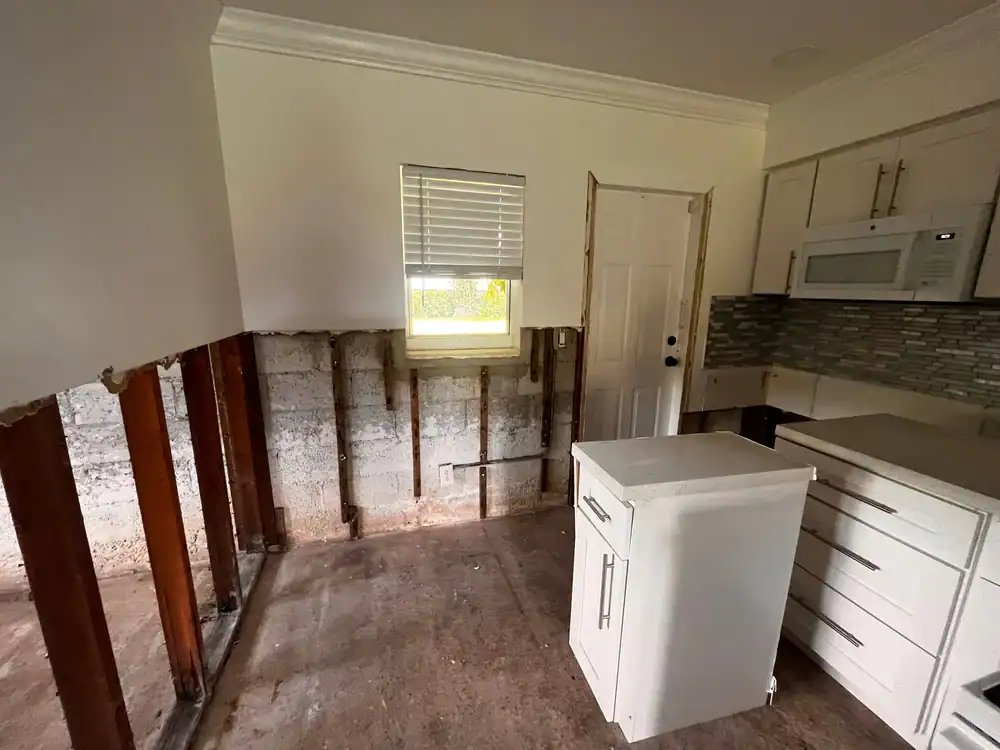
Demo comes next, and this is where the remediation background matters. Homes built in the 1950s and 1960s common throughout East Hampton North often contain asbestos in floor tiles, adhesives, and insulation that only becomes visible once the work starts. If it is there, it gets handled on the spot, by the same crew, without stopping the timeline or reopening the budget conversation. After that, it is cabinetry, countertops, flooring, fixtures, and the final inspection walkthrough one company, start to finish.
Kitchen Makeovers and Cabinet Renovation East Hampton North
Everything Your Kitchen Needs, Built for This Climate
A kitchen remodel with us covers the full scope design, demolition, cabinetry, countertops, flooring, lighting, plumbing coordination, and permit management. Nothing is handed off to a subcontractor you have never met. The same team that designs the space is the team that builds it, which means accountability does not disappear halfway through the project.
Material selection for East Hampton North homes is handled with the coastal environment in mind. Salt air off Three Mile Harbor and the surrounding bays accelerates corrosion on standard metal hardware. Humidity from the water causes improperly specified wood cabinetry to expand and contract through the seasons. Every material recommendation hardware, cabinet construction, countertop sealing, flooring is made with the understanding that this is a coastal Suffolk County environment, not a landlocked suburb. What holds up in Holbrook or Centereach is not automatically the right call for a home near Accabonac Road.
For homes where the kitchen renovation also uncovers older conditions deteriorated plumbing, outdated electrical, or materials requiring remediation those issues are addressed under the same roof. No stopping the project, no separate contractor to coordinate, no revised timeline handed to you as a surprise. The scope is managed transparently from the estimate forward, so what you are quoted is what you pay.
Do I need a permit for a kitchen remodel in East Hampton Town?
Yes and the Town of East Hampton has its own permitting requirements that go beyond what the state mandates. Any permitted kitchen work requires a licensed contractor, notarized workers’ compensation documentation, two sets of ¼-inch scale plans with square footage data, and compliance with both NY State Residential Code and East Hampton Town Zoning Code. The town also requires inspections at multiple stages of construction, not just at the end.
Skipping permits in this market is a real liability. An unpermitted kitchen remodel can complicate a future sale, trigger enforcement action from the Building Department, and potentially void your homeowners’ insurance coverage. We manage the entire permit process for East Hampton North homeowners from the initial application through the final sign-off so you are not navigating that process on your own or hoping your contractor got it right.
How much does a kitchen remodel typically cost in East Hampton North?
Kitchen remodel costs in the East Hampton North market run higher than Long Island averages, and for good reason the local contractor market reflects the caliber of the surrounding real estate. A base-level kitchen remodel covering cabinet refacing, new countertops, and a backsplash typically starts around $25,000. A mid-range remodel with custom cabinetry, new appliances, and a layout reconfiguration runs significantly higher. High-end work with marble countertops, a full layout redesign, and premium fixtures can reach well into six figures.
Labor accounts for 50 to 60 percent of total kitchen remodel costs, which means contractor selection directly affects what you spend. A lower bid from an unlicensed or underinsured contractor often results in unpermitted work, inferior materials, or a project that stalls mid-demo. For East Hampton North homeowners with homes averaging around $2.2 million in value, the cost of doing it wrong is far higher than the cost of doing it right the first time.
What kitchen materials hold up best near the water in East Hampton North?
Salt air and bay humidity are real forces in East Hampton North, and they affect kitchen materials in ways that are not always obvious until a few years after installation. Standard metal cabinet hardware hinges, pulls, and drawer slides corrodes noticeably faster in a coastal environment than it would in an inland home. Wood cabinetry that is not properly constructed or sealed will expand and contract with the seasonal humidity swings off Three Mile Harbor and Gardiners Bay, leading to warped doors and misaligned drawers within a few years.
For countertops, properly sealed quartz or granite performs well in coastal conditions. For cabinetry, moisture-resistant construction with a quality finish and marine-grade hardware is the right specification not because it looks different, but because it lasts. For flooring, porcelain tile and properly sealed hardwood outperform materials that are more vulnerable to moisture infiltration. These are not upsells they are the difference between a kitchen that holds up for 20 years and one that starts showing problems in five.
What happens if asbestos is found during my kitchen demo in East Hampton North?
It is a real possibility in East Hampton North. The area’s housing stock has a median construction year around 1962, and homes built before 1980 commonly contain asbestos in floor tiles, adhesives, pipe insulation, and ceiling materials all of which can be present in a kitchen. Most general contractors and kitchen design firms are not equipped to handle this in-house. When they find it, the project stops, a separate remediation subcontractor is brought in, and the timeline and budget get renegotiated from scratch.
We hold active asbestos abatement licensing and handle environmental remediation in-house. If asbestos-containing materials are identified during demo, our crew addresses it on the spot no project pause, no outside subcontractor, no surprise conversation about a new timeline. This is one of the most concrete reasons to choose a contractor with a remediation background for a kitchen remodel in an older East Hampton North home. The question is not whether it might come up it is whether your contractor is ready when it does.
How long does a kitchen remodel take from start to finish?
A straightforward kitchen remodel design, permitting, demo, and installation typically runs four to eight weeks from the time permits are approved, depending on the scope of work. The permit approval timeline with the Town of East Hampton Building Department adds time upfront, which is why starting the process early matters. East Hampton North homeowners who want a kitchen finished before summer or before the holidays need to account for the permitting window, not just the construction window.
More complex projects full layout reconfigurations, plumbing relocations, electrical upgrades, or remediation work take longer. The 3D design phase at the start of the process is where most of those complexities get identified and planned for, which prevents the mid-project discoveries that extend timelines unexpectedly. Getting the design right before demo begins is not just about aesthetics it is about knowing the full scope of the project before the first wall comes down, so the schedule you are given at the start is the schedule that holds.
How do I know a kitchen remodeler is actually licensed to work in East Hampton Town?
East Hampton Town requires home improvement contractors to be licensed this is a town-level requirement, separate from and in addition to state licensing. You can verify a contractor’s license status through the Nassau County licensing board, which is where our Home Improvement Contractor license is registered and active. Beyond the HIC license, any contractor doing permitted work in East Hampton Town must provide notarized workers’ compensation documentation at the time of permit application meaning an unlicensed contractor cannot legally pull a permit here.
The practical check is straightforward: ask for the license number and verify it. Ask to see the workers’ compensation certificate. Ask whether the contractor will be pulling permits for the work or asking you to pull them yourself a contractor who asks the homeowner to pull their own permits is a red flag. We carry the HIC license, five additional licenses including asbestos abatement and remediation credentials, IICRC certification, and M/WBE certification through New York State. Every credential is on record and verifiable before you sign anything.