South Shore Kitchens Built for How You Actually Live
Your East Massapequa home deserves more than a 1960s galley layout. We handle the full kitchen remodel — design through final inspection — so you don’t have to manage a revolving door of contractors.
I needed a professional consultation explanation of procedure for safe removal of Asbestos in my apartment complex. Without having an account yet, I was very impressed with the caring, knowledgeable and generous advice offered by Jessica, and will look forward to doing business in the future. Thank you so much! I feel much more informed about a sometimes scary endeavor. Peace. Nancy Silva Mineola, NY.
Mia Munoz
Used this company to clean up some water flood in my house. They were fast and easy to work with.very professional, Would recommend to anyone!
Nini Valle
Great company, had a flood and they responded quickly and efficiently. Billed my insurance company directly. I highly recommend this company!
joe colapietro, jr
I had pipe freeze in my basement right before a snow storm and they made to within an hour to help start the clean up process. They we by our side throughout the entire process and even helped with the insurance company. They did such a great job with the cleanup, repair, remidiation, I contracted them to perform the repairs and finishes in the basement. They came with enough manpower and material to get the job done. Leo and Jessica were nothing but a pleasure to deal with!!
Cristian Arredondo c
I had some water damage in my home and Green Island was able to take care of my issue quickly and effectively. I am very pleased with the work they did. They responded quickly and were very professional.
Michael M
Outstanding service! From the office to the field crew everyone was friendly, helpful and responsive. I highly recommend Green Island Group.
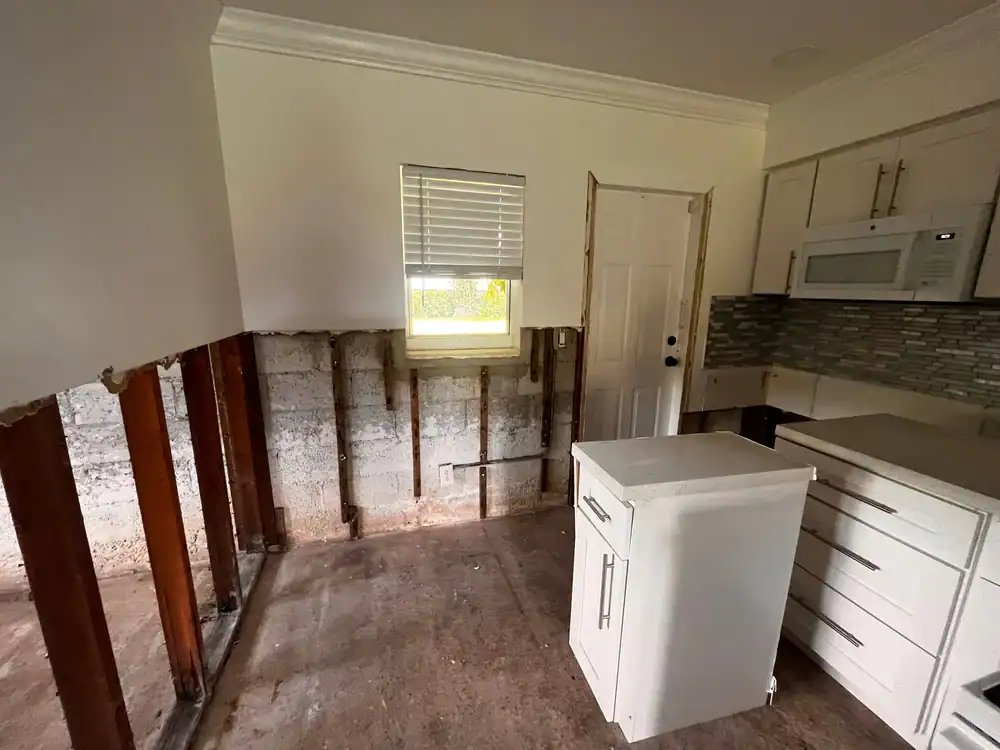
Most kitchens in East Massapequa were built when this neighborhood was brand new — compact layouts, minimal storage, and materials that made sense in 1962 but haven’t aged well. After six or seven decades of South Shore humidity, salt air, and coastal moisture cycles, those original cabinets aren’t just dated — they’re warped, swollen, and past the point where a fresh coat of paint fixes anything.
When the kitchen is done right, the difference isn’t just visual. Cooking feels easier. The space opens up. You stop working around a layout that was never designed for the way your household actually runs. For East Massapequa homeowners who commute into the city via the LIRR and come home to a kitchen that’s been on the to-do list for years, that shift matters more than most people expect.
There’s also the financial side. Massapequa-area homes are selling at a median of around $881,000, with buyers putting in an average of 11 offers per listing. A fully permitted, well-executed kitchen remodel strengthens your position in that market — and in a school district like Massapequa’s, where home values are tied directly to community reputation, that investment compounds over time.
We’re a full-service renovation contractor based in New York, and kitchen remodeling is one of the core things we do — not a side offering, not an upsell. We handle the entire project under one contract: design consultation, permit filing with the Town of Oyster Bay, demolition, construction, and final walkthrough. You have one point of contact from start to finish.
We know the South Shore housing stock because we work in it regularly. The post-war Cape Cods and expanded ranches throughout East Massapequa — from the neighborhoods north of Sunrise Highway down toward Merrick Road — come with specific layout challenges that require real solutions, not catalog suggestions. Low ceilings, structural walls in inconvenient places, kitchens that were never meant to be open-concept but need to be — we’ve worked through all of it.
When you hire us, you’re not getting a crew that shows up unannounced and disappears for a week. You get a real timeline, a written scope, and a contractor who answers the phone.
From Permit Filing to Final Walkthrough — Here's What to Expect
It starts with a consultation where we look at your actual kitchen — the layout, the condition of what’s there, what you want to change, and what’s realistic within your budget. We’re not going to hand you a catalog and tell you to pick cabinets. We walk through the space with you and give you honest input on what’s worth doing and what isn’t.
From there, we handle the permit application with the Town of Oyster Bay Building Division. For East Massapequa homeowners, that means working through the local annex at 977 Hicksville Road in Massapequa — and if your home sits in one of the lower-elevation areas south of Sunrise Highway, we account for the flood zone provisions in the Town’s building code from the start. Getting that right upfront is the difference between a project that moves on schedule and one that stalls at inspection.
Once permits are approved, demolition begins and the build follows a sequenced schedule — rough work first, then cabinets, countertops, tile, and fixtures. Before we leave, you do a full walkthrough with your project manager. If something isn’t right, it gets addressed before we close out the job. That’s not a promise — it’s how the process is structured.
A kitchen remodel with us covers the full scope — layout reconfiguration, cabinet installation, countertop fabrication and installation, backsplash, flooring, lighting, plumbing rough-in and finish work, and electrical. If your project involves removing a wall, upgrading your panel, or relocating a sink, that’s included in the scope we build together, not a surprise line item that shows up mid-project.
For East Massapequa homes specifically, we pay close attention to material selection. The coastal humidity on the South Shore is harder on kitchen materials than most homeowners realize — particularly wood cabinet boxes in homes that have been absorbing decades of cooking steam without adequate ventilation. We specify cabinet construction and countertop surfaces with that environment in mind, so what we install holds up the way it should.
If your home was built before 1978 — which covers the vast majority of East Massapequa’s housing stock — we carry EPA Lead-Safe Certification and follow proper containment protocols during demolition. That’s a federal requirement, not optional, and it’s something you should verify with any contractor before demo begins. We also carry Nassau County Home Improvement Contractor registration, which is required by law for any contractor performing this type of work in the county. Both are verifiable on request before you sign anything.
Do I need a building permit for a kitchen remodel in East Massapequa?
Yes, in most cases. East Massapequa falls under the jurisdiction of the Town of Oyster Bay for building permits, and any kitchen renovation that involves electrical work, plumbing relocation, or structural changes — including wall removal — requires a permit. The Town has a local Building Division annex at 977 Hicksville Road in Massapequa, which is where applications for projects in this area are processed.
Skipping the permit is one of the most common and costly mistakes homeowners make. In a market where Massapequa-area homes sell in under three weeks and regularly receive multiple offers, unpermitted work discovered during a home inspection can kill a deal or force an expensive remediation before closing. We handle the permit application, coordinate inspections, and make sure the project is fully signed off before we close out — so your renovation is an asset at resale, not a liability.
How much does a kitchen remodel typically cost in East Massapequa, NY?
It depends heavily on the scope. A targeted cabinet and countertop refresh in an East Massapequa home typically runs in the $27,000–$35,000 range. A full gut renovation — new layout, all new materials, electrical and plumbing work, the whole project — generally falls between $80,000 and $150,000 in the Northeast market, and Nassau County sits at the higher end of that range given local labor and material costs.
The more useful question is what you’re actually trying to accomplish. If your cabinets are structurally sound but dated, a cabinet renovation or reface might solve the problem at a fraction of the cost of a full replacement. If the layout itself is the issue — which is common in the post-war ranches and Cape Cods throughout East Massapequa — then a more comprehensive scope is usually the right call. We build a detailed, line-item proposal so you know exactly what you’re paying for before any work begins.
How long does a kitchen remodel take from start to finish on Long Island?
For a full kitchen renovation, you’re typically looking at eight to fourteen weeks from signed contract to final walkthrough — but that timeline includes permit processing with the Town of Oyster Bay, which can add two to four weeks depending on the scope of the project and the current volume at the Building Division. Material lead times, particularly for custom cabinets, also factor in and need to be ordered well before demo begins.
What most homeowners don’t account for is the pre-construction phase. Design decisions, permit filing, and material ordering all happen before a single cabinet comes down. If those steps are rushed or skipped, the construction phase slows down to compensate. We map out the full project timeline at the start — including permit and material lead times — so you know when the kitchen will be functional again before you ever commit to a start date.
My East Massapequa home was built in the 1950s — does that affect the remodel?
It does, and it’s worth knowing upfront. Homes built in the 1950s and 1960s — which describes most of East Massapequa’s housing stock — almost certainly contain lead paint somewhere in the kitchen, whether on cabinet surfaces, walls, or trim. Federal EPA RRP rules require that any contractor disturbing lead paint during renovation hold EPA Lead-Safe Certification and follow specific containment and disposal procedures. This isn’t optional, and it’s something you should ask about before any contractor starts demo work in your home.
Beyond lead paint, older homes in East Massapequa often have undersized electrical panels that need upgrading to support modern kitchen appliances, galvanized plumbing that should be addressed during a renovation rather than after, and load-bearing walls in places that complicate open-concept conversions. None of these are deal-breakers — they’re just realities of the housing stock that a contractor with real experience in East Massapequa homes will identify early and plan around, rather than discover mid-project.
What kitchen materials hold up best given the South Shore climate?
The South Shore coastal environment — higher humidity, salt air, and the moisture that comes with living close to the water — is genuinely harder on kitchen materials than most people factor into their renovation decisions. For cabinets, you want a construction that uses moisture-resistant materials in the box itself, not just a durable door finish. Solid wood face frames with plywood box construction outperform particleboard in this environment, which tends to swell and delaminate over time when exposed to consistent humidity.
For countertops, quartz is the most practical choice for South Shore kitchens — it doesn’t require sealing, doesn’t absorb moisture, and holds up well under the conditions common in East Massapequa homes. Natural stone like marble looks beautiful but demands more maintenance in a humid environment. Ventilation is also worth addressing during a renovation: many older homes in this area have recirculating range hoods that don’t actually exhaust cooking steam outside, which compounds the moisture problem over time. Upgrading to a properly vented hood is a small line item that makes a real difference in how your kitchen holds up long-term.
How do I know if a kitchen remodeling contractor is legitimate in Nassau County?
There are a few specific things to verify before you sign a contract with any contractor working in East Massapequa. First, Nassau County requires Home Improvement Contractors to be registered with the Nassau County Department of Consumer Affairs. This registration is verifiable — you can ask for the registration number and confirm it directly with the county. A contractor without this registration cannot legally enforce their contract if a dispute arises, which puts you in a difficult position if something goes wrong.
Second, ask for a current Certificate of Insurance before any work begins. This should show active general liability coverage and workers’ compensation insurance for all employees. In New York, if a contractor’s worker is injured on your property and the contractor doesn’t carry workers’ comp, you as the homeowner can be held liable. Third, for any home built before 1978 — which covers most of East Massapequa — confirm that the contractor holds EPA Lead-Safe Certification. These aren’t difficult things to ask for, and any legitimate contractor will provide them without hesitation. If someone pushes back on producing documentation, that’s your answer.