Elmont Kitchens Built for the Homes That Have Been Here Since the '50s
Most kitchens in Elmont haven’t been touched since the house was built — and it shows. We handle full kitchen remodels across Nassau County, from the first permit to the final finish.
I needed a professional consultation explanation of procedure for safe removal of Asbestos in my apartment complex. Without having an account yet, I was very impressed with the caring, knowledgeable and generous advice offered by Jessica, and will look forward to doing business in the future. Thank you so much! I feel much more informed about a sometimes scary endeavor. Peace. Nancy Silva Mineola, NY.
Mia Munoz
Used this company to clean up some water flood in my house. They were fast and easy to work with.very professional, Would recommend to anyone!
Nini Valle
Great company, had a flood and they responded quickly and efficiently. Billed my insurance company directly. I highly recommend this company!
joe colapietro, jr
I had pipe freeze in my basement right before a snow storm and they made to within an hour to help start the clean up process. They we by our side throughout the entire process and even helped with the insurance company. They did such a great job with the cleanup, repair, remidiation, I contracted them to perform the repairs and finishes in the basement. They came with enough manpower and material to get the job done. Leo and Jessica were nothing but a pleasure to deal with!!
Cristian Arredondo c
I had some water damage in my home and Green Island was able to take care of my issue quickly and effectively. I am very pleased with the work they did. They responded quickly and were very professional.
Michael M
Outstanding service! From the office to the field crew everyone was friendly, helpful and responsive. I highly recommend Green Island Group.
The average Elmont home was built in 1952. That means the kitchen was designed for a time when families cooked differently, stored less, and didn’t need an outlet every three feet. If yours hasn’t been updated, you’re not just dealing with dated cabinets — you’re working around a layout that was never built for the way your household actually runs.
A kitchen renovation fixes the daily friction. More counter space. Storage that makes sense. Lighting that doesn’t make the room feel like a basement. For multigenerational households — which are common in Elmont — that means a kitchen that can actually handle two people cooking at once without feeling like a fire drill.
There’s also the financial side, and it’s worth being direct about it. Elmont home values have climbed sharply, with median sale prices now sitting around $715,000 to $720,000. A well-done kitchen renovation in this price range returns roughly 85 to 96 cents on the dollar at resale in the Northeast. That’s not a renovation — that’s an investment with a real return. And with the UBS Arena and Belmont Park Village development actively pushing property values higher, the timing matters more than it did five years ago.
We’re a New York-based home improvement contractor that handles kitchen remodels from start to finish — design, demolition, cabinetry, countertops, plumbing, electrical coordination, tile, and final finishing. One team. One contract. No handoffs to strangers you’ve never met.
We hold the required Nassau County Home Improvement Contractor License and carry full general liability and workers’ compensation insurance. Before any work starts, you get documentation — not promises. That matters in Elmont, where homeowners have heard enough stories about contractors who disappeared after the deposit cleared.
We’ve worked throughout the Town of Hempstead and understand what’s behind the walls of Elmont’s post-war housing stock — the electrical realities of a pre-1965 home, the plumbing quirks of a galley kitchen that’s never been touched, the moisture issues that hide behind original cabinetry in Long Island’s older builds. That’s not something you learn from a brochure.
No Surprises — Here's Exactly How Your Remodel Runs
It starts with a consultation where we look at your actual kitchen — not a floor plan, your kitchen — and talk through what’s working, what isn’t, and what’s realistic given your layout and budget. For most Elmont homes, that means accounting for a closed or galley-style footprint that may have options you haven’t considered yet, like removing a non-load-bearing wall to open the space.
From there, we handle the Town of Hempstead permit process. Any kitchen remodel in Elmont that touches electrical, plumbing, or structure requires a building permit through the Town of Hempstead Building Department. We manage the application, the inspection scheduling, and the final sign-off. You don’t have to navigate Town Hall. We also hold EPA Lead-Safe certification — which is federally required for work in homes built before 1978, and that describes nearly every house in Elmont.
Once permits are in place, construction runs in a clear sequence: demo, rough work (electrical and plumbing), inspections, cabinetry and countertops, tile and flooring, fixtures, and final finish. A cabinet-focused remodel typically runs two to four weeks of active work. A full gut renovation runs six to ten weeks. We give you the real timeline upfront — including when you’ll need alternative cooking arrangements — so nothing catches you off guard.
Full Kitchen Renovation, Not Just the Parts You Can See
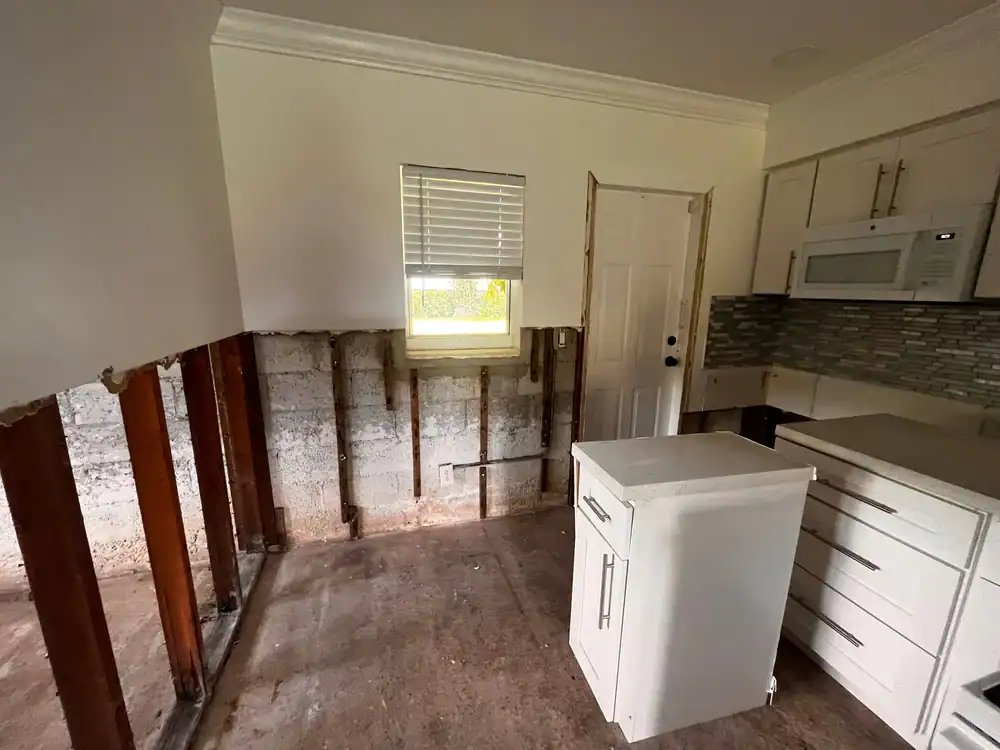
A kitchen remodel with us covers the full scope — cabinet removal and replacement, countertop installation, tile backsplash, flooring, lighting, plumbing fixture upgrades, and appliance hookups. We also handle the work that doesn’t show up in the after photos but matters just as much: electrical panel upgrades for modern appliance loads, plumbing rerouting when a layout change requires it, and moisture remediation when demo reveals what’s been hiding behind original cabinetry for decades.
For Elmont homeowners specifically, that last point comes up more than you’d expect. Long Island’s humidity and the age of the housing stock mean that water damage behind original kitchen walls is a common discovery during demolition. Finding it during a planned renovation — rather than during a future sale inspection — is exactly the kind of thing that protects your investment long-term.
On the design side, we work with you on material selections that fit how your household actually uses the kitchen. Quartz countertops have become the most common choice for active family kitchens — durable, low-maintenance, and well-suited to heavy daily use. Cabinet styles, hardware, lighting, and layout are all part of the conversation. If you’re considering a partial update — cabinet refacing, countertop replacement, or a focused cosmetic refresh — we can scope that too. The right project is the one that matches your goals and your timeline, not the most expensive option we can sell you.
Do I need a permit for a kitchen remodel in Elmont, NY?
If your kitchen remodel involves any electrical work, plumbing changes, or structural modifications — removing a wall, widening a doorway, relocating a sink — then yes, you need a permit from the Town of Hempstead Building Department. Elmont falls within the Town of Hempstead’s jurisdiction, not an incorporated village, so all residential permits go through their Building Department. The town does have an online permit portal that makes the process more manageable than it used to be, but it still requires correct documentation, proper sequencing, and inspection scheduling at specific stages of construction.
Skipping the permit is a risk that tends to surface at the worst possible time — during a sale, when a buyer’s attorney or inspector flags unpermitted work and either kills the deal or forces a price reduction. With Elmont home values where they are right now, that’s not a corner worth cutting. We handle the entire permit process on your behalf, so you’re covered from the first filing to the final inspection sign-off.
How much does a kitchen remodel typically cost in Elmont, NY?
The range is wide, and anyone who gives you a number before seeing your kitchen is guessing. That said, here’s a realistic framework for the Nassau County market. A cabinet-focused partial remodel — new cabinets, countertops, hardware, and cosmetic updates — typically runs between $27,000 and $45,000. A full gut renovation, where you’re reconfiguring the layout, upgrading electrical and plumbing, and starting fresh on everything, runs between $80,000 and $150,000 in the New York metro area based on current Remodeling Magazine Cost vs. Value data.
For Elmont specifically, older homes often add scope that isn’t visible until demo begins — outdated wiring that needs to be brought up to code before new appliances can be installed, moisture damage behind original cabinetry, or plumbing that hasn’t been touched in 50 years. These aren’t surprises we manufacture — they’re realities of the housing stock. We scope for them honestly upfront so your budget reflects the actual project, not an optimistic estimate that grows after the walls come down.
How long does a kitchen remodel take from start to finish in Elmont?
Active construction on a cabinet-focused remodel typically runs two to four weeks. A full gut renovation — demo through final finish — runs six to ten weeks. But the full project timeline, from signed contract to move-in-ready kitchen, is longer than that, and it’s worth understanding why.
Material lead times for cabinets and countertops can run four to eight weeks depending on what you select. The Town of Hempstead permit process adds time before construction can begin. And inspection scheduling — required at specific stages for electrical and plumbing work — has to be built into the sequence. We give you the complete timeline at the start, including the permit phase, material ordering, construction, and inspections. That way you know exactly when to plan for limited kitchen access and when to expect the finished result — not a moving target that keeps shifting week to week.
What should I look for when hiring a kitchen contractor in Nassau County?
Start with the Nassau County Home Improvement Contractor License, issued through the Nassau County Department of Consumer Affairs. This license is required by law for any contractor performing home improvement work in Elmont. It’s verifiable directly through Nassau County’s website, and a contractor who can’t provide their license number on request is a contractor you should walk away from — regardless of how good their photos look.
Beyond licensing, ask for a current Certificate of Insurance that documents general liability coverage and workers’ compensation. New York State requires workers’ comp, and general liability protects your property if something goes wrong during construction. Also ask whether the contractor holds EPA Lead-Safe certification. Because the majority of Elmont homes were built before 1978, federal law requires contractors disturbing lead paint to use certified Lead-Safe practices. It’s not a minor detail — it’s a legal requirement that directly affects the health of anyone living in the home during construction. We carry all three credentials and provide documentation before any contract is signed.
Is a kitchen remodel worth it if I'm planning to sell my Elmont home?
In most cases, yes — especially in Elmont’s current market. Median sale prices in the hamlet are sitting around $715,000 to $720,000 and trending upward, partly driven by the visibility and economic activity the UBS Arena and Belmont Park Village development has brought to the area. A minor kitchen remodel in the Northeast returns approximately 85 to 96 cents on the dollar at resale, which is among the strongest returns of any home improvement category.
More practically, buyers shopping in this price range expect a kitchen that’s move-in ready. An original 1952 kitchen — even in a well-maintained home — tends to stop buyers cold or trigger a lowball offer. A clean, updated kitchen removes that friction and keeps the sale moving. If you’re planning to list within the next one to two years, a kitchen renovation is worth a serious conversation. We can help you scope a project that makes financial sense relative to your expected sale price — not an over-improvement that won’t come back at closing.
Can Green Island Group handle both the design and construction of my Elmont kitchen remodel?
Yes, and that’s actually one of the more important things to clarify before you hire anyone. Some contractors handle construction only and expect you to arrive with a finalized design and material selections already made. Others are design-only firms that hand the project off to a separate contractor for execution. Either approach puts the coordination burden on you — and for homeowners with a 40-plus minute daily commute into New York City, managing two separate vendors on a kitchen renovation is a real problem.
We handle both sides. The process starts with a design consultation where we work through your layout options, material selections, and priorities — then we build and finish it ourselves. One point of contact from the first conversation to the final walkthrough. For Elmont homeowners specifically, that single-source accountability matters because the older housing stock here tends to produce mid-project discoveries that require real-time design and construction decisions. When the same team is doing both, those decisions get made quickly and correctly — not delayed while two separate vendors figure out whose responsibility it is.