Franklin Square Kitchens Built for How You Actually Live Now
Most homes in Franklin Square were built in the 1950s — and a lot of those original kitchens are still standing. We help you turn an outdated, cramped layout into a kitchen that works for your life, fully permitted through the Town of Hempstead.
I needed a professional consultation explanation of procedure for safe removal of Asbestos in my apartment complex. Without having an account yet, I was very impressed with the caring, knowledgeable and generous advice offered by Jessica, and will look forward to doing business in the future. Thank you so much! I feel much more informed about a sometimes scary endeavor. Peace. Nancy Silva Mineola, NY.
Mia Munoz
Used this company to clean up some water flood in my house. They were fast and easy to work with.very professional, Would recommend to anyone!
Nini Valle
Great company, had a flood and they responded quickly and efficiently. Billed my insurance company directly. I highly recommend this company!
joe colapietro, jr
I had pipe freeze in my basement right before a snow storm and they made to within an hour to help start the clean up process. They we by our side throughout the entire process and even helped with the insurance company. They did such a great job with the cleanup, repair, remidiation, I contracted them to perform the repairs and finishes in the basement. They came with enough manpower and material to get the job done. Leo and Jessica were nothing but a pleasure to deal with!!
Cristian Arredondo c
I had some water damage in my home and Green Island was able to take care of my issue quickly and effectively. I am very pleased with the work they did. They responded quickly and were very professional.
Michael M
Outstanding service! From the office to the field crew everyone was friendly, helpful and responsive. I highly recommend Green Island Group.
The kitchen in a Cape Cod or ranch home wasn’t designed for the way families use space today. It was designed for a different era — one with separate rooms, smaller appliances, and no concept of the kitchen as the center of the home. When that layout gets rethought, the whole house feels different. You get counter space that actually accommodates how you cook. You get storage that doesn’t require reorganizing every time you need something. You get a room you’re not avoiding.
For Franklin Square homeowners specifically, a kitchen renovation often means more than swapping out cabinets. Many of these homes are sitting on $800,000-plus in value, and the kitchen is one of the first things a buyer notices — or a guest does. An updated kitchen in this market doesn’t just feel better to live in, it protects what you’ve built here. Minor kitchen remodels in the Northeast return close to 90 cents on the dollar at resale. That’s not a coincidence in a market as competitive as Franklin Square, where Redfin scores the area 84 out of 100 for buyer competition.
The other thing worth saying: a lot of these homes have kitchens that haven’t been touched since before 1978. That means lead paint is a real consideration during any renovation — not a formality. Working with a contractor who is EPA Lead-Safe certified matters when your family is living in the home during the project.
We’re a full-service remodeling contractor serving Franklin Square, Nassau County, and the surrounding area. When you hire us for a kitchen remodel in Franklin Square, you’re not getting a general contractor who hands off the real work to a rotating cast of subcontractors. You get one team, one point of contact, and one company accountable for the entire project — from the first consultation through the final walkthrough.
We handle design guidance, material selection, permit filing with the Town of Hempstead Building Department, and all construction in-house. That matters in Franklin Square, where unpermitted work can create real problems when it’s time to sell — and where the Town of Hempstead conducts Certificate of Occupancy checks during property transfers.
We’ve worked throughout Franklin Square and Nassau County, including the post-war Cape Cods and colonials that define streets throughout the hamlet. We know what these homes look like behind the walls, and we know how to work with them.
It starts with a consultation where we look at your space, talk through what’s not working, and get a clear picture of what you actually want. A lot of Franklin Square homeowners come in knowing they hate their kitchen but not knowing exactly why. That’s fine — part of our job is helping you figure out what the right solution looks like before any money changes hands.
From there, we put together a detailed proposal with a real scope of work and a real timeline. Not a range so wide it’s useless — an actual schedule you can plan around. If you need the kitchen functional before the school year starts at Polk Street School or before the holidays, we build backward from that date. Once you approve the proposal, we handle the permit application with the Town of Hempstead. This step is non-negotiable for any project involving electrical, plumbing, or structural work — and in Franklin Square, where about a third of the housing stock predates 1950, most projects touch at least one of those systems.
Construction follows a clear sequence: demo, rough-in work, inspections, cabinet and countertop installation, finish work, and final walkthrough. Your project manager is reachable throughout — not just at the beginning and end.
Full Kitchen Remodels Built Around Franklin Square Homes
Kitchen remodeling in Franklin Square isn’t one-size-fits-all. The scope of what makes sense depends on your home, your goals, and how long you plan to stay. Some homeowners need a full gut renovation — new layout, relocated plumbing, upgraded electrical panel, new everything. Others need a well-executed cabinet renovation and countertop replacement that transforms the room without moving walls. We work across that entire range.
For the Cape Cods and ranch homes closest to the Southern State Parkway, the most common project involves opening up the kitchen to the adjacent dining or living space — removing a non-load-bearing wall and reconfiguring the layout to create something that actually functions for a modern family. For the larger colonials and bi-levels in the northern sections of Franklin Square, the work often centers on a full cabinet remodel, new countertops, updated fixtures, and appliance upgrades.
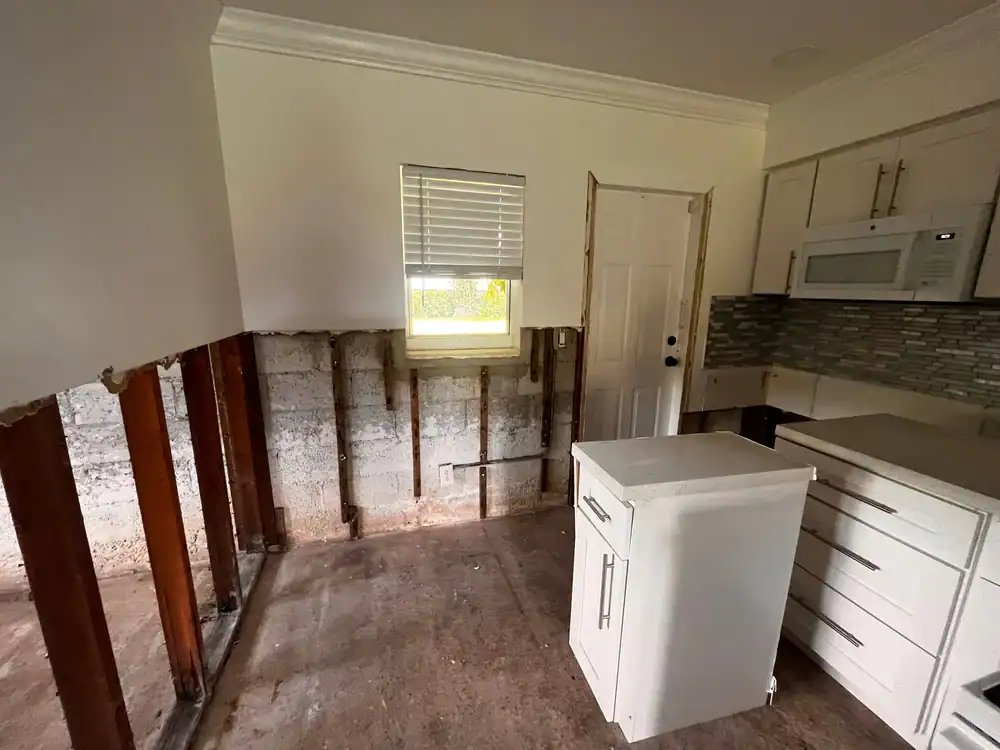
Every project we take on in Franklin Square is permitted through the Town of Hempstead, carried out by a Nassau County licensed contractor, and completed by a team that holds EPA Lead-Safe certification — which applies to virtually every home in this hamlet given the median construction year of 1954. If your kitchen suffered water damage from a pipe burst or ice dam infiltration — a common issue in Long Island’s older housing stock — we can take you from remediation straight into a full kitchen redesign without starting over with a second contractor.
How much does a kitchen remodel cost in Franklin Square, NY?
The honest answer is that it depends on scope, but here are real ranges for the Nassau County market. A cabinet renovation or cosmetic refresh — new cabinet fronts, countertops, and fixtures without moving anything structural — typically runs $15,000 to $35,000. A partial remodel with new cabinets, countertops, and updated appliances lands in the $35,000 to $65,000 range. A full gut renovation that involves layout changes, plumbing relocation, and electrical upgrades can run $65,000 to $120,000 or more.
Labor and material costs on Long Island run 25 to 40 percent above national averages, so if you’re comparing quotes to what you see online or hear from friends in other states, adjust your expectations accordingly. The good news is that Franklin Square’s home values — currently averaging $807,000 to $875,000 — mean the investment tends to hold up well. A well-done kitchen remodel here is not money spent; it’s equity protected.
Do I need a permit for a kitchen remodel in Franklin Square?
For any work involving electrical, plumbing, or structural changes — which covers most meaningful kitchen renovations — yes, you need a permit. Franklin Square is a hamlet within the Town of Hempstead, so permits are issued through the Town of Hempstead Building Department, not a village building department. This is different from neighbors in incorporated villages like Valley Stream or Malverne, who go through their own municipal systems.
This matters more than most homeowners realize. The Town of Hempstead conducts Certificate of Occupancy checks when properties transfer. Unpermitted work surfaces during that process and can delay or derail a sale — in one of the most competitive real estate markets on Long Island, that’s a real risk. We handle the entire permit process on your behalf, including coordinating required inspections. You don’t have to figure out the Town of Hempstead system. We do that.
How long does a kitchen remodel take in Franklin Square, NY?
A cabinet-focused partial remodel typically takes two to four weeks of active construction. A full gut renovation — the kind that involves layout changes, permit processing, rough-in inspections, and finish work — usually runs six to ten weeks from start to finish when managed correctly.
The timeline that matters is total project time, not just construction days. Permit processing through the Town of Hempstead, material lead times, and inspection scheduling all add time that contractors who give you a “three-week” estimate aren’t accounting for. We build those steps into the schedule upfront so you’re not surprised. If you have a hard deadline — a holiday, a school year starting, a family event — tell us at the consultation and we’ll tell you honestly whether it’s achievable.
What should I look for when hiring a kitchen remodel contractor in Nassau County?
Start with the basics: a current Nassau County Home Improvement Contractor License, issued by the Nassau County Office of Consumer Affairs, and a Certificate of Insurance that covers both general liability and workers’ compensation. Both are verifiable — the license through the Nassau County Department of Consumer Affairs website, the COI by simply asking for a copy before you sign anything. Any contractor who hesitates on either of those is a contractor worth passing on.
Beyond credentials, look for a contractor who can show you real project photos from homes that look like yours — not stock images, not renderings. Franklin Square’s housing stock has specific characteristics: compact post-war layouts, older plumbing configurations, electrical panels that often need upgrading before modern appliances can be installed. A contractor with genuine experience in these homes will talk about those details without being prompted. If they’re treating your Cape Cod like any other kitchen job, that’s worth noticing.
My Franklin Square home was built in the 1950s — does that affect my kitchen renovation?
It does, in a few specific ways. First, homes built before 1978 may contain lead paint, and federal law requires contractors to use EPA-certified Lead-Safe practices when disturbing painted surfaces during renovation. Given that the median construction year in Franklin Square is 1954, this applies to the vast majority of homes in the hamlet. Make sure any contractor you hire holds current EPA Lead-Safe certification — it’s not just a regulatory checkbox, it’s a real health protection for your family while work is underway.
Second, the electrical and plumbing systems in homes from this era were not designed for modern kitchen appliances. Upgrading a panel or relocating plumbing lines is often part of a full kitchen renovation in Franklin Square homes — not an add-on, but a necessity. Third, post-war Cape Cods have bearing walls in specific locations that affect which walls can be removed for an open-concept layout. An experienced contractor will identify these in the planning phase so there are no surprises during demo.
Can I use a kitchen renovation to fix water damage in my Long Island home?
Yes — and honestly, it’s one of the smarter ways to approach a damage event in an older home. Long Island winters create real stress on aging plumbing and insulation. Pipe bursts, ice dam water infiltration, and moisture intrusion are common in the compact Cape Cods and ranch homes throughout Franklin Square, particularly in homes that haven’t had mechanical systems updated in decades. When that damage hits the kitchen, most homeowners are faced with a choice: restore it to what it was, or use the opening to build something better.
We can take a Franklin Square kitchen from post-damage remediation straight into a full renovation without requiring you to hire a separate restoration contractor and then start over with a remodeler. That continuity saves time, reduces cost, and means one accountable team manages the entire outcome. If you’re dealing with water damage right now, the first step is getting the moisture issue fully resolved before any new materials go in — we’ll make sure that sequence is done right.