Hempstead Kitchens Built for Real Life, Not Showrooms
Your kitchen should work as hard as you do. We deliver full kitchen renovations in Hempstead, NY — from first design conversation to final walkthrough, under one roof and one contract.
I needed a professional consultation explanation of procedure for safe removal of Asbestos in my apartment complex. Without having an account yet, I was very impressed with the caring, knowledgeable and generous advice offered by Jessica, and will look forward to doing business in the future. Thank you so much! I feel much more informed about a sometimes scary endeavor. Peace. Nancy Silva Mineola, NY.
Mia Munoz
Used this company to clean up some water flood in my house. They were fast and easy to work with.very professional, Would recommend to anyone!
Nini Valle
Great company, had a flood and they responded quickly and efficiently. Billed my insurance company directly. I highly recommend this company!
joe colapietro, jr
I had pipe freeze in my basement right before a snow storm and they made to within an hour to help start the clean up process. They we by our side throughout the entire process and even helped with the insurance company. They did such a great job with the cleanup, repair, remidiation, I contracted them to perform the repairs and finishes in the basement. They came with enough manpower and material to get the job done. Leo and Jessica were nothing but a pleasure to deal with!!
Cristian Arredondo c
I had some water damage in my home and Green Island was able to take care of my issue quickly and effectively. I am very pleased with the work they did. They responded quickly and were very professional.
Michael M
Outstanding service! From the office to the field crew everyone was friendly, helpful and responsive. I highly recommend Green Island Group.
Most kitchens in the Village of Hempstead were built in the 1940s, 50s, and 60s. That means cramped galley layouts, cabinets that are barely hanging on, countertops that have seen better decades, and electrical panels that weren’t designed for a modern refrigerator — let alone a dishwasher and microwave running at the same time. A renovation doesn’t just make the kitchen look better. It makes the whole house function better.
When the layout actually fits how your household cooks and moves, mornings get easier. Storage that works means less clutter everywhere else. A kitchen that’s been properly updated — with new electrical, new plumbing connections, and materials built to last — stops being a source of daily frustration and starts being the center of the home it was always supposed to be.
And in Hempstead specifically, that investment carries real financial weight. Home values in the village have risen over 11% year-over-year, and the $10 million Downtown Revitalization Initiative from New York State is a direct signal that this community is appreciating. A well-executed kitchen renovation in this market doesn’t just improve your daily life — it strengthens your position in a housing stock that’s actively gaining value.
We are a full-service remodeling contractor based in New York, and kitchen renovation is one of the core things we do — not a side service we added to fill a calendar. When you hire us, you get a single point of accountability from the first conversation through the day we hand you back your kitchen. No disappearing after the deposit. No rotating crew that doesn’t know your scope.
We work throughout Nassau County, including the Village of Hempstead and the surrounding communities — West Hempstead, Uniondale, Garden City, and beyond. We know the housing stock here. We know what a post-WWII Cape Cod kitchen looks like before and after, and we know how to make the most of a compact footprint without cutting corners on what matters.
We carry Nassau County Home Improvement Contractor licensing, full general liability and workers’ compensation insurance, and EPA Lead-Safe certification — which matters in a village where the majority of homes were built before 1978. That’s not a marketing line. It’s a legal requirement that protects your family, and we take it seriously.
From Your Hempstead Kitchen to Finished — Here's the Process
It starts with a consultation. We come to your home, look at the existing kitchen, listen to what’s working and what isn’t, and talk through what you actually want — not what a catalog tells you to want. From there, we put together a scope and a realistic budget range so you know what you’re committing to before anything is signed.
Once the scope is agreed on, we handle the permit process with the Village of Hempstead Building Department. If your project involves electrical upgrades, plumbing relocation, or any structural changes — and most full kitchen renovations do — a permit is required. Skipping it isn’t a shortcut. It’s a liability that can complicate your insurance and your resale. We pull the permit, schedule the inspections, and manage the paperwork. You don’t have to navigate that process alone.
Then the work begins. Demolition, rough trades, cabinet installation, countertops, fixtures, flooring — all coordinated by a dedicated project manager who is your single contact throughout. We give you a timeline at the start that accounts for material lead times and inspection scheduling, not just construction days. The average Hempstead commute is already over 32 minutes. The last thing you need is a contractor who goes quiet for three weeks mid-project. We don’t operate that way.
Everything Your Hempstead Kitchen Renovation Actually Includes
A kitchen remodel with us covers the full scope — not just the cosmetic layer on top. That means cabinet replacement or refacing, countertop installation, layout reconfiguration, fixture and appliance integration, and coordination of the electrical, plumbing, and flooring trades that make everything function correctly underneath the surface. In Hempstead’s older housing stock, those underlying systems often need attention before anything visible can be done right. We don’t skip that step.
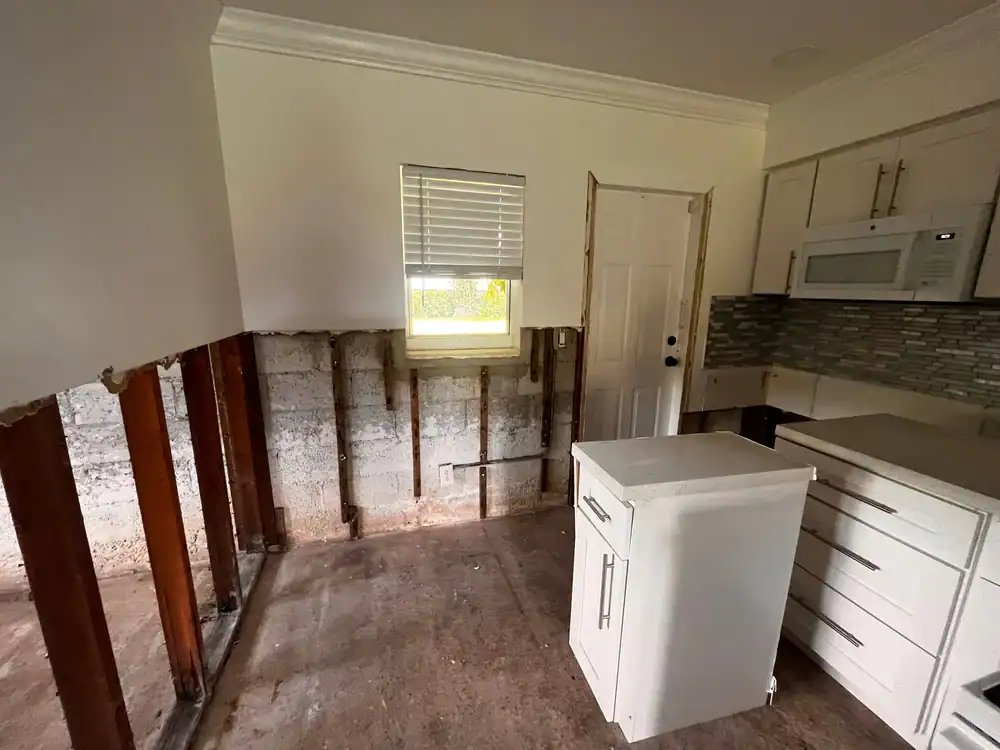
If your kitchen was damaged by water — a dishwasher leak, a supply line failure, a plumbing issue that’s been quietly doing damage for longer than you realized — we can take the project from remediation through to a fully finished, upgraded kitchen. Many homeowners in Hempstead end up with a better kitchen after a water damage event than they had before, because the walls are already open and the investment to upgrade is a fraction of what it would cost to do separately.
Every project is scoped and priced in writing before work begins. You know what’s included, what it costs, and what the timeline looks like — before a single cabinet is touched. For homes in the Village of Hempstead built before 1978, our EPA Lead-Safe certified process is standard on every job, not an add-on. Nassau County licensing and full insurance coverage are in place on every project, every time.
Do I need a permit for a kitchen remodel in the Village of Hempstead?
Yes, in most cases. The Village of Hempstead has its own Building Department — separate from the Town of Hempstead — and any kitchen renovation that involves electrical upgrades, plumbing relocation, or structural changes requires a permit issued through the village. That covers the majority of full kitchen remodels, especially in the older homes that make up most of the village’s housing stock.
Skipping the permit is a risk that tends to surface at the worst possible time — when you’re trying to sell, when your insurance has a claim, or when an inspector flags unpermitted work that has to be torn out. We handle the permit application, inspection scheduling, and sign-off process on your behalf. You don’t have to figure out the village’s process yourself or make calls to the Building Department at 516-489-3400 to track down paperwork. We manage it as part of the project.
How much does a kitchen remodel typically cost in Hempstead, NY?
It depends on the scope, but here’s a realistic range for the Hempstead market: a targeted cabinet-and-countertop refresh typically runs somewhere between $25,000 and $40,000. A full gut renovation — new layout, new electrical, new plumbing connections, new everything — can run $60,000 to $100,000 or more depending on the size of the kitchen and the materials selected. Nassau County labor and material costs run 25–40% above national averages, so national cost estimates you find online will often read lower than what you’ll actually encounter here.
The more useful question is what you’re getting for that investment. Kitchen renovations in the Northeast return approximately 85–96 cents on the dollar at resale, according to Remodeling Magazine’s Cost vs. Value data. In a village like Hempstead where home values have risen over 11% year-over-year, that math works in your favor. We provide written, itemized estimates before any work begins so you know exactly what you’re committing to — no vague ranges, no surprise change orders after the demo is done.
My Hempstead home was built in the 1950s — does that affect the renovation process?
It does, and it’s something every contractor working in the Village of Hempstead should be upfront about. Homes built before 1978 — which includes the vast majority of the village’s housing stock — are subject to federal EPA Lead-Safe renovation requirements. Any contractor disturbing painted surfaces in these homes is legally required to use certified Lead-Safe practices. That means containment, specific cleanup procedures, and proper disposal of debris. It’s not optional, and a contractor who doesn’t mention it is either unaware or cutting corners.
Beyond lead paint, 1950s kitchens in Hempstead often have electrical panels that can’t support modern appliances, galvanized plumbing that’s past its service life, and layouts that were designed for a very different way of living. We assess all of that during the initial walkthrough — not after demo when it’s too late to adjust the budget. Understanding what’s behind the walls before the project starts is how you avoid the change orders that give kitchen renovation a bad reputation.
How long does a kitchen renovation take from start to finish in Hempstead?
For a full kitchen gut renovation, you’re typically looking at six to twelve weeks from signed contract to completed kitchen — and that range accounts for real-world variables, not just the days a crew is physically on-site. Material lead times for cabinets and countertops can run four to six weeks depending on what you select. Permit processing through the Village of Hempstead Building Department adds time that many contractors don’t factor into their initial estimate. Inspection scheduling adds more.
A contractor who tells you your kitchen will be done in three weeks is either planning to skip the permit, hasn’t ordered materials yet, or is going to disappear for a month mid-project. We build a timeline that accounts for all of it — permits, material delivery, trade scheduling, and inspections — and we give it to you in writing before work starts. Living without a functional kitchen is genuinely disruptive, especially with a commute that averages over 30 minutes each way. We don’t minimize that, and we don’t give you a timeline we can’t keep.
Is it worth remodeling a kitchen in Hempstead before selling the house?
It depends on the condition of the kitchen and your timeline, but in many cases — yes. A kitchen that’s visibly dated or functionally compromised will show up in buyer feedback and often in the offer price. In the Village of Hempstead, where average sale prices have climbed to around $665,000 and the market has seen consistent year-over-year appreciation, buyers at that price point have expectations. A 1960s kitchen with original cabinets and laminate countertops creates friction in a sale that a refreshed kitchen eliminates.
A full gut renovation before listing may not always pencil out depending on your timeline and budget, but a targeted refresh — new cabinet fronts, updated countertops, new fixtures — can meaningfully improve how a home shows and how quickly it sells. We can help you think through what level of investment makes sense given your specific situation, the current Hempstead market, and what comparable homes in the village are presenting. The goal is a return, not just a renovation.
Can Green Island Group handle a kitchen renovation that started as water damage repair?
Yes, and it’s actually one of the more common ways kitchen renovation projects start in Hempstead. The village’s housing stock is predominantly 60 to 80 years old, which means aging plumbing systems, older supply lines, and appliances that have been running for decades. When something fails — a dishwasher leak, a refrigerator ice maker line, a supply line under the sink — the damage often goes further than what’s visible on the surface. Cabinets absorb water. Subfloors get compromised. Mold can establish itself quickly in an enclosed cabinet space.
When the remediation work is already underway and the walls are open, the incremental cost to upgrade rather than simply restore is significantly lower than it would be to do a separate renovation project later. We can coordinate the transition from damage repair to full kitchen renovation, working with your insurance claim where applicable and scoping the upgrade work clearly so you understand what’s covered and what’s an out-of-pocket improvement. Many Hempstead homeowners who start with a water damage call end up with a kitchen that’s genuinely better than what they had — and at a fraction of the cost of doing it in two separate projects.