Estate-Scale Kitchens Done Right, From Design to Move-In
Hewlett Neck homes aren’t standard Long Island construction — and your kitchen renovation shouldn’t be treated like one. We handle the full scope, from first design conversation to final walkthrough.
I needed a professional consultation explanation of procedure for safe removal of Asbestos in my apartment complex. Without having an account yet, I was very impressed with the caring, knowledgeable and generous advice offered by Jessica, and will look forward to doing business in the future. Thank you so much! I feel much more informed about a sometimes scary endeavor. Peace. Nancy Silva Mineola, NY.
Mia Munoz
Used this company to clean up some water flood in my house. They were fast and easy to work with.very professional, Would recommend to anyone!
Nini Valle
Great company, had a flood and they responded quickly and efficiently. Billed my insurance company directly. I highly recommend this company!
joe colapietro, jr
I had pipe freeze in my basement right before a snow storm and they made to within an hour to help start the clean up process. They we by our side throughout the entire process and even helped with the insurance company. They did such a great job with the cleanup, repair, remidiation, I contracted them to perform the repairs and finishes in the basement. They came with enough manpower and material to get the job done. Leo and Jessica were nothing but a pleasure to deal with!!
Cristian Arredondo c
I had some water damage in my home and Green Island was able to take care of my issue quickly and effectively. I am very pleased with the work they did. They responded quickly and were very professional.
Michael M
Outstanding service! From the office to the field crew everyone was friendly, helpful and responsive. I highly recommend Green Island Group.
What a Finished Kitchen Actually Looks Like in Hewlett Neck
Living on a peninsula along Macy Channel means your home deals with things most Nassau County homeowners don’t think twice about — ambient humidity, salt air, and the occasional coastal weather event that reminds you exactly where you live. The wrong cabinet finish delaminates. The wrong flooring warps. A contractor who doesn’t understand that will cost you more in the long run than they saved you upfront.
When the renovation is done right, you get a kitchen that holds up — not just visually, but structurally. Materials chosen for your environment. Finishes that don’t fail after one South Shore winter. A space that actually functions the way a kitchen in a home like yours should.
Beyond durability, there’s the value side of it. Hewlett Neck properties are among the most valuable residential real estate in Nassau County. A well-executed, fully permitted kitchen renovation on an estate-scale home isn’t just an upgrade — it’s a documented asset. It shows up in the appraisal, it holds up during a sale, and it reflects the standard of the home it’s in.
Green Island Group is a New York-based renovation contractor with an established presence in Hewlett Neck and the broader Five Towns market. This isn’t a national franchise routing calls through a 1-800 number. We’re a local company that knows the building departments, understands the housing stock, and has worked in homes across the Hewlett communities — including the kind of large, architecturally complex properties that define Hewlett Neck.
What that means for you is a contractor who already understands what we’re walking into. Historic homes. Large kitchen footprints. Permit requirements through the Town of Hempstead. The coastal maintenance realities that come with living near the South Shore bays. You don’t have to explain your home’s character to us — we’ve been in homes like it.
Every project has a named project manager as your single point of contact. One person accountable from demo to done. That’s not a policy we advertise — it’s just how we work.
It starts with a design consultation where we look at your kitchen as it actually exists — the footprint, the architecture, the way it connects to the rest of your home. For Hewlett Neck properties, that often means working within historic proportions, high ceilings, and layouts that don’t follow the standard suburban template. We ask questions before we make recommendations, because a kitchen that fits your home is more valuable than one that looks good in a showroom.
From there, you get a detailed written scope of work — line-item pricing, materials, permit requirements, and a realistic timeline. No verbal commitments. No vague estimates that expand into change orders. If something is going to cost more, you know before it starts, not after.
Once work begins, we pull all required permits through the Town of Hempstead and coordinate with village building authorities as needed. For homes built before 1978 — and Hewlett Neck has a meaningful number of them — we follow EPA Lead-Safe renovation practices as required by federal law. Inspections are scheduled, work is documented, and when the project closes, you have a permitted, warranted renovation on record.
A kitchen renovation in Hewlett Neck isn’t a single-scope job. The homes here — many of them large, historic, and architecturally distinct — require a contractor who can manage custom cabinetry, countertop fabrication, plumbing relocation, electrical upgrades, and finish work all under one roof. We handle the complete scope: layout redesign, cabinet renovation or full replacement, countertop installation, flooring, lighting, and all required trade coordination.
For coastal homes along the South Shore bay system, material selection matters more than most contractors acknowledge. We walk you through options — cabinet finishes, countertop materials, flooring substrates — with your environment in mind. What holds up in a landlocked Nassau County home isn’t always what holds up in a waterfront-adjacent property dealing with humidity and salt air year-round.
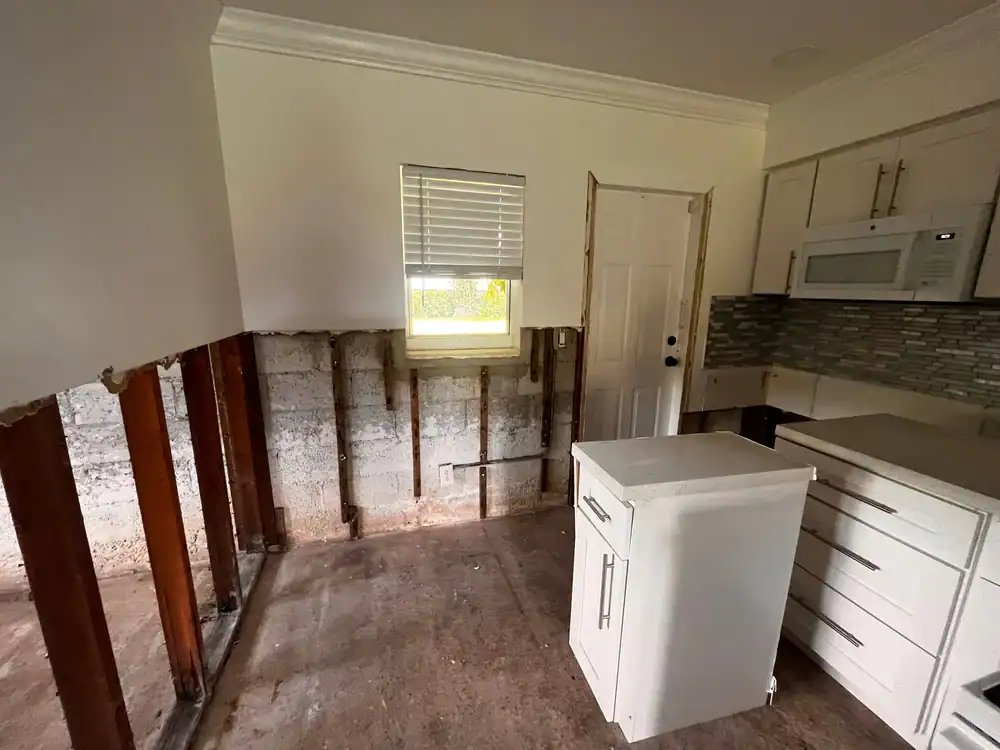
If your kitchen has experienced water damage or moisture intrusion — not uncommon given the coastal exposure of properties in Hewlett Neck — we can take the project from damage documentation all the way through to a finished renovation. No second contractor to coordinate. No gap between remediation and rebuild. That’s a capability the restoration-only companies in this market simply can’t offer, and it matters when your home sits where yours does.
Do I need a permit for a kitchen remodel in Hewlett Neck, NY?
In most cases, yes. Kitchen remodels that involve electrical work, plumbing changes, or structural modifications require building permits — and in Hewlett Neck, that means coordinating with both the Town of Hempstead’s building department and potentially the village’s own building authorities, since Hewlett Neck is an incorporated village with its own local government layer.
Skipping permits on a property of this value is a real liability. It surfaces during sales, during insurance claims, and during municipal inspections at the worst possible time. We pull all required permits as a standard part of every project — not as an add-on, not as something we leave to you to figure out. The permit process is part of what you’re hiring us to manage, and we handle it from application through final inspection sign-off.
How much does a kitchen remodel typically cost in Hewlett Neck?
The honest answer is that it depends on scope, and scope in Hewlett Neck tends to run larger than in most Nassau County communities. Estate-scale homes with 300 to 600-plus square feet of kitchen space, custom cabinetry requirements, and high-end material specifications are simply different projects than a standard suburban kitchen renovation.
A mid-range kitchen remodel in the New York metro area typically runs between $50,000 and $100,000. A full renovation in a large, architecturally complex home — custom cabinets, stone countertops, professional-grade appliances, full layout redesign — can run $100,000 to $200,000 or more. In the Northeast market, well-executed kitchen renovations return approximately 85 to 96 cents on the dollar at resale, which matters when your home is valued in the multi-million dollar range. The more useful question isn’t what the cheapest option is — it’s what a finished kitchen that’s actually worthy of your home is worth to you.
How long does a kitchen renovation take from start to finish?
For a standard kitchen remodel, plan for six to twelve weeks from the time permits are pulled and materials are ordered. Larger, more complex projects — particularly in historic homes where surprises behind walls are more common — can run longer. The timeline also depends on how quickly decisions get made at the front end: cabinet lead times, countertop fabrication, and appliance delivery all affect the schedule.
One thing worth knowing for Hewlett Neck specifically: older homes, including those with roots going back generations, sometimes reveal structural or mechanical surprises once demo begins. Outdated wiring, plumbing that doesn’t meet current code, or walls that don’t land where the plans suggest they should. A contractor who has worked in homes like yours will flag these possibilities upfront and build realistic contingency into the schedule — rather than discovering them mid-project and calling you with a change order.
What kitchen materials hold up best in a waterfront home near the South Shore?
Living near Macy Channel and the South Shore bays means your home experiences elevated humidity, salt air, and occasional moisture events that accelerate wear on the wrong materials. This is one of the most important questions a Hewlett Neck homeowner can ask, and most contractors won’t raise it unless you do.
For cabinetry, you want finishes that are sealed and moisture-resistant — not standard MDF with a painted face that will swell and delaminate over time. Quartz countertops outperform natural stone in high-humidity environments because they’re non-porous and don’t require sealing. For flooring, porcelain tile and properly sealed hardwood hold up better than engineered products with lower-quality cores. Hardware and fixtures should be specified in finishes that resist salt air corrosion — brushed nickel and stainless hold up far better than chrome in a coastal environment. These aren’t upsells. They’re the difference between a kitchen that looks great for two years and one that holds up for twenty.
Can you remodel a kitchen in a historic Hewlett Neck home without losing its character?
Yes — and frankly, that’s one of the more interesting challenges in this kind of work. Hewlett Neck has homes with genuine architectural history, some with roots dating back generations. The goal in renovating a kitchen in a home like that isn’t to make it look new — it’s to make it function like a modern kitchen while respecting the proportions, millwork, and character that make the home what it is.
That means the design process starts with the architecture, not a catalog. We look at ceiling heights, existing millwork profiles, the relationship between the kitchen and adjacent formal spaces, and how a modern layout can be introduced without erasing what’s there. Custom cabinetry is often the right answer in these homes, because stock cabinets rarely fit the proportions of a historic estate kitchen. It takes more time and more thought — but the result is a kitchen that looks like it belongs in the house, not like it was dropped in from a showroom floor.
How do I verify that a kitchen contractor is properly licensed to work in Nassau County?
Any contractor doing home improvement work in Nassau County — including Hewlett Neck — is required to hold a Nassau County Home Improvement Contractor License issued by the Nassau County Department of Consumer Affairs. This is a county-level license, separate from any state registration, and you can verify it directly through the Nassau County DCA’s online lookup tool using the contractor’s name or license number.
Beyond the county license, ask for a current Certificate of Insurance showing general liability and workers’ compensation coverage before anyone starts work. In Nassau County, building permits require proof of workers’ comp coverage — so a contractor who can’t produce that documentation can’t legally pull permits on your project. Also ask whether we carry EPA Lead-Safe certification. For homes built before 1978, which covers a meaningful portion of Hewlett Neck’s housing stock, federal law requires certified lead-safe renovation practices when disturbing painted surfaces. A legitimate contractor provides all of this documentation without hesitation.