I needed a professional consultation explanation of procedure for safe removal of Asbestos in my apartment complex. Without having an account yet, I was very impressed with the caring, knowledgeable and generous advice offered by Jessica, and will look forward to doing business in the future. Thank you so much! I feel much more informed about a sometimes scary endeavor. Peace. Nancy Silva Mineola, NY.
Mia Munoz
Used this company to clean up some water flood in my house. They were fast and easy to work with.very professional, Would recommend to anyone!
Nini Valle
Great company, had a flood and they responded quickly and efficiently. Billed my insurance company directly. I highly recommend this company!
joe colapietro, jr
I had pipe freeze in my basement right before a snow storm and they made to within an hour to help start the clean up process. They we by our side throughout the entire process and even helped with the insurance company. They did such a great job with the cleanup, repair, remidiation, I contracted them to perform the repairs and finishes in the basement. They came with enough manpower and material to get the job done. Leo and Jessica were nothing but a pleasure to deal with!!
Cristian Arredondo c
I had some water damage in my home and Green Island was able to take care of my issue quickly and effectively. I am very pleased with the work they did. They responded quickly and were very professional.
Michael M
Outstanding service! From the office to the field crew everyone was friendly, helpful and responsive. I highly recommend Green Island Group.
Laurel Hollow homes are built on a different scale than most of Long Island. Two-acre lots, sprawling floor plans, butler’s pantries, and kitchens designed for a different era — these are not standard renovation projects, and they shouldn’t be treated like one. When the kitchen finally matches the rest of the house, the whole home feels intentional. That’s what a well-executed remodel actually delivers.
A lot of the housing stock in Laurel Hollow was built between the 1940s and 1980s. Those kitchens were designed around closed floor plans and layouts that made sense then. They don’t anymore. Opening up the space, reconfiguring the island, integrating appliances properly — these changes don’t just look better, they change how you actually use the room every day.
And if your home sits near Cold Spring Harbor’s inner harbor, there’s a durability conversation worth having too. Elevated humidity and salt air exposure accelerate wear on cabinetry finishes, drawer hardware, and countertop sealants faster than most homeowners expect. The right material choices up front mean you’re not revisiting the same problems five years from now.
We’re a full-service home improvement and renovation contractor based in New York, serving the North Shore of Long Island — including Laurel Hollow and the surrounding Oyster Bay area. Every project runs under a single contract with a dedicated project manager as your direct point of contact throughout. No handoffs to subcontractors you’ve never met, no gaps in communication when something needs to be addressed.
Working in Laurel Hollow means understanding what estate-scale work actually requires. Clean job sites, defined work hours, protective coverings throughout the home, and a crew that operates with the same care on day thirty as on day one. That standard isn’t optional here — it’s the baseline.
We carry the required Nassau County Home Improvement Contractor License and full general liability and workers’ compensation insurance. Both are available to review before anything gets signed.
No Surprises — Here's What the Process Actually Looks Like
It starts with a consultation where we walk the space together. We’re looking at the existing layout, what’s working, what isn’t, and what you actually want the kitchen to do for you. From there, we put together a clear scope of work — materials, timeline, and cost — before anything moves forward.
Once the scope is agreed on, we handle the Town of Oyster Bay building permit process on your behalf. For any kitchen remodel in Laurel Hollow that involves electrical upgrades, plumbing relocation, or structural changes, a permit is required through the Town’s Building Division. We manage the application, submission, and inspection scheduling so you don’t have to. Skipping this step isn’t something we do — unpermitted work creates real problems when it comes time to sell a home at the price point Laurel Hollow commands.
Construction follows a sequenced schedule built around your life, not just our crew availability. If you have a target completion date — a holiday, a family event, a listing timeline — we work backward from that date and tell you honestly whether it’s achievable before we start. When the work is done, we do a full walkthrough with you before we consider the job complete.
A kitchen remodel with us covers the full scope — demolition, cabinetry, countertops, tile, plumbing coordination, electrical coordination, and finishing. Whether you’re looking at a full gut renovation or a focused kitchen cabinet renovation that refreshes the space without rebuilding everything, the process and the accountability are the same.
For homes in Laurel Hollow with pre-1978 construction, we follow EPA Lead-Safe (RRP) certified practices throughout demolition and renovation. This is a federal requirement when disturbing lead paint, and it’s worth confirming with any contractor you’re evaluating — not every company working in Nassau County carries this certification.
Material selection is part of the conversation, not an afterthought. For waterfront-adjacent homes near Cold Spring Harbor, that means discussing finishes and countertop materials that hold up in higher-humidity environments, not just what looks good in a showroom. For homeowners preparing a Laurel Hollow property for the market, it means understanding which investments translate to sale price at the $1.4M+ median value range this community operates in. Whatever your situation, the recommendation you get is based on your home — not a standard package that gets applied to every job.
Do I need a permit for a kitchen remodel in Laurel Hollow, NY?
Yes — if your kitchen remodel involves any electrical upgrades, plumbing relocation, or structural changes, a building permit is required through the Town of Oyster Bay’s Building Division. Laurel Hollow falls under the Town of Oyster Bay’s jurisdiction for building and zoning purposes, so applications go through their office at 74 Audrey Avenue in Oyster Bay. The Town also has an online portal for permit tracking, though contractors must be licensed with the Town to submit applications directly.
Skipping the permit process might seem like a shortcut, but in a market where homes regularly sell for $1.5 million and above, unpermitted work is a liability that surfaces during real estate transactions — often at the worst possible time. A buyer’s attorney or inspector will find it. We manage the entire permit process on your behalf, including application, submission, and inspection scheduling, so the finished kitchen is fully documented and legally protected.
How much does a kitchen remodel typically cost in Laurel Hollow?
For a home in Laurel Hollow, a realistic budget range for a kitchen remodel runs from $75,000 on the lower end for a focused refresh — new cabinetry, countertops, and updated finishes — up to $150,000 to $300,000 or more for a full gut renovation with premium appliances, custom cabinetry, and natural stone countertops. Estate-scale kitchens with butler’s pantries, secondary prep areas, or integrated dining spaces naturally involve more square footage, more material, and more labor than a standard Nassau County kitchen project.
The number that matters most isn’t the total cost — it’s whether the investment is proportional to the home. In a community with a median home value around $1.4 million, a $100,000 kitchen upgrade is financially rational and often reflected in the sale price when the time comes. The more important question is whether the contractor you’re hiring has experience executing at this level. That’s worth asking directly, and worth asking to see the work before you commit.
How long does a full kitchen remodel take from start to finish?
A full gut kitchen renovation typically takes eight to fourteen weeks from the start of construction, depending on the scope of work and material lead times. Custom cabinetry alone can run six to ten weeks from order to delivery — that timeline starts before demo, not after. When you factor in the Town of Oyster Bay permit process, material procurement, and construction sequencing, the total project timeline from signed contract to completed walkthrough is usually three to four months for a full renovation.
The good news for many Laurel Hollow homeowners is that the disruption factor is manageable. If you have a secondary residence or plan to travel during part of the project, working in an unoccupied home is actually ideal — it allows the crew to move faster and eliminates the daily coordination around a functioning household. If you’re staying in the home throughout, we build the schedule around minimizing the impact on the rooms and routines that matter most to you.
What kitchen materials hold up best in a waterfront-adjacent home near Cold Spring Harbor?
Homes near Cold Spring Harbor’s inner harbor deal with elevated humidity and salt air exposure that accelerate wear on certain materials faster than most homeowners realize. For cabinetry, this means prioritizing finishes and box construction that resist moisture-driven swelling — painted MDF can be problematic in high-humidity environments, while certain thermofoil and wood species with proper sealing perform significantly better over time. Drawer glides and hinges with corrosion-resistant hardware are worth the upgrade as well.
For countertops, engineered quartz generally outperforms natural marble in a coastal environment because it’s non-porous and doesn’t require the ongoing sealing that marble demands. If you’re set on a natural stone look, quartzite is a durable middle ground. For hardware finishes, unlacquered brass will develop a natural patina faster in a humid environment — some homeowners love that, others don’t. Satin brass or brushed nickel tends to hold its finish more consistently in these conditions. These aren’t upsells — they’re the conversations worth having before the materials are ordered.
Can Green Island Group handle a kitchen remodel after water or storm damage in Laurel Hollow?
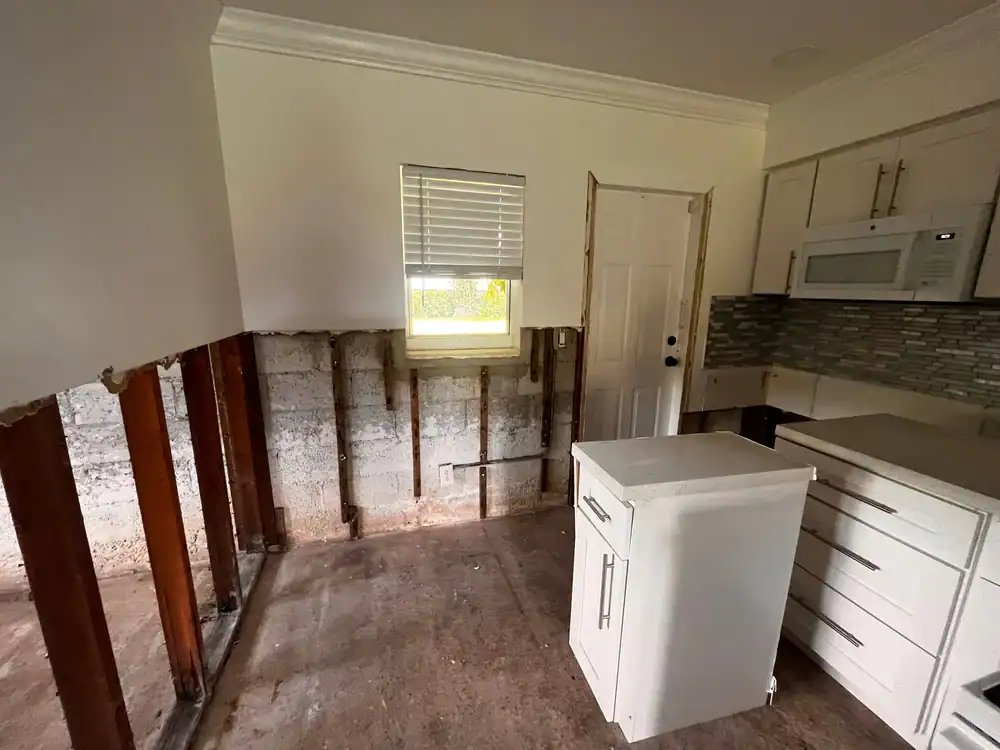
Yes — and this is actually one of the more practical reasons to work with a full-service contractor rather than a restoration-only company. When a Laurel Hollow kitchen sustains water damage from a nor’easter, a burst pipe, or a roof failure, the standard restoration response is to put it back the way it was. That’s a missed opportunity. With the walls already open and the cabinetry already removed, the incremental cost to upgrade the kitchen — rather than simply restore it — is significantly lower than starting a renovation from scratch at a later date.
We can take a project from post-damage remediation all the way through a completed kitchen renovation under one contract. You’re not managing a restoration company and a separate remodeler simultaneously, which is a coordination burden that adds time, cost, and friction. If your kitchen has been damaged and you’ve been thinking about updating it anyway, the timing may actually work in your favor.
How do I evaluate kitchen remodel contractors in the Laurel Hollow and Oyster Bay area?
Start with the basics that are easy to verify: a Nassau County Home Improvement Contractor License (issued by the Nassau County Department of Consumer Affairs) and a current Certificate of Insurance showing general liability and workers’ compensation coverage. Any contractor working in Laurel Hollow should be able to produce both without hesitation. If there’s a delay or deflection when you ask, that’s useful information.
Beyond credentials, ask to see completed work from homes that are actually comparable to yours — not photos from a 1,200-square-foot cape in a different market. North Shore estate kitchens have different proportions, different complexity, and different expectations than a standard Nassau County remodel. Ask who your project manager will be, whether that person is your direct contact throughout the job, and how change orders are handled if the scope shifts. The answers to those questions will tell you more about how the project will actually go than any sales presentation will.