I needed a professional consultation explanation of procedure for safe removal of Asbestos in my apartment complex. Without having an account yet, I was very impressed with the caring, knowledgeable and generous advice offered by Jessica, and will look forward to doing business in the future. Thank you so much! I feel much more informed about a sometimes scary endeavor. Peace. Nancy Silva Mineola, NY.
Mia Munoz
Used this company to clean up some water flood in my house. They were fast and easy to work with.very professional, Would recommend to anyone!
Nini Valle
Great company, had a flood and they responded quickly and efficiently. Billed my insurance company directly. I highly recommend this company!
joe colapietro, jr
I had pipe freeze in my basement right before a snow storm and they made to within an hour to help start the clean up process. They we by our side throughout the entire process and even helped with the insurance company. They did such a great job with the cleanup, repair, remidiation, I contracted them to perform the repairs and finishes in the basement. They came with enough manpower and material to get the job done. Leo and Jessica were nothing but a pleasure to deal with!!
Cristian Arredondo c
I had some water damage in my home and Green Island was able to take care of my issue quickly and effectively. I am very pleased with the work they did. They responded quickly and were very professional.
Michael M
Outstanding service! From the office to the field crew everyone was friendly, helpful and responsive. I highly recommend Green Island Group.
What Changes When Your Lloyd Harbor Kitchen Finally Works for You
A kitchen remodel in Lloyd Harbor is not the same project it would be somewhere else on Long Island. The homes here are older a significant portion of the housing stock on Lloyd Neck was built during the post-war boom of the late 1940s through the early 1960s and the environment is genuinely demanding. You’re surrounded by Huntington Bay, Cold Spring Harbor, and Long Island Sound. That coastal air does real damage over time: cabinet finishes swell and peel, hardware corrodes, grout fails. When you finally decide to renovate, you want materials and workmanship that hold up to where you actually live.
Beyond the environment, there’s the question of what a finished kitchen does for your home’s value. In a market where Lloyd Harbor listings are moving faster than they were a year ago and buyers have high expectations, an outdated kitchen is a negotiating liability. A properly executed renovation custom cabinetry, quality countertops, a layout that actually functions protects what you’ve invested in this property and strengthens what it’s worth.
And then there’s the day-to-day. A kitchen that’s been designed around how your household actually uses it the cooking, the homework, the dinner parties, the mornings is a different experience than one that was designed for a showroom catalog. That’s the version worth building.
12 Years in Suffolk County, Ready for What's Inside Your Lloyd Harbor Walls
We’ve been working inside Long Island homes since 2012 over 5,000 completed projects across New York State, and a base of operations right here in Suffolk County. We know this part of the North Shore. We know the housing stock on Lloyd Neck. And we know that opening a wall in a home built in 1957 is a different situation than opening one in a new construction down island.
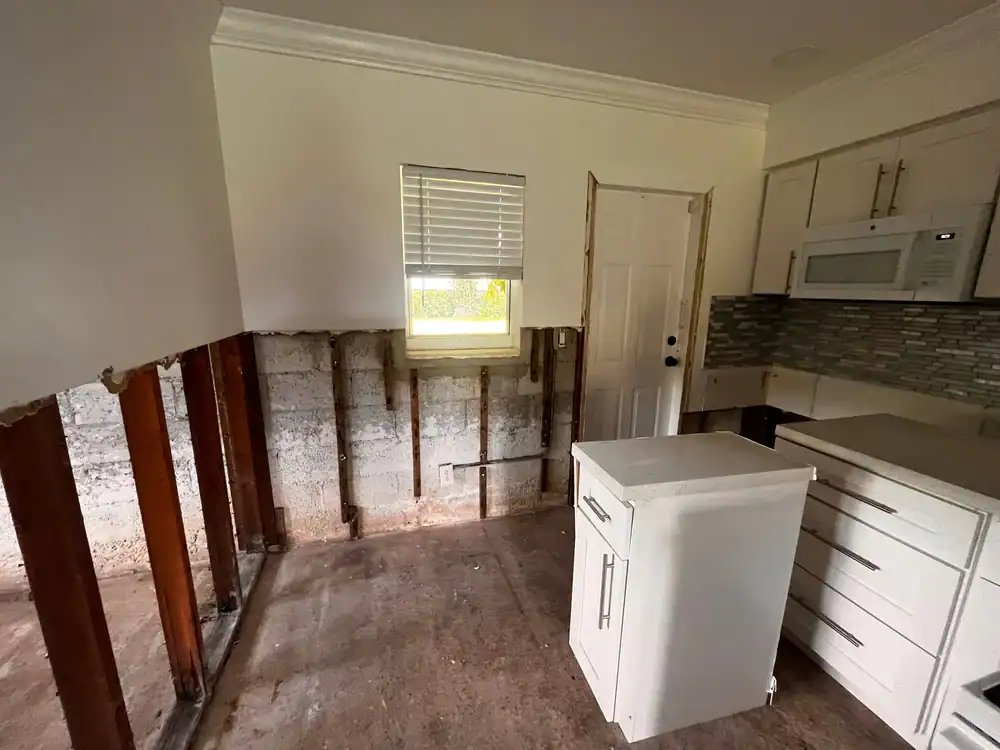
What sets us apart from a standard kitchen contractor is the depth behind our license. We hold a Home Improvement Contractor license, five additional licenses, IICRC certification, and M/WBE certification from New York State. More importantly, we’re licensed for environmental remediation which means if demolition turns up asbestos tile, mold behind the drywall, or lead paint on the trim, the project doesn’t stop. We handle it in-house and keep moving.
For a Lloyd Harbor homeowner, that’s not a hypothetical. It’s a real and common scenario in this community’s older homes, and it’s one of the clearest reasons to choose a contractor who was built for it.
No Surprises Here's Exactly How Your Lloyd Harbor Project Runs
It starts with a conversation at your home. We come to you, measure the space, ask the right questions about how you use the kitchen, and get a clear picture of what you want the finished result to look like. From there, we build a 3D model of the design not a sketch, not a mood board an actual photorealistic rendering so you can see the cabinet layout, the countertop material, the island dimensions, and the flow of the space before anything is touched. You request changes, adjust the layout, swap materials, and lock in the design when it’s right.
Once the design is approved, we handle the permits. Lloyd Harbor is an incorporated village with its own building department, its own zoning code, and a Site and Building Permit Review Board that reviews every permit application before it’s approved. That’s an extra layer of process that many contractors aren’t familiar with. We manage the filing, the referral timeline, and the inspector coordination you don’t have to become an expert in village code to get your kitchen renovated.
Then the work begins. Demolition, structural assessment, any environmental remediation that’s needed, rough work, installation, finishing. One crew, one project manager, one point of contact from the first consultation to the final walkthrough. When it’s done, you get a kitchen that was built for your home not assembled from a catalog.
Everything Your Lloyd Harbor Kitchen Renovation Actually Needs
A full kitchen remodel with us covers the complete scope custom cabinetry, countertop fabrication and installation, layout redesign, flooring, lighting, plumbing coordination, and electrical work. Every material decision is made with your environment in mind. Cabinet finishes are selected for moisture resistance because coastal humidity is a real factor on Lloyd Neck. Hardware is specified for longevity in a salt-air environment. Countertop materials are chosen for both performance and the aesthetic standards that Lloyd Harbor homeowners expect.
If your kitchen renovation involves structural changes opening a wall, relocating an island, expanding the footprint that work is handled in-house as well. And if demolition reveals something unexpected, whether that’s mold, water damage, asbestos in the floor tile, or deteriorated framing, we’re licensed to address it without bringing in a third party. For homes built before 1980, which covers a large portion of the housing stock in this village, that capability matters more than most homeowners realize until they’re mid-project.
The process includes a detailed written quote before work begins, 3D design modeling, full permit management through Lloyd Harbor’s village-level building department, and direct coordination with local inspectors. No portion of the project gets handed off to someone you’ve never met. From the first design consultation to the final walkthrough, you’re working with the same team and the same standard of work throughout.
Do I need a permit to remodel my kitchen in Lloyd Harbor, NY?
Yes, and the permitting process in Lloyd Harbor has an additional step that most homeowners don’t expect. Because Lloyd Harbor is an incorporated village not just an unincorporated part of Huntington it operates its own building department with its own code requirements. Any permit application for construction, reconstruction, or alteration of a building must be referred to the village’s Site and Building Permit Review Board within 21 days of submission. That review adds time to the process if you’re not accounting for it upfront.
The village’s own building permits page explicitly notes that many changes homeowners want to make require a permit, and that starting work without one is a problem they see regularly with new residents. For a kitchen renovation that involves structural changes, layout modifications, or anything affecting the exterior of the home, you’ll need to navigate both the village-level process and Suffolk County requirements. We handle all of this as a standard part of every project the filing, the referral, the inspector scheduling so you’re not managing a bureaucratic process on top of a renovation.
How much does a kitchen remodel typically cost in Lloyd Harbor?
The honest answer is that it depends on the scope, and in Lloyd Harbor, the scope is usually more involved than a standard kitchen renovation elsewhere on Long Island. The average kitchen remodel in New York runs around $27,000 to $30,000, but that figure reflects a broad range of homes and project types. In Lloyd Harbor, where homes are larger, older, and often require environmental assessments during demolition, the realistic range for a full custom renovation with quality materials tends to run from $50,000 to $150,000 or more.
Labor accounts for roughly half to sixty percent of total project cost, which means the quality and licensing of the contractor is one of the most significant cost variables not just a trust consideration, but a financial one. A contractor who isn’t licensed for environmental remediation may quote lower upfront, but if they hit asbestos or mold mid-project and have to stop work and bring in a third party, the cost and timeline consequences are significant. Getting a detailed written quote that accounts for the full scope of work including what might be found inside the walls of an older home is the right way to budget for this project.
What should I know about remodeling a kitchen in an older Lloyd Harbor home?
Older homes in Lloyd Harbor particularly those built during the post-war growth period from the late 1940s through the early 1960s present specific renovation considerations that newer construction doesn’t. Homes of that era commonly contain asbestos in floor tiles, pipe insulation, and ceiling materials, as well as lead paint on walls, trim, and cabinetry. These aren’t rare edge cases. They’re standard findings in kitchens of that vintage, and they require a contractor who is licensed to address them not one who stops the project and tells you to find someone else.
Beyond the environmental factors, older homes often have non-standard room dimensions, original plasterwork, and structural conditions that need to be assessed before demolition begins. The framing may not be what you’d find in a newer build. The plumbing and electrical may need updating as part of the renovation rather than as a separate future project. A contractor who has worked extensively inside Long Island’s older North Shore housing stock knows how to plan for these realities from the start which is the difference between a project that runs on schedule and one that keeps expanding in scope and cost.
How long does a full kitchen renovation in Lloyd Harbor typically take?
A full kitchen renovation design through final inspection typically takes between six and twelve weeks for most projects, though the timeline in Lloyd Harbor can be affected by a few factors specific to this community. The village’s permit review process, which includes a referral to the Site and Building Permit Review Board, adds time that needs to be built into the schedule from the start. Contractors who aren’t familiar with this step often underpromise on timeline and then run into delays once the project is underway.
Environmental remediation work, if it’s needed, also adds time though having it handled in-house rather than subcontracted keeps that addition as short as possible. The 3D design modeling phase at the beginning of the project, while it takes a week or two, actually saves time overall because it eliminates the back-and-forth that happens when design decisions are made mid-construction. If you’re planning around a specific date a listing, a family event, the summer entertaining season build in a realistic buffer and start the planning process earlier than you think you need to.
Does a kitchen remodel increase home value in Lloyd Harbor, NY?
In this specific market, yes and the numbers are meaningful. Minor kitchen renovations are delivering up to 113% return on investment in 2025, meaning homeowners are recouping more than they spend when they sell. In a market where the median home value in Lloyd Harbor is around $2.2 million and listings are moving faster than they were a year ago, the condition of the kitchen is a direct factor in what buyers offer and how quickly they move.
Fifty-four percent of real estate agents nationally recommend a kitchen upgrade before listing a home for sale. In an affluent, high-expectation market like Lloyd Harbor where buyers are sophisticated and have seen a lot of homes an outdated kitchen isn’t just a cosmetic issue, it’s a negotiating point that can cost more than the renovation would have. A well-executed renovation that uses quality materials and a layout that photographs well and functions properly tends to pay for itself in the final sale price, and often more than that.
How do I choose the right kitchen remodel contractor for my Lloyd Harbor home?
The most important thing to verify is licensure and not just a general contractor’s license. In Lloyd Harbor, where a significant portion of the housing stock predates 1980, you want a contractor who is licensed for environmental remediation. Asbestos and lead paint are common findings during kitchen demolitions in this community, and a contractor who isn’t equipped to handle them will either stop your project or proceed without proper protocols, both of which create serious problems.
Beyond that, look for a contractor who has direct experience with the village’s permitting process. Lloyd Harbor’s Site and Building Permit Review Board adds a layer of review that many contractors who work elsewhere on Long Island don’t know exists. A contractor who discovers this mid-project will cause delays. Ask specifically how they handle Lloyd Harbor permits and what their timeline assumptions account for. Finally, ask to see 3D design renderings before you commit to anything in a home where you’re investing $50,000 to $150,000 or more, you should be able to see exactly what you’re getting before the first cabinet comes down.