Malverne's Older Homes Deserve More Than a Generic Remodel
Nearly half the homes in Malverne were built before 1939. A kitchen remodel here isn’t like working in a new subdivision — and the contractor you hire should know the difference.
I needed a professional consultation explanation of procedure for safe removal of Asbestos in my apartment complex. Without having an account yet, I was very impressed with the caring, knowledgeable and generous advice offered by Jessica, and will look forward to doing business in the future. Thank you so much! I feel much more informed about a sometimes scary endeavor. Peace. Nancy Silva Mineola, NY.
Mia Munoz
Used this company to clean up some water flood in my house. They were fast and easy to work with.very professional, Would recommend to anyone!
Nini Valle
Great company, had a flood and they responded quickly and efficiently. Billed my insurance company directly. I highly recommend this company!
joe colapietro, jr
I had pipe freeze in my basement right before a snow storm and they made to within an hour to help start the clean up process. They we by our side throughout the entire process and even helped with the insurance company. They did such a great job with the cleanup, repair, remidiation, I contracted them to perform the repairs and finishes in the basement. They came with enough manpower and material to get the job done. Leo and Jessica were nothing but a pleasure to deal with!!
Cristian Arredondo c
I had some water damage in my home and Green Island was able to take care of my issue quickly and effectively. I am very pleased with the work they did. They responded quickly and were very professional.
Michael M
Outstanding service! From the office to the field crew everyone was friendly, helpful and responsive. I highly recommend Green Island Group.
A Kitchen That Finally Works for How You Actually Live
Most Malverne kitchens were designed for a mid-century lifestyle — compartmentalized, cut off from the rest of the house, and built long before anyone thought about counter space, kitchen islands, or open-concept flow. If yours feels tight, dated, or just wrong for the way your family uses it, that’s not a personal failing. That’s an 80-year-old floor plan doing what it was designed to do in 1935.
When we get the work right, you get a kitchen that fits your life — not just your house. That means layouts that open up to dining and living spaces, storage that makes sense, surfaces that hold up to daily use, and finishes that feel like they belong in the home rather than dropped in from a catalog showroom.
For homeowners on the West Hempstead Branch line, the daily commute is already long. The last thing you need is to come home to a kitchen that frustrates you. With median home values in Malverne pushing toward $740,000 and climbing, a well-executed kitchen renovation isn’t just a quality-of-life upgrade — it’s one of the strongest financial moves you can make in this market.
We’re a full-service renovation contractor serving Nassau County homeowners, including the Village of Malverne and surrounding South Shore communities like Lynbrook, Valley Stream, Rockville Centre, and West Hempstead. Every kitchen remodel runs under one contract, one project manager, and one accountable team — from the first consultation through the final inspection.
In Malverne, reputation travels fast. Word moves between neighbors, across LIRR platforms, and through school pickup lines at Malverne Union Free School District. That’s not pressure — it’s just how a one-square-mile community works, and it’s exactly the kind of accountability that keeps our work honest.
Every kitchen remodel we handle comes with the licensing, insurance, and permit compliance that Nassau County and the Village of Malverne require. No shortcuts, no unlicensed subs, no paperwork left for you to sort out after the fact.
It starts with a consultation where we look at the actual space — not just dimensions, but what’s behind the walls, what the layout can realistically support, and what your home’s construction will allow. In Malverne’s pre-war homes, that conversation matters more than it does in newer builds. Plaster walls, older electrical panels, cast iron plumbing — these are common here, and they affect the plan before a single cabinet gets ordered.
From there, you get a clear scope of work, a realistic timeline, and a permit application filed with the Village of Malverne Building Department at 99 Church Street — not the Town of Hempstead, which is a distinction that trips up contractors who don’t know this area. The village has its own building department, its own inspection process, and its own code requirements. We handle all of it.
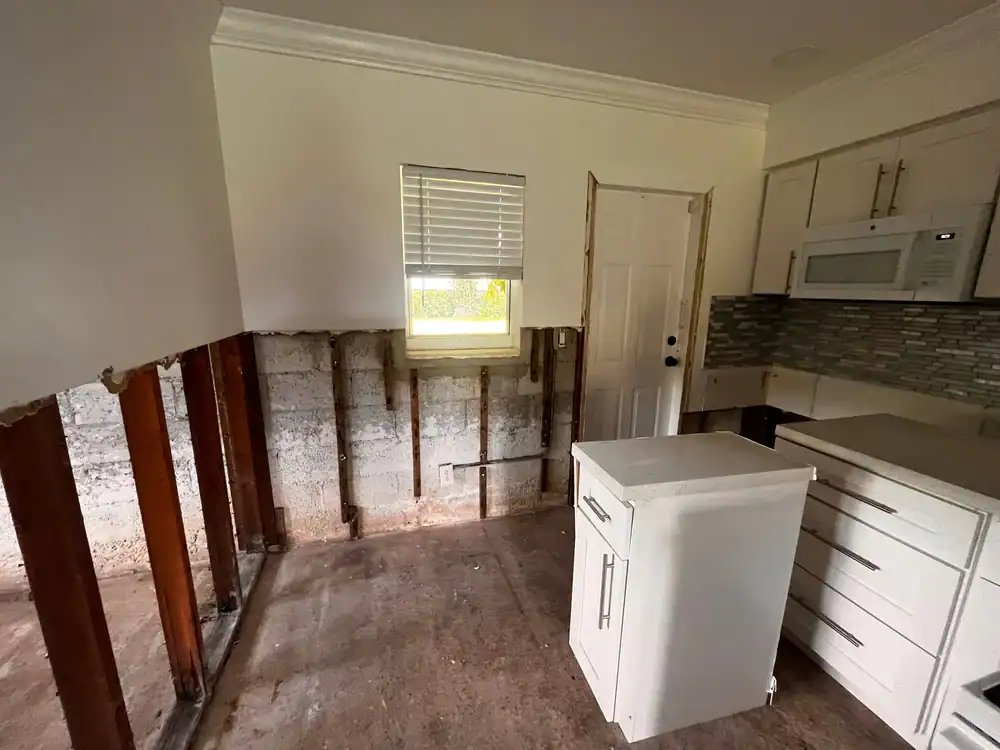
Once work begins, the site is managed daily and the project moves in a logical sequence: demo, rough work (electrical, plumbing, structural if needed), inspections, then finishes. If you’re timing the project around the school year or a summer break — which most Malverne families do — we build the schedule around that from day one, not as an afterthought.
Full Kitchen Remodels Built for Nassau County Homes
Our kitchen remodels cover the full scope — layout redesign, cabinet installation or cabinet renovation, countertop replacement, tile work, lighting, electrical upgrades, plumbing relocation, and finish work. If your Malverne kitchen needs a complete gut, we handle that. If the bones are solid and you’re looking at a focused cabinet remodel with new countertops and hardware, we’ll tell you that honestly during the consultation rather than upsell you into a project you don’t need.
For homeowners in pre-1978 Malverne homes — which is the overwhelming majority of the village — EPA Lead-Safe certified practices are required by federal law during any renovation that disturbs painted surfaces. We hold that certification. It’s not a selling point we invented; it’s a legal requirement that protects your family during demo, and it’s something worth confirming with any contractor you’re considering.
Every project includes permit management through the Village of Malverne’s building department, coordination of all required inspections, and a written scope so you know exactly what’s covered. Our Nassau County Home Improvement Contractor licensing is current and verifiable. The Certificate of Insurance is available before you sign anything — not after you ask twice.
Do I need a permit for a kitchen remodel in Malverne, NY?
Yes — and the permit needs to come from the Village of Malverne Building Department specifically, not the Town of Hempstead. This is a distinction that matters because Malverne is an incorporated village with its own building department at 99 Church Street. A contractor who pulls a permit through the wrong jurisdiction hasn’t actually permitted the work.
Any kitchen remodel that involves electrical upgrades, plumbing relocation, or structural changes requires a building permit issued by the village’s Superintendent of Buildings. The village takes code compliance seriously — violations are treated as misdemeanors, and each week of continued violation is considered a separate offense. Getting this right from the start protects your homeowner’s insurance, your family’s safety, and your ability to sell the home without complications down the road. We manage the permit process on every project we take on in Malverne.
How much does a kitchen remodel typically cost in Malverne, NY?
For a full gut renovation in Malverne, you’re generally looking at a range of $50,000 to $120,000 depending on scope, material selections, and what’s discovered once the walls are open. A more focused cabinet renovation — new doors, drawer fronts, hardware, and countertops without moving plumbing or changing the layout — typically runs $20,000 to $45,000.
Labor and material costs in Nassau County run 25 to 40 percent above national averages, but the return at resale is proportionally stronger. In the Northeast, kitchen remodels return approximately 85 to 96 cents on the dollar at resale. With Malverne’s median home sale price sitting around $739,500 and rising 11 percent year-over-year, a kitchen renovation here is one of the more financially sound improvements you can make. The consultation is where we give you a specific number based on your actual kitchen — not a ballpark pulled from a national average.
What should I know about remodeling a kitchen in a pre-war Malverne home?
Malverne’s housing stock is genuinely old — roughly 46 percent of homes in the village were built before 1939, making it one of the oldest communities in the country by that measure. That means the kitchen remodeling process here involves considerations that simply don’t apply in newer construction.
Plaster walls behave differently from drywall during demo. Older electrical panels often need to be upgraded to support modern appliance loads — and in many cases, that upgrade is a code requirement, not optional. Cast iron and galvanized plumbing may be at or near the end of its service life, and opening a kitchen wall gives you the opportunity to address it proactively. Lead paint is nearly universal in homes built before 1978, which covers virtually every house in Malverne. A contractor who treats your 1928 Colonial like a 2005 suburban build is going to run into problems — and those problems become your problems. We’ve worked in these homes, and we know what to look for before it becomes a costly surprise.
How long will a kitchen remodel take, and how do I plan around it?
A full kitchen gut renovation typically runs six to ten weeks from demo to final walkthrough, depending on scope and whether any unexpected conditions turn up once walls are opened. A more limited cabinet remodel can run three to five weeks. These are real ranges — not marketing estimates.
For Malverne families, the most common approach is to schedule the most disruptive work during summer break, when the routine is already disrupted, outdoor dining is practical, and the Malverne Union Free School District calendar isn’t adding complexity to the logistics. We build the timeline around your schedule from the beginning of the project — including permit processing through the Village of Malverne Building Department, which has its own review timeline that needs to be factored in before work can legally begin. If you’re trying to have the kitchen finished before Thanksgiving or before listing the home in the spring market, tell us that upfront and we’ll work backward from that date.
How do I know if I need a full gut renovation or just a cabinet remodel?
The honest answer is that it depends on the layout and the condition of what’s already there. If your kitchen’s footprint works — meaning the flow makes sense, the plumbing is where it needs to be, and you’re not trying to remove walls — then a focused cabinet renovation with new countertops, hardware, and lighting can genuinely transform the space at a fraction of the cost of a full gut.
If the layout is the problem — which is common in Malverne’s older homes, where kitchens were designed as separate, closed-off rooms — then surface-level updates won’t fix the underlying issue. A gut renovation gives you the ability to move plumbing, upgrade electrical, reconfigure the layout, and address anything that’s been deferred for decades. The consultation is where we look at your specific kitchen and give you a straight answer on which approach actually makes sense, rather than defaulting to the larger scope because it’s a bigger job.
What licenses and certifications should a kitchen contractor have to work in Malverne?
At minimum, a contractor doing kitchen remodel work in Malverne should hold a Nassau County Home Improvement Contractor License issued by the Nassau County Department of Consumer Affairs. This is the county-level credential required by law for residential renovation work in Nassau County — it’s verifiable, and you should ask for the license number before signing anything.
Beyond that, because virtually every home in Malverne was built before 1978, EPA Lead-Safe Certification is a federal requirement — not optional — for any contractor disturbing lead paint during renovation. A contractor without this certification is legally prohibited from performing that work without proper precautions, and the risk isn’t bureaucratic. It’s lead dust exposure for your family during demolition. You should also confirm that the contractor carries general liability insurance and workers’ compensation, and ask for a Certificate of Insurance before work begins. We hold all of the above, and we’ll provide documentation upfront — because in a village where everyone talks, doing it right isn’t just good practice. It’s the only way we operate.