Gold Coast Kitchens Built for How You Actually Live
Mill Neck homes carry real history — and real complexity. We handle full kitchen renovations in Mill Neck, NY, from the first permit pulled at the village building department to the last cabinet door hung.
I needed a professional consultation explanation of procedure for safe removal of Asbestos in my apartment complex. Without having an account yet, I was very impressed with the caring, knowledgeable and generous advice offered by Jessica, and will look forward to doing business in the future. Thank you so much! I feel much more informed about a sometimes scary endeavor. Peace. Nancy Silva Mineola, NY.
Mia Munoz
Used this company to clean up some water flood in my house. They were fast and easy to work with.very professional, Would recommend to anyone!
Nini Valle
Great company, had a flood and they responded quickly and efficiently. Billed my insurance company directly. I highly recommend this company!
joe colapietro, jr
I had pipe freeze in my basement right before a snow storm and they made to within an hour to help start the clean up process. They we by our side throughout the entire process and even helped with the insurance company. They did such a great job with the cleanup, repair, remidiation, I contracted them to perform the repairs and finishes in the basement. They came with enough manpower and material to get the job done. Leo and Jessica were nothing but a pleasure to deal with!!
Cristian Arredondo c
I had some water damage in my home and Green Island was able to take care of my issue quickly and effectively. I am very pleased with the work they did. They responded quickly and were very professional.
Michael M
Outstanding service! From the office to the field crew everyone was friendly, helpful and responsive. I highly recommend Green Island Group.
A Kitchen That Finally Matches the Rest of Your Mill Neck Estate
Most kitchens in Mill Neck were never designed for the way people cook and entertain today. They were built for a different era — separated from the living spaces, sized for staff, and laid out in a way that made sense in 1930. If yours still feels that way, you already know the problem. The layout doesn’t work. The finishes are dated. And the space that should be the center of your home feels like an afterthought.
A well-executed kitchen renovation changes all of that. You get a layout that actually functions — open, connected, designed around how your household moves through the day. You get materials that hold up in a waterfront environment. Mill Neck’s proximity to Oyster Bay Harbor means coastal humidity is harder on cabinetry and countertops than most people realize until they’re already dealing with warped doors and failing finishes.
What you also get — and this matters in a home at this level — is a finished space that reflects the scale and character of the property around it. Not a builder-grade update. A kitchen that belongs in a Mill Neck estate.
We’re a full-service renovation contractor based in New York, and we’ve been working in Mill Neck and Nassau County’s North Shore communities long enough to know what makes this village different from everywhere else. The homes here aren’t standard suburban builds. They’re estate-scale properties with real architectural history, older construction systems, and a level of expectation that most contractors aren’t equipped to meet.
We handle every part of a kitchen renovation under one roof — design, demolition, cabinetry, countertops, plumbing, electrical, and finish work. That means one point of contact, one accountable team, and no coordination gaps between trades. For a home in Mill Neck or anywhere within the village, that structure isn’t a convenience — it’s what keeps a complex project from going sideways.
We also pull permits directly through the Village of Mill Neck Building Department. Not Nassau County. Not the Town of Oyster Bay. The village. That distinction matters, and we know it.
It starts with a consultation at your home. We walk the space, ask the right questions, and get a clear picture of what you’re working with — the existing layout, the structural conditions, the age of the plumbing and electrical, and what you actually want the finished kitchen to do. For homes in Mill Neck, that walkthrough often turns up things worth knowing early: older wiring that needs to be brought up to code, plaster walls that require a different demolition approach, or lead paint protocols that apply to any home built before 1978. A significant portion of the housing stock here predates 1940, so we treat EPA Lead-Safe compliance as a standard part of the process, not an afterthought.
From there, we put together a written proposal with line-item detail — labor, materials, permits, and contingency — so you know exactly what you’re approving before anything starts. We handle the permit application directly with the Village of Mill Neck Building Department and manage the inspection schedule throughout the project.
Once work begins, you have a named project manager as your single point of contact from start to finish. Progress is communicated on a defined schedule. The job site is kept clean and contained. And the work doesn’t wrap until the result meets the standard the home deserves.
Every Detail Handled to the Standard Mill Neck Demands
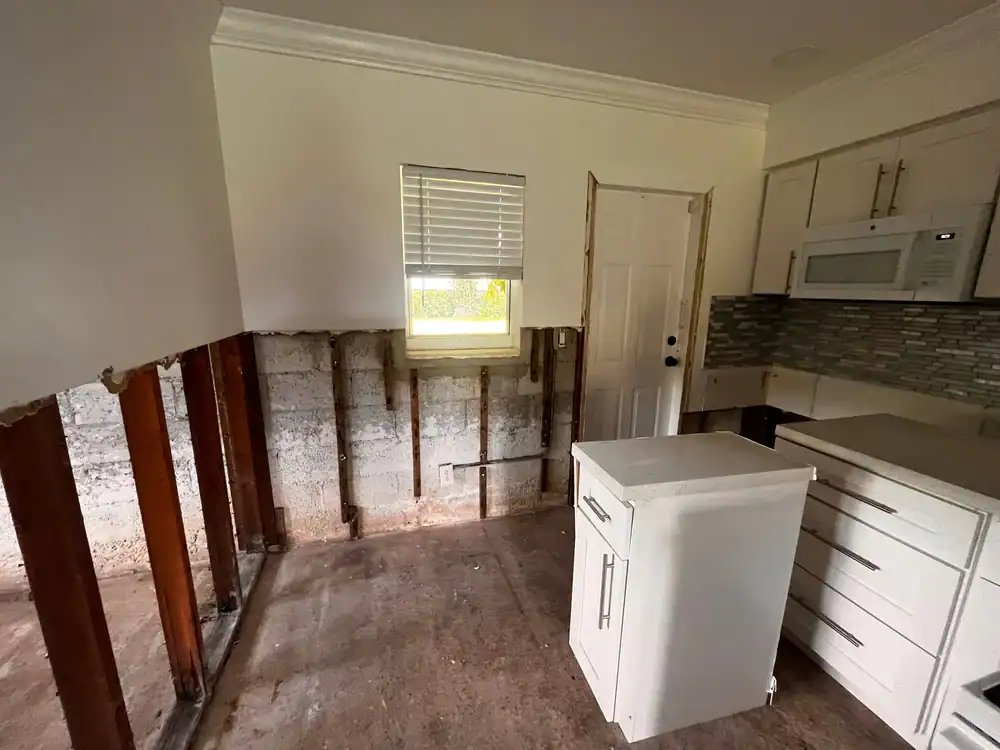
A full kitchen renovation with us covers the complete scope — layout reconfiguration, custom cabinetry, countertop fabrication and installation, backsplash, plumbing relocation, electrical upgrades, lighting, flooring, and appliance integration. If your project starts with water damage from a coastal storm or a plumbing failure in an aging system, we can take it from remediation all the way through to a finished, fully renovated kitchen. That’s a path the restoration companies on this island can’t offer you.
For Mill Neck homeowners, material selection is a real conversation, not a catalog drop-off. We work with custom cabinet lines, professional-grade appliance brands, and premium stone — and we can walk you through the practical differences between options so you’re making informed decisions, not just aesthetic ones. Quartzite versus marble, inset versus overlay cabinetry, integrated versus panel-ready appliances — these are choices that affect how the kitchen performs for years, and you deserve straight answers about all of it.
If your project involves a kitchen that connects to a butler’s pantry, a catering space, or a formal dining room — which is common in the estate homes throughout Mill Neck — we design and build those transitions as part of a unified scope. The result is a kitchen that functions as well as it looks, in a home that’s earned that standard.
Do I need a permit for a kitchen remodel in Mill Neck, NY?
Yes — and the permit comes from the Village of Mill Neck Building Department specifically, not from Nassau County or the Town of Oyster Bay. This is one of the most common points of confusion for homeowners and contractors who aren’t familiar with how incorporated villages in New York operate. Mill Neck handles its own building permits independently, and the application process goes through the village directly. The Village Hall is located on Frost Mill Road, and the building inspector handles permit review and inspection scheduling for all construction work within the village boundaries.
Any kitchen remodel that involves structural changes, electrical upgrades, plumbing relocation, or HVAC modifications requires a permit. That covers most full renovations. We manage the entire permitting process on your behalf — we prepare the application, submit it to the village, and coordinate inspections throughout the project. You don’t have to navigate that process yourself, and you don’t have to worry about unpermitted work creating complications if you ever sell the property.
How much does a kitchen renovation typically cost in Mill Neck, NY?
For a full kitchen renovation in Mill Neck — custom cabinetry, premium countertops, professional appliances, layout changes, updated plumbing and electrical — you’re generally looking at a range of $150,000 to $400,000 or more depending on the scope and finishes. That range reflects the scale of the homes here and the level of material quality that makes sense in a property valued at several million dollars. A $40,000 renovation budget might be reasonable in a different market. In a Mill Neck estate, it’s not going to produce a result that belongs in the space.
The more important number is what’s in your written proposal — broken down by line item, not presented as a lump sum. That’s how you compare bids accurately and avoid the change order surprises that inflate costs once demolition has already started. We provide detailed written proposals before any contract is signed, so you know exactly what you’re approving and what’s included.
How long does a full kitchen remodel take from start to finish?
For a full gut renovation — layout reconfiguration, new cabinetry, countertops, updated plumbing and electrical, and finish work — a realistic timeline is typically 10 to 16 weeks from permit approval to project completion. That range accounts for the permit review process with the Village of Mill Neck, lead times on custom cabinetry and specialty materials, and the actual construction schedule.
Many Mill Neck homeowners choose to schedule major renovations during the summer months, when they have access to a secondary residence or vacation property and can vacate the home during construction. That works well for a project of this scale, and it’s a scheduling approach we can plan around. If you’re working toward a specific completion date — before the holiday season, before a real estate listing, or before a family event — tell us that upfront and we’ll build the schedule accordingly. We’ll also tell you honestly if the timeline isn’t achievable, rather than overpromise and underdeliver.
What should I look for when hiring a kitchen remodel contractor in Mill Neck?
The first thing to verify is licensing and insurance. In Nassau County, home improvement contractors are required to hold a valid Nassau County Home Improvement Contractor license. Ask for the license number and look it up — it takes two minutes and tells you whether the contractor is operating legally. Then ask for a current Certificate of Insurance showing general liability and workers’ compensation coverage. Any legitimate contractor will produce both without hesitation.
Beyond credentials, look for demonstrated experience with the type of home you have. Mill Neck’s housing stock is older — many properties date to the Gold Coast era, with plaster walls, original millwork, and systems that haven’t been updated in decades. A contractor who primarily works in newer construction may not know how to handle what’s behind your walls. Ask specifically about experience with pre-war homes, lead paint protocols, and working within the village’s permitting process. The answers will tell you quickly whether you’re talking to someone who actually knows this market or someone who’s figuring it out as they go.
Can a kitchen remodel be done in a historic or older Mill Neck home without damaging the original character?
Yes — but it requires a contractor who understands what they’re working with before demolition begins. Many of the estate homes in Mill Neck were built between 1890 and 1940, and they have architectural details that are worth preserving: original millwork profiles, plaster ceiling details, period-appropriate proportions. A kitchen renovation in a home like this isn’t just a construction project — it’s a balancing act between modern functionality and architectural integrity.
The practical approach is to do a thorough assessment before any walls come down. That means identifying original materials worth preserving or matching, understanding the structural system, and planning the new layout in a way that doesn’t require unnecessary damage to the surrounding spaces. It also means being EPA Lead-Safe certified, because homes of this age almost certainly have lead paint present somewhere in the construction. We hold that certification and follow the required RRP protocols on every project in a pre-1978 home — which, in Mill Neck, is the majority of homes we work in.
What happens if my kitchen has water damage — can you handle the renovation after remediation?
This is more common in Mill Neck than most people expect. The village sits along Oyster Bay Harbor and Mill Neck Bay, and the combination of coastal humidity, aging plumbing systems in older homes, and periodic storm-related water intrusion creates real exposure to kitchen water damage. Most restoration companies — the ServPros and water mitigation contractors you’ll find in a search — can dry out the structure and stop there. That leaves you managing a second contractor relationship to actually rebuild the kitchen, which means more time, more coordination, and more opportunity for things to fall through the cracks.
We handle both sides. If your kitchen has suffered water damage, we can assess the structural condition, coordinate with your insurance adjuster on the scope, and take the project from remediation through complete kitchen renovation — new cabinetry, countertops, flooring, updated plumbing and electrical — under one contract. You end up with a finished kitchen, not just a dried-out shell, and you deal with one team throughout the entire process.