Estate Kitchens Built for Old Field's Coastal Reality
Old Field homes deserve more than a showroom refresh they need a contractor who understands what’s behind the walls and what the salt air does over time. We handle kitchen remodeling in Old Field, NY from design through final inspection, in-house.
I needed a professional consultation explanation of procedure for safe removal of Asbestos in my apartment complex. Without having an account yet, I was very impressed with the caring, knowledgeable and generous advice offered by Jessica, and will look forward to doing business in the future. Thank you so much! I feel much more informed about a sometimes scary endeavor. Peace. Nancy Silva Mineola, NY.
Mia Munoz
Used this company to clean up some water flood in my house. They were fast and easy to work with.very professional, Would recommend to anyone!
Nini Valle
Great company, had a flood and they responded quickly and efficiently. Billed my insurance company directly. I highly recommend this company!
joe colapietro, jr
I had pipe freeze in my basement right before a snow storm and they made to within an hour to help start the clean up process. They we by our side throughout the entire process and even helped with the insurance company. They did such a great job with the cleanup, repair, remidiation, I contracted them to perform the repairs and finishes in the basement. They came with enough manpower and material to get the job done. Leo and Jessica were nothing but a pleasure to deal with!!
Cristian Arredondo c
I had some water damage in my home and Green Island was able to take care of my issue quickly and effectively. I am very pleased with the work they did. They responded quickly and were very professional.
Michael M
Outstanding service! From the office to the field crew everyone was friendly, helpful and responsive. I highly recommend Green Island Group.
Old Field isn’t a typical Long Island suburb, and your kitchen shouldn’t be treated like one. The homes here sit on large wooded lots, many of them built in the mid-20th century, surrounded on multiple sides by Long Island Sound, Conscience Bay, and the tidal waters of Flax Pond. That environment the salt air, the coastal humidity, the nor’easters that roll through every winter puts real stress on kitchens in ways that most contractors never account for. Cabinet interiors corrode faster here. Hardware fails sooner. Materials that perform fine ten miles inland start showing wear within a few years when they’re not specified for a coastal setting.
When the renovation is done right, you get a kitchen that holds up. One where the cabinetry was built for moisture resistance, the hardware won’t pit and corrode after two winters, and the layout actually works for how your household runs. That’s important when you’re living in a home that’s worth what Old Field homes are worth.
There’s also the financial side. Average sale prices in Old Field have climbed above two million dollars, and buyers at that level walk into a kitchen and form an opinion immediately. A dated kitchen in an estate home isn’t neutral it’s a negotiating liability. A well-executed kitchen renovation doesn’t just improve your daily life; it protects the value you’ve already built.
Twelve Years, 5,000 Projects, Local to the Three Villages
We’re a Suffolk County-based contractor headquartered in Bohemia with over twelve years of operation and more than 5,000 completed projects across New York State. The Three Village area, including Old Field, Stony Brook, and the Setaukets, is territory we know well. We’re not mapping your street for the first time when we show up for a consultation.
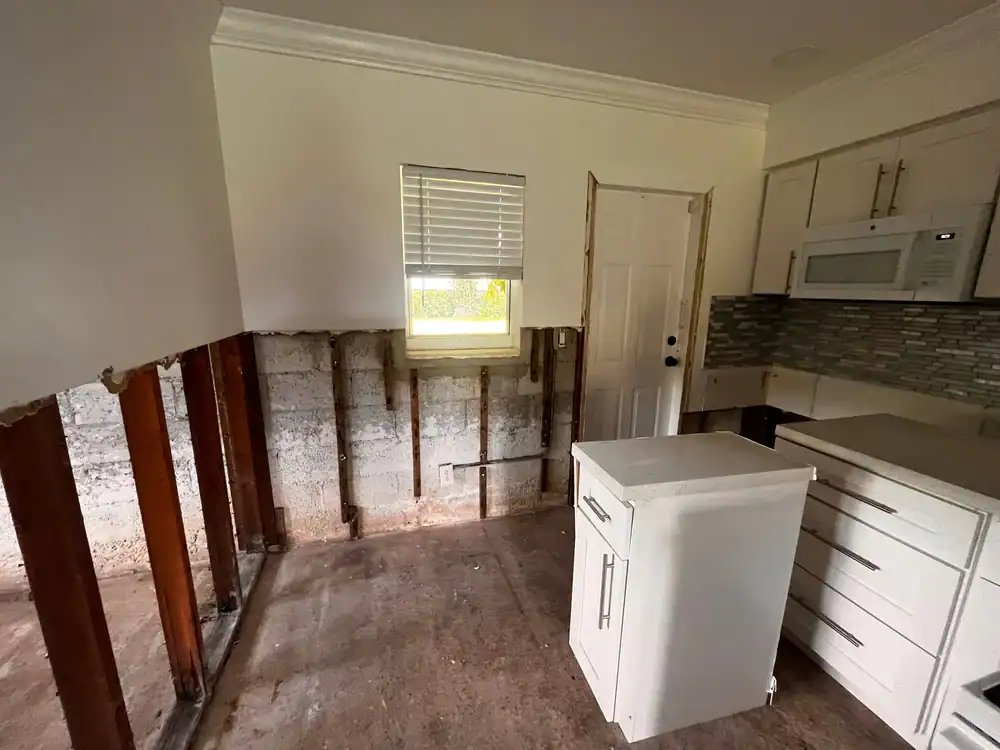
What separates us from a typical kitchen remodeling company is what happens when something unexpected turns up. Old Field’s mid-century housing stock means that opening a wall during kitchen demolition can surface asbestos-containing materials, lead paint, or moisture damage from years of coastal exposure. We hold the environmental remediation and asbestos abatement licenses to handle those discoveries in-house no second contractor, no stalled project, no added confusion. One company, start to finish.
We’re also a New York State-certified M/WBE, IICRC-certified, and carry a Home Improvement Contractor license plus five additional licenses. Every credential is verifiable. We expect you to check.
From First Visit to Final Inspection Here's What to Expect
It starts with a home visit. We come to you, walk the existing kitchen, take measurements, and have a real conversation about what’s working, what isn’t, and what you actually want the space to do. No pressure, no pitch just a clear picture of the scope before anything else happens.
From there, we move into 3D design modeling. You’ll see a photorealistic rendering of the finished kitchen every cabinet placement, countertop material, appliance position, and lighting layout before a single cabinet is touched. You review it, request changes, and approve it. The most common remodeling regret is “it doesn’t look like what I imagined.” This step eliminates that entirely.
Once the design is approved, we handle permitting. In Old Field, that means navigating two layers: the Village Board of Trustees, which reviews and approves all building permits at their monthly meetings and requires an Environmental Assessment Form with every application, and the Town of Brookhaven Building Division, which administers the New York State Uniform Building Code. We manage both. Then construction begins demolition, any environmental remediation if needed, full build-out, inspections, and a final walkthrough with you before we close out the project. The process is thorough because in a village like Old Field, thorough is the only way to do it right.
A kitchen remodel with us covers the full scope design, demolition, construction, and closeout. That includes custom cabinetry built for your specific space, countertop selection and installation, flooring, lighting, plumbing and electrical coordination, and all permit management through both the Village of Old Field and the Town of Brookhaven. Nothing is handed off to a separate company unless you request it.
For Old Field specifically, material selection is part of the conversation from day one. The coastal environment along the North Shore the proximity to Long Island Sound and the persistent salt air that comes with it means we’re recommending cabinet construction, hardware finishes, and countertop sealants that are appropriate for where you actually live. Soft-close hardware rated for coastal humidity, moisture-resistant cabinet interiors, and properly sealed stone edges aren’t upgrades here they’re the baseline.
If demolition uncovers anything regulated asbestos floor tiles, lead paint in older substrate layers, or evidence of past water intrusion we handle it under the same contract, with our own licensed team. You don’t get a phone call telling you the project is paused while we find someone else. We keep moving. For homes in a village where the average sale price exceeds two million dollars, that kind of continuity isn’t a luxury it’s what protects your investment and your timeline.
Do I need a permit for a kitchen remodel in Old Field, NY?
Yes and in Old Field, the permitting process is more involved than in most of Suffolk County. Because Old Field is an incorporated village, it has its own building authority that operates separately from the Town of Brookhaven. All building permit applications are reviewed and approved by the Village Board of Trustees at their monthly meetings, and every application requires the completion of an Environmental Assessment Form. Depending on the scope of work, a site plan submission may also be required before the village approves anything.
On top of that, any work involving structural changes, electrical, or plumbing also falls under the Town of Brookhaven Building Division’s jurisdiction, which enforces the New York State Uniform Fire Prevention and Building Code. That’s two separate approval processes running in parallel, and the village itself notes that homeowners can face additional delays from county and state agencies even after the village processes their end quickly. We manage both layers we know the forms, the meeting schedules, and what each agency needs so you’re not navigating a government process on top of a construction project at the same time.
How much does a kitchen remodel typically cost in Old Field?
Kitchen remodel costs in Old Field generally range from around $40,000 on the lower end for a focused cabinet and countertop update, up to $100,000 or more for a full gut renovation with structural changes, high-specification materials, and custom cabinetry. The wide range comes down to scope how much of the kitchen you’re changing, what materials you’re selecting, and whether the demolition phase surfaces anything that needs to be addressed before construction can continue.
In Old Field’s market specifically, it’s worth putting that number in context. With average home sale prices above two million dollars, a $60,000–$80,000 kitchen renovation represents a relatively small percentage of total home value and one with a documented return. Minor kitchen remodels are delivering up to 113% ROI in 2025, and more than half of realtors recommend a kitchen upgrade before listing. For homeowners in Old Field who are either preparing to sell or planning to stay long-term, a well-executed kitchen renovation is one of the cleaner financial decisions you can make. We provide itemized quotes so you know exactly what you’re paying for before anything starts.
What happens if asbestos or mold is found during kitchen demolition in my Old Field home?
It’s a real possibility in Old Field, and it’s one worth preparing for before the project starts rather than during it. Many homes in the village were built between the 1940s and 1970s the era when asbestos-containing materials were standard in kitchen flooring, ceiling tiles, pipe insulation, and joint compound. Lead paint was equally common in pre-1978 construction. When you open walls and pull up floors in a home of that vintage, there’s a meaningful chance of encountering regulated materials.
Most kitchen remodeling companies aren’t equipped to handle this. They stop work, bring in a separate remediation contractor, and your project timeline stretches by weeks while two companies coordinate around each other. We hold asbestos abatement licensing and IICRC certification we handle remediation in-house, under the same contract, with the same crew already on-site. If something turns up during demolition, we address it, document it properly for permit compliance, and keep the project moving. For a home in Old Field, that continuity matters both for your timeline and for making sure the work is done to code the first time.
How long does a kitchen remodel take in Old Field, NY?
For a mid-scope kitchen renovation new cabinetry, countertops, flooring, updated lighting and plumbing fixtures you’re generally looking at four to eight weeks of active construction once permits are in hand. The design and permitting phase adds time on the front end, and in Old Field that phase takes longer than in unincorporated Suffolk County areas because of the village-level approval process. The Board of Trustees meets monthly, which means your application timing relative to their meeting schedule can add a few weeks before construction can legally begin.
That said, the permitting timeline is manageable when you plan for it. Starting the design process early ideally in late winter or early spring if you want a summer completion, or in late summer for a fall finish before the holiday season gives you the buffer you need. We submit permit applications as early in the process as possible and track both the village and town timelines so nothing stalls on a missed deadline or a missing form. We’ll give you a realistic project timeline at the consultation stage, not an optimistic one that falls apart once permits are involved.
What kitchen materials hold up best near the Long Island Sound and Conscience Bay?
The coastal environment in Old Field is harder on kitchens than most homeowners realize until they’ve seen it firsthand. Salt air from Long Island Sound and the surrounding bays Conscience Bay, Smithtown Bay, the tidal waters of Flax Pond carries moisture and corrosive particles that infiltrate cabinet interiors, attack metal hardware, and degrade finishes that would last years in an inland home. Kitchens already generate significant humidity from cooking and dishwashing, so you’re compounding two moisture sources in the same space.
For cabinetry, solid wood or moisture-resistant plywood construction significantly outperforms MDF in this environment MDF absorbs moisture and swells over time, especially in under-sink areas and spaces adjacent to exterior walls. Hardware should be stainless steel or marine-grade finished rather than standard zinc alloy, which corrodes visibly within a few years near the water. For countertops, properly sealed quartz or granite with attention to edge sealing is the right call unsealed stone edges in a coastal kitchen will show water damage and staining faster than you’d expect. These aren’t premium upgrades for Old Field homes they’re the practical baseline for materials that will actually hold up where you live.
How do I know which kitchen remodeling contractor is the right fit for an Old Field project?
The most important thing to verify is whether the contractor can handle the full scope of what an Old Field kitchen remodel actually involves not just the design and cabinetry work, but the permitting complexity, the potential for environmental discoveries in older homes, and the material knowledge required for a coastal setting. A contractor who handles the pretty parts and subcontracts everything else creates real risk in a project like this: multiple crews, multiple schedules, and no single point of accountability when something goes sideways.
Beyond scope, verify credentials directly. Look up their Home Improvement Contractor license number through the appropriate licensing board, confirm their insurance coverage, and check whether they hold any environmental remediation or abatement licenses especially relevant for Old Field’s mid-century housing stock. Read reviews carefully and look for specifics: do reviewers mention how the company handled problems, not just how the finished kitchen looked? Our licenses, certifications, and project history are all verifiable we’ll give you the specifics at the consultation so you’re not taking our word for it.