Your Old Westbury home deserves a kitchen that matches it — not a contractor who treats it like any other job. We handle full kitchen renovations from the first conversation to the final walkthrough, with the expertise that comes from working on properties throughout Nassau County’s North Shore.
I needed a professional consultation explanation of procedure for safe removal of Asbestos in my apartment complex. Without having an account yet, I was very impressed with the caring, knowledgeable and generous advice offered by Jessica, and will look forward to doing business in the future. Thank you so much! I feel much more informed about a sometimes scary endeavor. Peace. Nancy Silva Mineola, NY.
Mia Munoz
Used this company to clean up some water flood in my house. They were fast and easy to work with.very professional, Would recommend to anyone!
Nini Valle
Great company, had a flood and they responded quickly and efficiently. Billed my insurance company directly. I highly recommend this company!
joe colapietro, jr
I had pipe freeze in my basement right before a snow storm and they made to within an hour to help start the clean up process. They we by our side throughout the entire process and even helped with the insurance company. They did such a great job with the cleanup, repair, remidiation, I contracted them to perform the repairs and finishes in the basement. They came with enough manpower and material to get the job done. Leo and Jessica were nothing but a pleasure to deal with!!
Cristian Arredondo c
I had some water damage in my home and Green Island was able to take care of my issue quickly and effectively. I am very pleased with the work they did. They responded quickly and were very professional.
Michael M
Outstanding service! From the office to the field crew everyone was friendly, helpful and responsive. I highly recommend Green Island Group.
What Changes When the Kitchen Finally Matches the Home
Most homeowners in Old Westbury aren’t renovating because something broke. They’re renovating because the kitchen — original to a home built in the 1940s or 50s — simply hasn’t kept up with the rest of the house. The layout is cramped. The cabinets are dated. The appliances don’t belong in a home of this caliber. And every time you walk through that room, you notice it.
A well-executed kitchen renovation changes that completely. You get a space that functions the way you actually live — whether that means a layout built for large-scale entertaining, a butler’s pantry that flows into the dining room, or a professional appliance suite that can hold its own next to a Sub-Zero refrigerator and a Wolf range. The kitchen stops being the one room you apologize for and starts being the one guests talk about.
In homes like yours — estate-scale properties on multi-acre parcels in one of the most recognized communities on Long Island’s North Shore — the kitchen renovation also carries real financial weight. Buyers in the Old Westbury zip code are paying $2.5 million, $3.5 million, and more. A kitchen that looks and performs at that level protects and adds to that value. One that doesn’t will cost you at the negotiating table.
We’re a full-service renovation contractor based in New York, and we’ve worked on homes throughout Nassau County’s North Shore — including properties in Old Westbury where the scale, the history, and the expectations are all different from a standard suburban remodel.
We’re not a restoration company that stops at drywall. We’re not a national franchise with a local phone number. When you hire us, you get a contractor who manages the entire process — design, demolition, cabinetry, countertops, plumbing, electrical, and the final finish — under one roof and one point of contact.
Old Westbury has its own Village Building Department at 1 Store Hill Road, and permits here require both a village submission and a Nassau County Building Permit Assessment Form. We handle all of it. You shouldn’t have to learn a permitting process to get your kitchen renovated, and with us, you won’t have to.
It starts with a consultation. We come to your home, walk through the kitchen, and listen to how you use the space — what’s working, what isn’t, and what you actually want out of the renovation. We’re not selling you a package before we understand the project. That conversation shapes everything that comes after.
From there, we put together a detailed, line-item written proposal. Not a ballpark. Not a range that doubles by the time work starts. A real proposal with real numbers, so you know what you’re committing to before anything is signed. For older homes in Old Westbury — many of which were built before modern electrical codes and have plumbing that’s well past its expected lifespan — we’ll flag anything we anticipate finding behind the walls before demolition begins, not after.
Once the scope is agreed on, we pull the permits through the Village of Old Westbury Building Department and handle the Nassau County assessment form concurrently. Work begins on a confirmed schedule, with a dedicated project manager as your single point of contact from day one through the final Certificate of Occupancy. When we’re done, you get a written walkthrough, a copy of all permit documentation, and a clear warranty on labor — in writing.
From Cabinet Refresh to Full Gut Renovation — We Handle It All
What we do covers the full range. Some clients come to us needing a focused kitchen cabinet renovation — new doors, new hardware, new countertops — without touching the layout. Others are starting from scratch: full demolition, structural reconfiguration, new plumbing and electrical, custom cabinetry built to spec, and high-end appliance integration from brands like Sub-Zero, Wolf, and Miele. We handle both, and everything in between.
For Old Westbury homes specifically, we’re experienced with the kind of work these properties demand. That means custom and semi-custom cabinetry that fits the architectural character of the home, not stock boxes pulled from a warehouse. It means countertop materials — book-matched marble, quartzite, Calacatta stone — selected and installed with the attention they deserve. And it means kitchens designed to support the way this community actually entertains: large gatherings, catered events, the kind of gracious hospitality that’s part of life here.
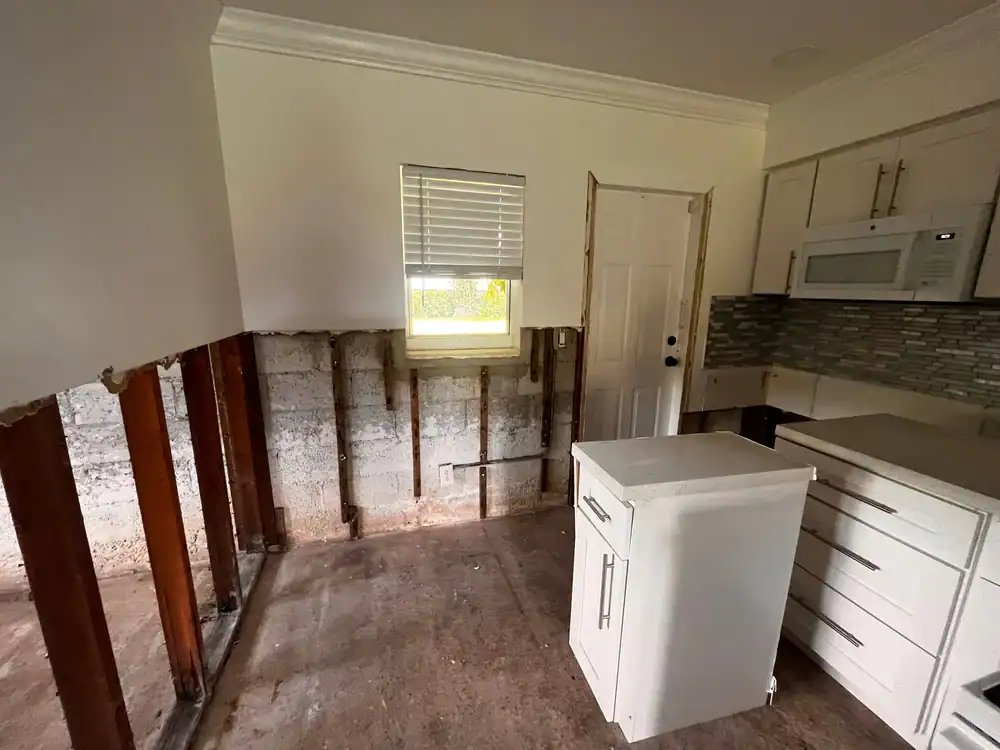
If your home has suffered water damage or a plumbing failure, we can take you from a stripped-down kitchen through to a fully finished renovation — something restoration-only companies simply can’t do. Many of the homes along Old Westbury Road, Chicken Valley Road, and the surrounding estate corridors have infrastructure that’s decades old. When the walls are already open, it’s often the right time to address what’s been waiting and build the kitchen you actually want.
Do I need a building permit for a kitchen remodel in Old Westbury, NY?
Yes — and the process in Old Westbury is more involved than in many other Nassau County communities. Because Old Westbury is an incorporated village, permits are handled through the Village’s own Building Department at 1 Store Hill Road, not through the county directly. Every application also requires a Nassau County Building Permit Assessment Form submitted concurrently, which adds a layer that homeowners often don’t anticipate.
Any kitchen remodel that involves electrical upgrades, plumbing relocation, structural changes, or HVAC modifications requires a building permit. That covers the majority of meaningful kitchen renovations — especially in older homes where the existing systems are being brought up to current code as part of the project. Work completed without permits creates real problems at resale and can complicate homeowner’s insurance claims during construction. We handle the full permitting process on your behalf, including both the village submission and the county form, so you don’t have to navigate it yourself.
How much does a kitchen remodel typically cost in Old Westbury?
In Old Westbury, realistic kitchen remodel budgets range from roughly $60,000–$80,000 for a focused cabinet and countertop renovation in a secondary kitchen or smaller space, to $150,000–$300,000 or more for a full gut renovation of a primary estate kitchen with custom cabinetry, premium appliances, and architectural millwork. These aren’t exceptional projects for this market — they’re typical, given the scale of the homes and the quality of materials that belong in them.
A few things drive cost in this area specifically. Many Old Westbury homes were built in the 1940s and 1950s, which means renovations frequently uncover outdated electrical systems, galvanized or aging supply lines, and structural layouts that need to be reconfigured for modern open-concept living. Addressing that infrastructure properly adds to the budget — but it’s the right call, both for your family’s safety and for the long-term value of the home. We provide a detailed, line-item proposal before any work starts so you know exactly what you’re investing in.
How long does a kitchen remodel take from start to finish?
A focused kitchen cabinet renovation or countertop replacement can be completed in two to four weeks once materials are on-site and permits are in place. A full gut renovation — including demolition, structural work, new plumbing and electrical, custom cabinetry, and finish work — typically runs eight to fourteen weeks depending on scope and material lead times.
In Old Westbury, the permitting timeline through the Village Building Department adds time to the front end of the project. We factor that into the schedule from the start, so it doesn’t come as a surprise mid-project. If you’re working toward a specific deadline — a holiday entertaining season, a spring listing, or a family event — let us know early in the consultation. We’ll build the schedule around that target and be straightforward with you about what’s realistic given the scope.
What should I look for when hiring a kitchen remodel contractor in Old Westbury?
A few things matter more than anything else in this market. First, verify that the contractor holds a Nassau County Home Improvement Contractor license — this is required by Nassau County law and is specific to the county, not just a general state license. Ask for the license number and confirm it’s current. Second, ask for a current Certificate of Insurance showing general liability and workers’ compensation coverage before signing anything. A contractor who hesitates on either of those requests is a red flag.
Beyond licensing and insurance, ask whether the contractor has experience with homes comparable to yours — estate-scale properties in Old Westbury or similar North Shore communities like Old Brookville, Brookville, or Muttontown. A kitchen in a 6,000-square-foot estate is a fundamentally different project from a kitchen in a standard suburban home, and the contractor’s experience should reflect that. Ask to see a real portfolio of completed work, not renderings. And make sure the proposal you receive is detailed and line-item specific — vague estimates are where budget surprises come from.
Can a kitchen remodel increase my home's value in Old Westbury?
In Old Westbury, the ROI case for a well-executed kitchen renovation is about as strong as it gets. With average home values above $2.3 million and many properties trading at $3 million to $5 million and above, even a $150,000 kitchen renovation represents a modest percentage of the home’s total value — and buyers at this price point are paying close attention to kitchen quality. A kitchen that looks and functions at the level of the home can meaningfully move the needle at the negotiating table.
According to Remodeling Magazine’s Cost vs. Value data, kitchen remodels in the Northeast return approximately 85–96 cents on the dollar at resale on the lower end of the scope spectrum, with premium renovations in high-value markets often contributing more to perceived value than the raw cost-to-return ratio suggests. In a community like Old Westbury — where buyers are financially sophisticated and have seen the inside of enough homes to know the difference between a kitchen that was done right and one that wasn’t — the quality of the renovation matters as much as the fact that it was done at all.
Our kitchen suffered water damage — can you renovate it instead of just restoring it?
Yes, and this is actually one of the more common conversations we have with homeowners in older Old Westbury homes. When a pipe fails or water damage forces a kitchen to be gutted, most restoration companies will dry out the structure, replace the damaged materials, and put things back roughly the way they were. That gets you a functional kitchen — but not necessarily the kitchen you wanted.
Because we handle full kitchen renovations, we can take you from a stripped-down, damage-remediated space all the way through to a completely finished, redesigned kitchen. The walls are already open. The old cabinets are already gone. That’s actually the ideal moment to reconfigure the layout, upgrade the plumbing and electrical, and build something that reflects how you want to live in the space — rather than just restoring what was there before. Many homeowners in the estate corridors along Old Westbury Road and Chicken Valley Road have taken exactly that approach, turning a frustrating situation into the renovation they’d been putting off for years. We coordinate with your insurance adjuster on the restoration scope and handle the renovation scope under a separate, clearly defined contract so there’s no confusion about what’s covered and what isn’t.