I needed a professional consultation explanation of procedure for safe removal of Asbestos in my apartment complex. Without having an account yet, I was very impressed with the caring, knowledgeable and generous advice offered by Jessica, and will look forward to doing business in the future. Thank you so much! I feel much more informed about a sometimes scary endeavor. Peace. Nancy Silva Mineola, NY.
Mia Munoz
Used this company to clean up some water flood in my house. They were fast and easy to work with.very professional, Would recommend to anyone!
Nini Valle
Great company, had a flood and they responded quickly and efficiently. Billed my insurance company directly. I highly recommend this company!
joe colapietro, jr
I had pipe freeze in my basement right before a snow storm and they made to within an hour to help start the clean up process. They we by our side throughout the entire process and even helped with the insurance company. They did such a great job with the cleanup, repair, remidiation, I contracted them to perform the repairs and finishes in the basement. They came with enough manpower and material to get the job done. Leo and Jessica were nothing but a pleasure to deal with!!
Cristian Arredondo c
I had some water damage in my home and Green Island was able to take care of my issue quickly and effectively. I am very pleased with the work they did. They responded quickly and were very professional.
Michael M
Outstanding service! From the office to the field crew everyone was friendly, helpful and responsive. I highly recommend Green Island Group.
A Kitchen That Fits How Your Family Actually Lives
South Hempstead’s housing stock tells a pretty clear story. Ranch homes and capes built between the 1940s and 1960s — which describes most of this hamlet — were designed around a completely different idea of how families use a kitchen. Closed off from the living room. Limited counter space. Wired for a fraction of what modern appliances demand. If that sounds familiar, you’re not imagining it. The kitchen isn’t just dated — it’s working against you every day.
A well-executed kitchen remodel changes that in ways you feel immediately. You get a layout that actually makes sense for cooking and entertaining. You get storage that doesn’t require reorganizing everything just to find the right pan. And if you’re in the Rockville Centre School District — which South Hempstead is — you’re also protecting a real estate asset that buyers pay a premium for. An updated kitchen in this school district isn’t just a lifestyle upgrade. It’s one of the smartest investments you can make in this specific market.
Beyond the daily function, there’s the longer-term picture. South Hempstead’s older homes carry real renovation considerations — pre-1978 construction means lead-safe protocols matter, aging plumbing means water damage is a real risk, and Long Island’s seasonal humidity swings mean your material choices need to hold up year-round. When those details are handled correctly from the start, the result isn’t just a beautiful kitchen. It’s one that lasts.
Local Knowledge of South Hempstead Homes, One Point of Contact, Zero Guesswork
We’re a Nassau County-based home improvement contractor that handles kitchen remodels from the first conversation to the final inspection. No rotating crews. No subcontractor phone tag. One project manager who knows your job, knows your home, and is reachable throughout.
Working in South Hempstead and the surrounding Hempstead area means we understand what these homes actually look like inside — the closed-off galley layouts, the original cabinetry, the electrical panels that weren’t built for a modern kitchen. That familiarity matters. It’s the difference between a contractor who’s guessing and one who’s already solved the same problem a dozen times over in homes just like yours.
We’re registered with the Nassau County Department of Consumer Affairs, carry full general liability and workers’ compensation insurance, and hold EPA Lead-Safe Certification — which is directly relevant in a community where nearly every home was built before 1978. Every permit required by the Town of Hempstead Building Department gets pulled as a standard part of the project. Not optional. Not an afterthought.
From the First Walk-Through to the Final Inspection — Here's What to Expect
It starts with a consultation at your home. Not a sales pitch — a real walkthrough where we look at your existing layout, talk through what’s working and what isn’t, and get a clear picture of what you actually want the space to do. For South Hempstead’s ranch and cape-style homes, that often means evaluating whether a non-load-bearing wall can come down to open the kitchen to the living area, or whether a smarter cabinet configuration can solve the storage problem without any structural work at all.
From there, you get a detailed, written proposal. Itemized scope of work, clear payment schedule, and a project timeline that accounts for every phase — including permit processing through the Town of Hempstead Building Department, material lead times, and inspection scheduling. That last part matters more than most homeowners realize. A timeline that doesn’t factor in permit review or inspection windows isn’t a real timeline. Ours is.
Once the project starts, demolition is handled under EPA Lead-Safe protocols — required in pre-1978 homes and non-negotiable here. Work proceeds in a logical sequence: structural changes first, then rough mechanical work (electrical, plumbing, HVAC), then inspections, then finishes. You’ll know what’s happening each day. When the final inspection clears and the last detail is complete, you get full documentation — closed permits, material warranties, and a written labor warranty — before we consider the job done.
Kitchen Renovation Services in South Hempstead, NY
Everything a South Hempstead Kitchen Remodel Actually Requires
A kitchen remodel in South Hempstead isn’t a single trade job. It’s cabinetry, countertops, flooring, lighting, electrical, plumbing, and often layout reconfiguration — all of which have to happen in the right sequence, with the right materials, under the right permits. We manage all of it under one contract.
Cabinet work is typically where the biggest visual transformation happens. For South Hempstead’s older homes, that might mean full replacement with new cabinetry configured for modern storage needs, or it might mean a targeted cabinet remodel — new doors, hardware, and a fresh layout — that delivers a significant upgrade at a lower investment. Countertop selection gets real attention here too, because Long Island’s seasonal humidity fluctuations affect how materials perform over time. What looks great in a showroom needs to hold up through a Nassau County winter and a humid July. We’ll walk you through what actually makes sense for your home, not just what’s trending.
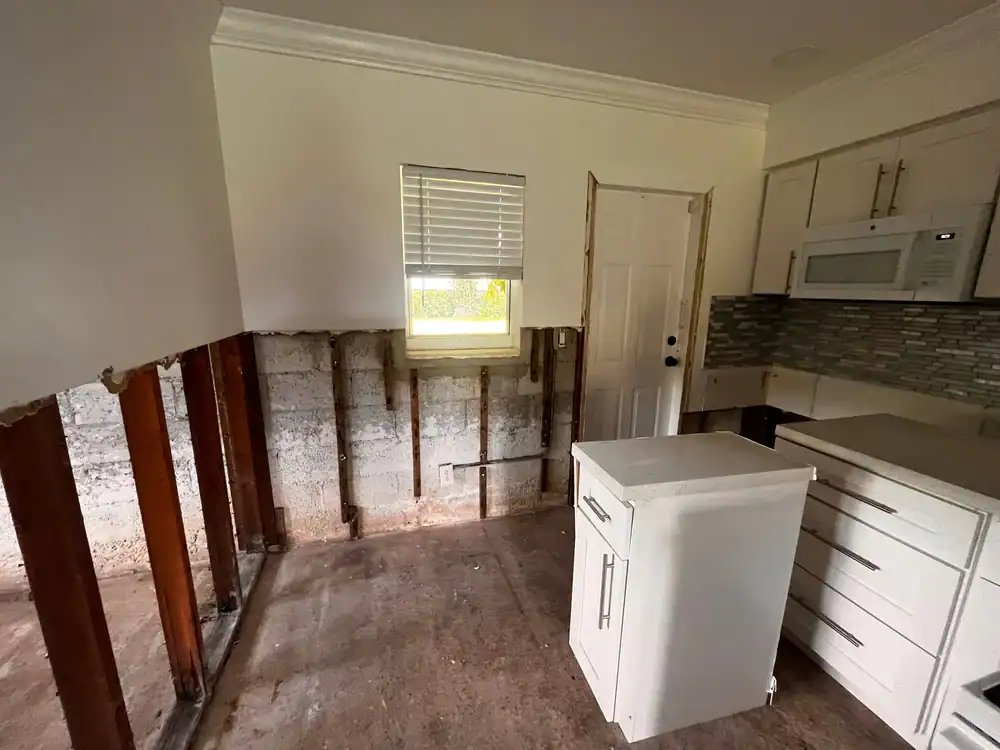
If your kitchen has experienced water damage — a common reality in South Hempstead’s aging housing stock — this is also the right time to address the underlying plumbing while the walls are already open. Restoring to what you had is one option. Upgrading to what you always wanted is another, and the incremental cost when the demo is already done is far less than a standalone remodel later. Whatever the scope, the project closes with full Town of Hempstead permit documentation and a written warranty on labor.
Do I need a permit for a kitchen remodel in South Hempstead, NY?
In most cases, yes — and it depends on what the remodel involves. South Hempstead is an unincorporated hamlet governed by the Town of Hempstead, so all building permits are issued through the Town of Hempstead Building Department. If your kitchen remodel includes electrical upgrades, plumbing relocation, structural wall removal, or HVAC changes, a permit is required. Cosmetic work — like replacing cabinet doors or swapping out a countertop without moving anything — typically doesn’t trigger a permit requirement.
The reason this matters beyond compliance is resale. Nassau County home inspectors routinely flag unpermitted work, and resolving it after the fact can be expensive and complicated. In some cases, it means opening walls back up for retroactive inspection. A licensed contractor who pulls permits correctly from the start protects you from that problem entirely. We handle all required Town of Hempstead permitting as a standard part of every project — it’s included in the scope, not added as a line item surprise.
How much does a kitchen remodel typically cost in South Hempstead?
The range is wide, and it depends heavily on scope. For a targeted kitchen cabinet renovation — new doors, hardware, countertops, and updated fixtures without any structural changes — you’re generally looking at $25,000 to $40,000 in the South Hempstead market. A full gut renovation with layout reconfiguration, new cabinetry, countertops, appliances, flooring, and lighting typically runs $80,000 to $150,000 in Nassau County, where labor and material costs run 20 to 30 percent above the national median.
What drives cost more than anything else is scope creep from surprises inside the walls — and in South Hempstead’s older housing stock, surprises happen. Outdated wiring that needs to be brought up to code, plumbing that hasn’t been touched since the 1960s, or a wall that turns out to be load-bearing when you expected it not to be. A contractor who’s worked extensively in mid-century Nassau County homes will flag these risks during the walkthrough, not after demo day. That upfront honesty is what keeps your project on budget.
My South Hempstead home was built in the 1950s — what does that mean for my remodel?
It means a few things that are worth knowing before you start. First, if your home was built before 1978 — which covers virtually every home in South Hempstead — federal EPA regulations require contractors to use Lead-Safe Certified practices when disturbing painted surfaces during demolition. This isn’t optional, and it’s not just a formality. Lead dust exposure during a kitchen renovation is a real health risk, especially for families with children. We hold current EPA Lead-Safe Certification and follow all required protocols on every job.
Second, homes from this era often have electrical panels and wiring that weren’t designed for modern kitchen loads. Running a dishwasher, refrigerator, microwave, and range on circuits from the 1950s is a code issue and a safety one. A proper kitchen remodel in a South Hempstead home of this age almost always includes an electrical assessment and, in many cases, a panel upgrade. Third, original plumbing from this period may need attention — and if the walls are already open for a remodel, addressing aging supply lines at the same time is far more cost-effective than doing it separately later.
How long will a kitchen remodel take in my South Hempstead home?
For a full kitchen renovation — layout changes, new cabinetry, countertops, flooring, and updated mechanicals — a realistic timeline in South Hempstead is eight to fourteen weeks from project start to final walkthrough. That range accounts for permit processing through the Town of Hempstead Building Department, material lead times (cabinetry in particular can run four to six weeks from order to delivery), and inspection scheduling, which adds time that many contractors don’t build into their initial estimates.
A more targeted kitchen remodel — cabinet renovation, new countertops, and cosmetic updates without structural work — can move considerably faster, sometimes four to six weeks. The honest answer is that the timeline depends on the scope, and any contractor who gives you a firm completion date before they’ve seen your home and reviewed the permit requirements should be questioned on how they arrived at that number. We build timelines that include every phase, so what you’re told at the start of the project is what you can actually plan around.
Should I replace or reface my kitchen cabinets in a South Hempstead home?
It depends on the condition of your cabinet boxes and what you’re trying to accomplish with the overall layout. Refacing — replacing just the doors, drawer fronts, and hardware while keeping the existing cabinet boxes — makes sense when the boxes are structurally sound and you’re happy with the current layout. It’s a meaningful visual upgrade at a lower cost than full replacement, and in South Hempstead’s older homes where the original cabinetry was built with solid materials, the boxes are often worth keeping.
Full cabinet replacement makes more sense when the existing layout isn’t working — when you want to reconfigure storage, extend the cabinet run, or open up the kitchen to an adjacent room. It also makes sense when the boxes themselves are damaged, warped from moisture, or simply too shallow to accommodate modern storage solutions. For most South Hempstead kitchens built in the 1950s and 1960s, the original cabinet depth and configuration reflects a different era of cooking and storage. A full kitchen cabinet remodel gives you the opportunity to design around how you actually use the space today, not how someone in 1958 thought you would.
What's the return on investment for a kitchen remodel in South Hempstead, NY?
Kitchen remodels consistently rank among the highest-ROI home improvements in the Northeast, and South Hempstead’s specific real estate context makes the numbers even more compelling. Minor kitchen remodels in the Northeast return approximately 85 to 96 cents on the dollar at resale, according to Remodeling Magazine’s Cost vs. Value data. In Nassau County, where home values are well above national averages and buyer expectations are high, an updated kitchen directly affects how quickly a home sells and what buyers are willing to offer.
The Rockville Centre School District affiliation is the key local factor here. South Hempstead homeowners chose this community in part because of the school district, and buyers shopping in this district are comparing homes carefully. When two similar homes are available and one has a renovated kitchen with documented permits and updated mechanicals, the difference in buyer interest is not subtle. Beyond resale, there’s the daily quality-of-life return — a kitchen that works for your family, handles your routines, and doesn’t require workarounds every time you cook. In a community where most homeowners plan to stay for years, that return starts the day the project is complete.