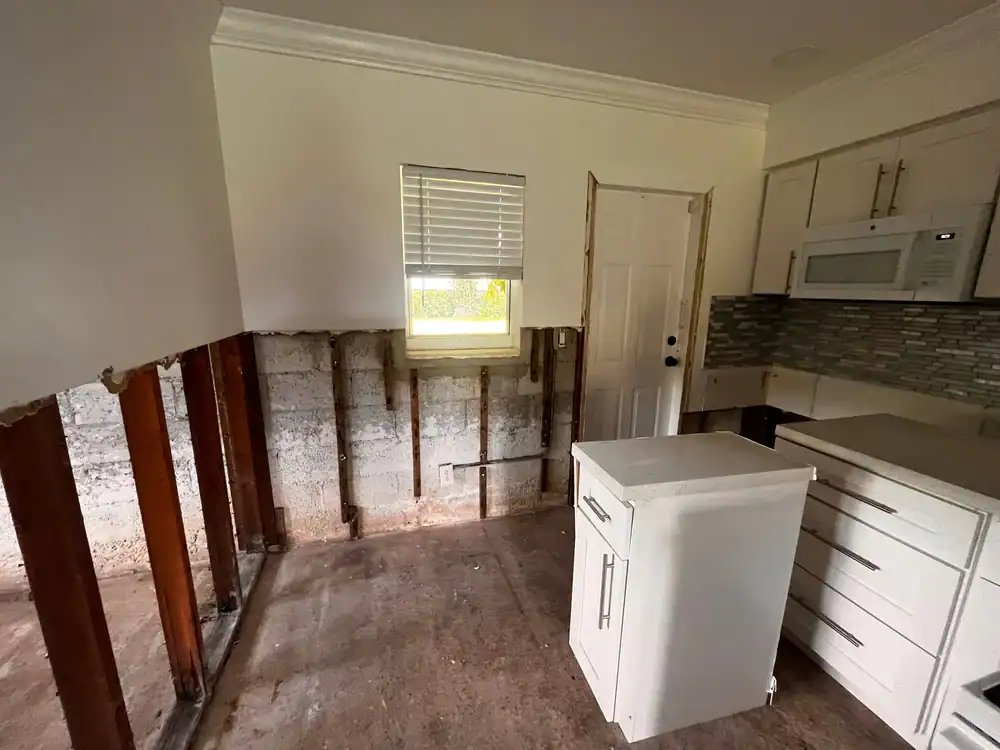
Wainscott homes carry real value and your kitchen should reflect that. We deliver kitchen renovations built for coastal conditions, tight seasonal timelines, and properties that deserve more than a generic remodel.
I needed a professional consultation explanation of procedure for safe removal of Asbestos in my apartment complex. Without having an account yet, I was very impressed with the caring, knowledgeable and generous advice offered by Jessica, and will look forward to doing business in the future. Thank you so much! I feel much more informed about a sometimes scary endeavor. Peace. Nancy Silva Mineola, NY.
Mia Munoz
Used this company to clean up some water flood in my house. They were fast and easy to work with.very professional, Would recommend to anyone!
Nini Valle
Great company, had a flood and they responded quickly and efficiently. Billed my insurance company directly. I highly recommend this company!
joe colapietro, jr
I had pipe freeze in my basement right before a snow storm and they made to within an hour to help start the clean up process. They we by our side throughout the entire process and even helped with the insurance company. They did such a great job with the cleanup, repair, remidiation, I contracted them to perform the repairs and finishes in the basement. They came with enough manpower and material to get the job done. Leo and Jessica were nothing but a pleasure to deal with!!
Cristian Arredondo c
I had some water damage in my home and Green Island was able to take care of my issue quickly and effectively. I am very pleased with the work they did. They responded quickly and were very professional.
Michael M
Outstanding service! From the office to the field crew everyone was friendly, helpful and responsive. I highly recommend Green Island Group.
A Kitchen That Finally Matches the Rest of Your Home
A lot of Wainscott homeowners have put serious money into their properties the landscaping, the outdoor spaces, the living areas and then walk into a kitchen that just doesn’t belong. It’s not falling apart. It just doesn’t fit. That gap is exactly what a well-executed kitchen remodel fixes, and it’s more noticeable in a home at this price point than almost anywhere else.
What you get on the other side of this isn’t just a nicer-looking room. It’s a kitchen that actually works for how you live in Wainscott whether that means a layout built for summer entertaining, storage that makes sense when a full house comes in off Wainscott Beach, or finishes that hold up against the salt air and humidity that come with being this close to the Atlantic. Materials that look great in an inland showroom can warp, corrode, and fail within a few years in a coastal environment. Choosing the right ones from the start is the difference between a kitchen that lasts and one that needs to be redone.
For homeowners thinking about selling, the numbers are hard to ignore. Minor kitchen renovations are returning up to 113% ROI in 2025, and in a market where median sale prices sit around $2.9 to $3.1 million, a dated kitchen can quietly suppress what your property commands. This isn’t a discretionary upgrade it’s a financially sound decision for any home at this level.
12 Years In, 5,000 Projects Deep Across the South Fork
We’ve been working across Suffolk County since 2012. That’s over a decade of navigating Long Island’s housing stock, building departments, and the specific demands of coastal South Fork properties including the seasonal renovation rhythm that anyone working in Wainscott and the surrounding Hamptons knows well. More than 5,000 completed projects across New York State isn’t a marketing number. It’s the kind of track record that tells you a team has seen what can go wrong and knows how to prevent it.
What sets us apart in a market like Wainscott isn’t just construction experience it’s our environmental remediation background. We hold an IICRC certification and full licensing for asbestos abatement, mold remediation, and moisture damage work. When a kitchen demo in a pre-1980 farmhouse off Wainscott Main Street opens a wall and finds something unexpected, the project doesn’t stop. We handle it and keep moving. We’re also M/WBE certified by New York State a credential that requires formal government vetting, not just a self-declaration.
No Surprises Here's What the Process Actually Looks Like
It starts with a real conversation about how you use your kitchen who’s in it, how often, what drives you crazy about the current layout, and what you actually want on the other side of this. From there, the design phase begins, and before any construction starts, you’ll see your finished kitchen in 3D. Every cabinet placement, countertop choice, and layout detail is visible and approved before a single wall comes down. For homeowners managing this from a distance which is common in Wainscott that visualization step removes a huge amount of uncertainty.
Once design is locked, we handle the permit process directly with the Town of East Hampton Building Department. That includes the licensed contractor documentation, the energy compliance paperwork (HERS rating or Res-Check as required under New York State code), and the ¼-inch scale plan sets the town requires. For properties near Georgica Pond, there may also be a Natural Resources Special Permit involved we manage that too. Permit delays are the most common reason Hamptons renovations miss the summer season deadline, and having a contractor who handles this proactively is the most reliable way to avoid it.
Construction follows a defined schedule with clear milestones. If the demo surfaces moisture damage, older insulation materials, or anything else that needs to be addressed before new cabinetry goes in, we handle it in-house no subcontractors, no project stoppage, no timeline reset. The job finishes with a full walkthrough, and you don’t sign off until everything is right.
Kitchen remodeling in Wainscott requires a different level of material thinking than most of Long Island. Salt air accelerates corrosion on metal hardware. Humidity from the Atlantic and from Georgica Pond causes particleboard-core cabinetry to swell and delaminate. Countertop sealants that perform fine in a Nassau County suburb can fail in two seasons here. We spec materials specifically for the coastal South Fork environment solid wood or high-density polymer cabinetry, marine-grade hardware coatings, quartz countertops with strong moisture resistance, and ventilation systems designed to manage the interior humidity that comes with year-round coastal living.
The full scope of what we include covers custom cabinetry design and installation, countertop selection and installation, layout reconfiguration, plumbing and electrical coordination, appliance integration, and finish work throughout. The 3D design process is included from the start not an add-on. Permit management through the East Hampton Town Building Department is handled in full. And because we carry environmental remediation licensing, any discovery during demolition moisture intrusion, hazardous materials, structural issues gets resolved by our team without breaking the project timeline.
Whether you’re converting a summer kitchen into a year-round space, updating an estate property before listing, or starting fresh in a home that’s been in the family for decades, the process is the same: designed specifically for your home, built for the conditions it actually faces, and finished on a schedule that works for how you use this place.
Do I need a permit for a kitchen remodel in Wainscott, NY?
Yes any kitchen remodel in Wainscott that involves structural changes, plumbing modifications, electrical upgrades, or gas line work requires a building permit through the Town of East Hampton Building Department. This is a specific regulatory environment, and the requirements are more detailed than what you’d encounter in most other Long Island municipalities.
The permit application needs to include two sets of ¼-inch scale plans with square footage noted and gross floor area calculations, a signed and notarized licensed contractor declaration, workers’ compensation documentation, and energy compliance paperwork either a HERS rating or a Res-Check under New York State’s Energy Conservation Construction Code. If your property is near Georgica Pond or another natural resource area, a Natural Resources Special Permit from the East Hampton Town Zoning Board of Appeals may also be required on top of the standard building permit. We manage this entire process in-house, which matters a lot if you’re working against a summer season deadline and can’t afford weeks of back-and-forth with the building department.
How much does a kitchen remodel typically cost in the Hamptons?
Renovation costs in the Hamptons run at a level comparable to New York City per square foot so the numbers are higher than what you’d see quoted for inland Long Island or suburban markets. A budget kitchen remodel for a space under 100 square feet starts around $25,000 in this market. Mid-range and high-end full remodels for estate-scale properties scale significantly from there depending on layout changes, material selections, appliance integration, and the scope of any structural or remediation work discovered during demolition.
One thing worth understanding is that labor accounts for 50 to 60 percent of total kitchen remodel costs. That means the efficiency and experience of your contractor directly affects the final number not just the material choices. A team that handles permits, design, construction, and any unexpected discoveries in-house moves faster and with fewer costly interruptions than one that relies on subcontractors for any part of the job. We provide written, itemized estimates before work begins so you know exactly what you’re looking at before anything is committed.
What's the best time of year to remodel a kitchen in Wainscott?
If you want your kitchen finished before the summer season, the renovation needs to start well before it. The Hamptons renovation calendar is a real constraint contractors are in high demand from late spring through Labor Day, scheduling gets compressed, and projects that start in June rarely finish before August. The approach that works consistently is starting the design process in the fall, executing construction through the winter months when contractor schedules are more open, and targeting a completion date in April or early May.
For seasonal homeowners managing a renovation from a distance, the winter window is actually ideal the property is unoccupied, there’s no disruption to summer use, and the finished kitchen is ready when you arrive for the season. For year-round residents in Wainscott, winter construction means the disruption happens during the quieter months rather than cutting into the time you actually want to use the space. Our process is built around defined milestones and proactive permit management specifically because timeline reliability is what matters most in a market with this kind of seasonal pressure.
What kitchen materials hold up best in a coastal home near the ocean?
Salt air and Atlantic humidity are hard on kitchen materials that were never designed with coastal exposure in mind. The most common failures are metal hardware corroding faster than expected, particleboard-core cabinetry swelling and delaminating at the joints, and natural stone countertops losing their sealant integrity within a season or two. These aren’t worst-case scenarios they’re predictable outcomes when inland material specs get applied to a home that faces the ocean or sits adjacent to Georgica Pond in Wainscott.
The materials that perform well in Wainscott’s environment are solid wood or high-density polymer cabinetry rather than particleboard-core construction, stainless steel hardware with marine-grade protective coatings, and quartz countertops which resist moisture penetration better than most natural stone options. Ventilation matters too a properly designed exhaust and ventilation system manages interior humidity at the source rather than letting it accumulate behind cabinetry and inside walls. Getting the material spec right at the design stage is far less expensive than replacing components a few years in because the original choices weren’t built for where you actually live.
What happens if something unexpected is found during kitchen demolition?
It’s more common than most homeowners expect especially in Wainscott, where the housing stock ranges from historic farmhouses that have been standing since the 1800s to mid-century estates that have absorbed decades of Atlantic coastal weather. Opening a kitchen wall during demo can surface moisture intrusion, older insulation materials that require licensed handling, or structural conditions that need to be addressed before new cabinetry can go in. In most cases, a standard kitchen remodeler has to stop the project at that point, bring in a separate remediation contractor, wait for that work to be completed, and then restart construction which can add weeks to the timeline and significant unplanned cost.
We hold full licensing for asbestos abatement, mold remediation, and moisture damage work, and our team handles whatever is found in the wall. The timeline stays intact, there’s no coordination gap between contractors, and there’s no moment where your project is sitting idle waiting for a subcontractor to show up. For a Wainscott homeowner working against a summer season deadline, that in-house capability is a meaningful protection.
How long does a kitchen remodel take from start to finish in Wainscott?
The honest answer depends on the scope of the project, but a realistic timeline for a full kitchen remodel in Wainscott from initial design through construction and final inspection typically runs between eight and fourteen weeks once permits are approved. The design and permitting phase usually takes three to five weeks on its own, which is why starting early matters so much in this market. The Town of East Hampton Building Department has specific documentation requirements, and any back-and-forth during the permit review process adds time that most homeowners don’t account for when they’re setting expectations.
Actual construction on a standard full kitchen remodel runs four to eight weeks depending on the complexity of the layout changes, the scope of any plumbing or electrical work, and whether anything unexpected surfaces during demolition. Projects that involve structural reconfiguration, custom cabinetry with longer fabrication lead times, or remediation work discovered mid-demo will run toward the longer end of that range. We build a project schedule with specific milestones before construction begins, manage the permit process proactively to avoid administrative delays, and communicate clearly throughout so if something shifts, you know about it before it becomes a problem rather than after.