Wantagh Kitchens Built for South Shore Homes and Real Life
Most kitchens in Wantagh were designed for a different era. We build them for the one you’re actually living in—start to finish, no handoffs, no surprises.
I needed a professional consultation explanation of procedure for safe removal of Asbestos in my apartment complex. Without having an account yet, I was very impressed with the caring, knowledgeable and generous advice offered by Jessica, and will look forward to doing business in the future. Thank you so much! I feel much more informed about a sometimes scary endeavor. Peace. Nancy Silva Mineola, NY.
Mia Munoz
Used this company to clean up some water flood in my house. They were fast and easy to work with.very professional, Would recommend to anyone!
Nini Valle
Great company, had a flood and they responded quickly and efficiently. Billed my insurance company directly. I highly recommend this company!
joe colapietro, jr
I had pipe freeze in my basement right before a snow storm and they made to within an hour to help start the clean up process. They we by our side throughout the entire process and even helped with the insurance company. They did such a great job with the cleanup, repair, remidiation, I contracted them to perform the repairs and finishes in the basement. They came with enough manpower and material to get the job done. Leo and Jessica were nothing but a pleasure to deal with!!
Cristian Arredondo c
I had some water damage in my home and Green Island was able to take care of my issue quickly and effectively. I am very pleased with the work they did. They responded quickly and were very professional.
Michael M
Outstanding service! From the office to the field crew everyone was friendly, helpful and responsive. I highly recommend Green Island Group.
When your Wantagh home is worth close to a million dollars and you’re paying over $10,000 a year in property taxes, the kitchen isn’t just a room—it’s a significant part of what makes that investment hold its value. A well-executed kitchen renovation in Nassau County returns roughly 85 to 96 cents on the dollar at resale. That’s not a guess; it’s what the numbers consistently show for the Northeast market. So the question isn’t really whether you can afford to renovate. It’s whether you can afford not to.
Wantagh’s housing stock tells a specific story. Most homes here were built between the 1950s and 1970s—Cape Cods, split-levels, ranch homes that were solid when they went up but weren’t designed for the way families cook, work, and gather today. Add the reality of South Shore living—the salt air off the water, the elevated humidity that comes with being minutes from Jones Beach, the coastal moisture that quietly wears down cabinet finishes and hardware over time—and you’ve got kitchens that age faster than their inland counterparts and need more thoughtful material choices when it’s time to replace them.
The 17.5% of Wantagh residents now working from home spend more time in their kitchens than ever before. A layout that barely functioned when you left at 7 AM and came back at 7 PM becomes genuinely frustrating when you’re home all day. Getting it right isn’t about aesthetics. It’s about daily quality of life in a home you’ve invested heavily in and plan to stay in.
We’re a full-service renovation contractor serving Wantagh and the surrounding South Shore communities—including Seaford, Bellmore, and the rest of Nassau County. What that means in practice is that your kitchen remodel doesn’t get handed off between separate companies for demolition, cabinets, plumbing, and electrical. One team handles all of it, under one contract, with one person you can actually call when you have a question.
In a community like Wantagh—where neighbors talk, where families have lived on the same blocks for two and three generations—reputation is everything. We know that. Every project we take on here is a direct reflection of our name in this community, and we treat it that way.
We’re also familiar with what South Shore homes actually require: the Town of Hempstead permitting process, the specific material considerations for coastal environments, and the older housing stock that makes up most of Wantagh’s neighborhoods. That local knowledge isn’t incidental—it’s what keeps your project on track and your home protected.
No Guesswork—Here's Exactly How Your Remodel Moves
It starts with a conversation, not a sales pitch. We come to your Wantagh home, look at the actual space, and talk through what’s working, what isn’t, and what you want it to become. From there, we put together a detailed written scope of work and a line-item proposal—so you know exactly what’s included, what it costs, and what the timeline looks like before anyone picks up a tool.
Once you’re ready to move forward, we handle the Town of Hempstead building permit process on your behalf. Any kitchen remodel involving electrical upgrades, plumbing changes, or structural modifications requires a permit from the Town of Hempstead Building Department—and navigating that correctly matters. Skipped permits create real problems at resale, especially in a market as active as Wantagh’s, where homes are moving in an average of 20 days. We’ve done this enough times in this jurisdiction to know the process, the timelines, and what inspectors are looking for at each stage.
Construction follows a clear sequence: demolition, rough work (electrical, plumbing, structural), inspections, installation, and finish work. You’ll know what’s happening each week. If your home was built before 1978—which describes the majority of Wantagh’s housing stock—we follow all EPA Lead-Safe protocols required by federal law during renovation. Payment is tied to completion milestones, not calendar dates. The final installment doesn’t come due until we’ve done a formal walkthrough and resolved every item on the punch list together.
Full Kitchen Remodels Built for Nassau County Homes
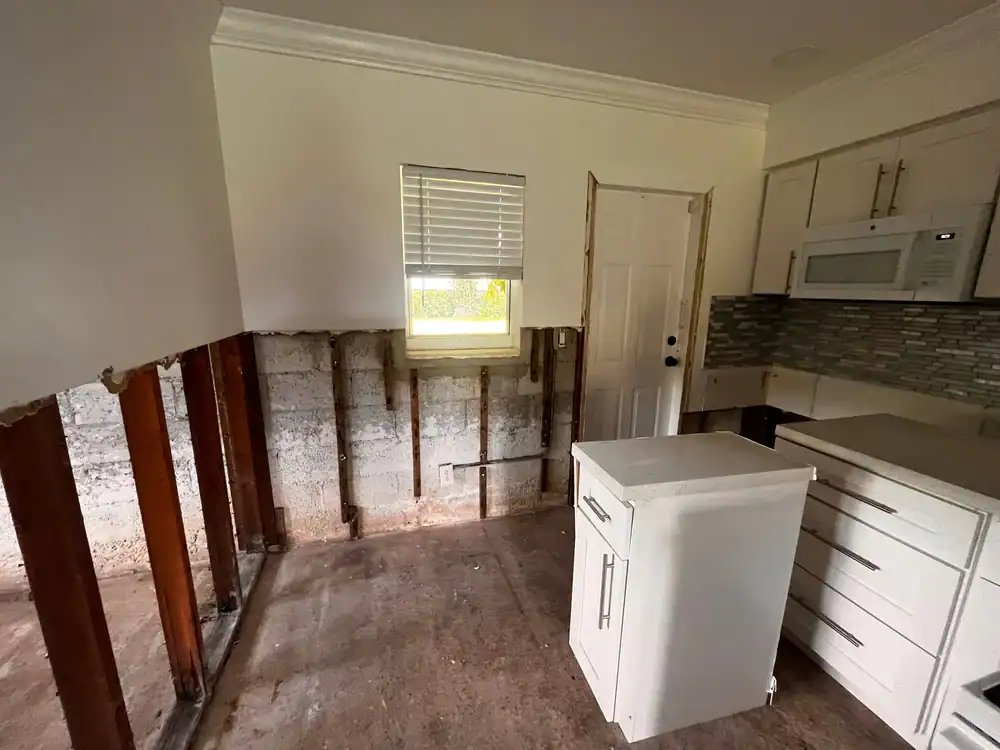
A kitchen remodel with us covers everything from layout reconfiguration to the final coat of paint—cabinets, countertops, flooring, lighting, electrical, plumbing, and all the finish work in between. If your Wantagh kitchen is a cramped galley that hasn’t been touched since the 1970s, we can open it up. If you’ve had water intrusion from a storm event—like the August 2024 flooding that hit Nassau County hard—we can take the damage as a starting point and rebuild it better than it was.
For South Shore homes specifically, material selection matters more than most homeowners realize. Salt air and coastal humidity accelerate the breakdown of standard cabinet finishes, hardware, and caulking. We spec materials with that environment in mind—finishes built to hold up, hardware that won’t corrode, countertop options that don’t demand constant maintenance under elevated moisture conditions. This isn’t an upsell. It’s just what makes sense for a home in Wantagh.
Whether you’re doing a full gut renovation—which in Nassau County typically runs $50,000 to $120,000 depending on scope—or a more focused cabinet and countertop update in the $20,000 to $45,000 range, the process is the same: detailed scope, transparent pricing, one accountable team, and a written warranty on labor when we’re done. We’re registered with the Nassau County Department of Consumer Affairs as a home improvement contractor, and we carry full general liability and workers’ compensation coverage. A Certificate of Insurance is available before you sign anything.
Do I need a permit for a kitchen remodel in Wantagh, NY?
Yes, in most cases. Wantagh is an unincorporated hamlet within the Town of Hempstead, so building permits are issued by the Town of Hempstead Building Department—not a village or city office. If your kitchen remodel involves any electrical upgrades, plumbing relocation, structural changes, or HVAC modifications, a permit is required. Cosmetic-only updates like painting or replacing hardware typically don’t trigger a permit, but the moment you’re moving a wall, adding recessed lighting, or relocating a sink, you’re in permit territory.
This matters more than people sometimes realize. Nassau County has one of the most active real estate markets in the state, and unpermitted work is a genuine liability when you go to sell. Buyers’ attorneys flag it, home inspectors flag it, and it can delay or derail a closing. We handle the Town of Hempstead permit process on your behalf—application, plan review coordination, and scheduling inspections at each required stage. You don’t have to manage that process yourself.
How much does a kitchen remodel cost in Wantagh, NY?
The honest answer is that it depends on scope, but here’s a realistic range for Nassau County: a full gut renovation—new layout, cabinets, countertops, flooring, electrical, and plumbing—typically runs between $50,000 and $120,000. A more focused update centered on cabinets and countertops, without moving walls or relocating plumbing, generally falls in the $20,000 to $45,000 range. Nassau County labor and material costs run 25 to 40 percent above national averages, so national cost guides will consistently underestimate what you’re actually looking at here.
What drives the number up or down is mostly layout complexity, material selections, and whether the existing infrastructure needs to be brought up to current code. Older Wantagh homes—particularly those built in the 1950s and 1960s—sometimes have electrical panels or plumbing configurations that need to be updated as part of the renovation. That’s not a surprise we spring on you mid-project. It’s something we identify during the initial walkthrough and factor into the proposal before work begins.
How long does a kitchen remodel take for a South Shore Long Island home?
For a full kitchen renovation, you’re typically looking at six to ten weeks from the start of demolition to final walkthrough—but that clock doesn’t start on day one of the conversation. Material lead times, Town of Hempstead permit processing, and inspection scheduling all happen before a single cabinet goes in, and contractors who don’t account for those steps in their timeline estimates are setting you up for frustration.
In Wantagh specifically, summer can actually be a practical time to renovate. Many families are spending time at Jones Beach or Wantagh State Park, which makes it easier to manage without a fully functional kitchen for a few weeks. Fall tends to be the busiest period because homeowners want their kitchens finished before the holiday season. If you’re thinking about a fall completion, the time to start the planning and permitting process is late summer—not October. We build realistic timelines from the first conversation and communicate clearly about where things stand each week.
What should I look for when hiring a kitchen remodel contractor in Nassau County?
Start with the basics: Nassau County requires home improvement contractors to be registered with the Nassau County Department of Consumer Affairs. That registration is verifiable, and any contractor who can’t provide their registration number on request isn’t legally authorized to do the work. Beyond that, ask for a current Certificate of Insurance showing general liability and workers’ compensation coverage. In New York, a contractor without workers’ comp exposes you—the homeowner—to liability if someone gets hurt on your property.
After the credentials check out, pay attention to how they handle the estimate. A contractor who gives you a number without walking the space, reviewing the existing plumbing and electrical, and putting together a written scope of work is not giving you a real estimate—they’re giving you a number designed to win the job. The low bid that balloons through change orders is the most common remodeling complaint in Nassau County. A detailed, line-item proposal tied to a clear scope of work is what separates a legitimate contractor from one who’s going to cost you more in the long run.
My Wantagh home had water damage—can a kitchen remodel be part of the restoration?
Yes, and it’s often the smartest time to do it. When a storm event, coastal flooding, or plumbing failure damages your kitchen, the insurance restoration process typically puts things back the way they were—not the way you wished they’d been. But with walls already open and materials already being replaced, the incremental cost of upgrading your layout, your cabinets, or your countertops is significantly lower than it would be in a standalone renovation.
Wantagh’s South Shore location makes this more relevant than it would be for an inland community. The August 2024 flash flooding that hit Nassau County caused real damage to homes throughout the area, and the state specifically made recovery funds available for Nassau homeowners. Governor Hochul also announced a $9.5 million investment in drainage improvements along the Wantagh State Parkway corridor—an acknowledgment that flooding risk here is ongoing, not a one-time event. If your kitchen took water damage and you’re already going through the restoration process, it’s worth a conversation about what an upgrade path looks like while the work is already underway.
Is a kitchen renovation worth it before selling a home in Wantagh, NY?
In most cases, yes—but the specifics matter. Wantagh’s median home sale price reached $913,000 as of mid-2025, and homes here are moving fast, averaging about 20 days on market. In that environment, a kitchen that’s visibly dated can push buyers toward lower offers or cause them to move on entirely when there are other well-maintained options available. A kitchen renovation in the Northeast returns roughly 85 to 96 cents on the dollar at resale, which makes it one of the stronger pre-sale investments you can make on a high-value property.
That said, the return depends on doing it right. An over-customized renovation that doesn’t match the neighborhood’s price point won’t recoup the same way a clean, well-executed update will. The goal before a sale is usually a kitchen that reads as modern, functional, and move-in ready—not a showpiece that prices itself out of the market. We can walk you through what makes sense for your specific home and what buyers in Wantagh are actually responding to, so you’re spending where it counts and not over-investing where it won’t move the needle.