When water gets into a home worth close to a million dollars, the last thing you need is a franchise crew that’s never set foot in Nassau County. We respond fast, work thoroughly, and know exactly what’s at stake in Garden City’s pre-war Colonials and mid-century homes.
I needed a professional consultation explanation of procedure for safe removal of Asbestos in my apartment complex. Without having an account yet, I was very impressed with the caring, knowledgeable and generous advice offered by Jessica, and will look forward to doing business in the future. Thank you so much! I feel much more informed about a sometimes scary endeavor. Peace. Nancy Silva Mineola, NY.
Mia Munoz
Used this company to clean up some water flood in my house. They were fast and easy to work with.very professional, Would recommend to anyone!
Nini Valle
Great company, had a flood and they responded quickly and efficiently. Billed my insurance company directly. I highly recommend this company!
joe colapietro, jr
I had pipe freeze in my basement right before a snow storm and they made to within an hour to help start the clean up process. They we by our side throughout the entire process and even helped with the insurance company. They did such a great job with the cleanup, repair, remidiation, I contracted them to perform the repairs and finishes in the basement. They came with enough manpower and material to get the job done. Leo and Jessica were nothing but a pleasure to deal with!!
Cristian Arredondo c
I had some water damage in my home and Green Island was able to take care of my issue quickly and effectively. I am very pleased with the work they did. They responded quickly and were very professional.
Michael M
Outstanding service! From the office to the field crew everyone was friendly, helpful and responsive. I highly recommend Green Island Group.
Water damage doesn’t stay where you can see it. It moves into wall cavities, under original hardwood floors, and behind plaster that’s been on those walls for a hundred years. In Garden City’s older homes — especially in the pre-war Colonials and Tudors near Cathedral Avenue — moisture hides in places that look fine on the surface and feel dry to the touch. That’s where mold starts. And once it does, you’re dealing with a much bigger problem than you started with.
When restoration is done correctly, you get more than a dry room. You get documented proof that the moisture is actually gone — not just visually, but measured. You get walls, floors, and structural materials that were dried to the standard your insurance company will stand behind. You get a home that’s safe for your family, not just signed off on.
For Garden City homeowners specifically, that matters in a way it might not somewhere else. The Hempstead Plain’s shallow water table means groundwater rises fast during heavy rain events, and older homes without modern waterproofing systems absorb that moisture deep into their foundations and framing. Getting it out completely — not mostly, not visually — is the only outcome worth paying for.
We are a locally owned and operated restoration company serving Garden City and Nassau County. When you call, you’re not routed through a national dispatch system. You’re talking to someone who knows this area, knows how to reach you, and can have a crew moving in your direction fast.
That matters more than most people realize until they’re standing in a flooded basement at midnight. National franchises will take your call — but what you get on the other end is a centralized intake system, subcontracted crews, and inconsistent results depending on which location picks up. We don’t work that way.
We’ve worked across Garden City’s full range of housing stock — from post-war split-levels near Adelphi University to historic homes with original plaster walls and wood framing that require a completely different approach to drying. If your home is off Stewart Avenue, near the A.T. Stewart Era Historic District, or anywhere else in the village, we know what we’re walking into before we arrive.
From First Call to Final Reading — Here's the Process
The first thing that happens when you call is simple: we pick up. From there, we get a crew moving toward Garden City while we gather the basic details — what happened, how long the water has been there, and what type of space is affected. That timeline matters because mold can begin developing within 24 to 48 hours, and in a home with original plaster and old-growth wood framing, it spreads faster and hides deeper than it would in a newer build.
When we arrive, we start with a full assessment using moisture meters and thermal imaging cameras. This is how we find the water you can’t see — inside walls, under flooring, in ceiling assemblies. In Garden City’s older homes, this step isn’t optional. A surface inspection alone will miss the damage that causes real problems later.
From there, we set up industrial extraction and drying equipment calibrated to the specific materials in your home. We monitor moisture readings throughout the process and don’t call the job complete until the numbers confirm it — not when the equipment has been running for a set number of days, and not when things look dry. If your home requires reconstruction work after the drying is complete, we handle the permit filing with the Village of Garden City Building Department so that process doesn’t fall on you.
Every job starts with a full moisture assessment — thermal imaging, moisture mapping, and a clear picture of where the damage actually is versus where it appears to be. For Garden City homes, this often means looking beyond the obvious. A finished basement that took on water during a nor’easter may look manageable on the surface, but the framing behind the drywall, the subfloor, and the insulation tell a different story.
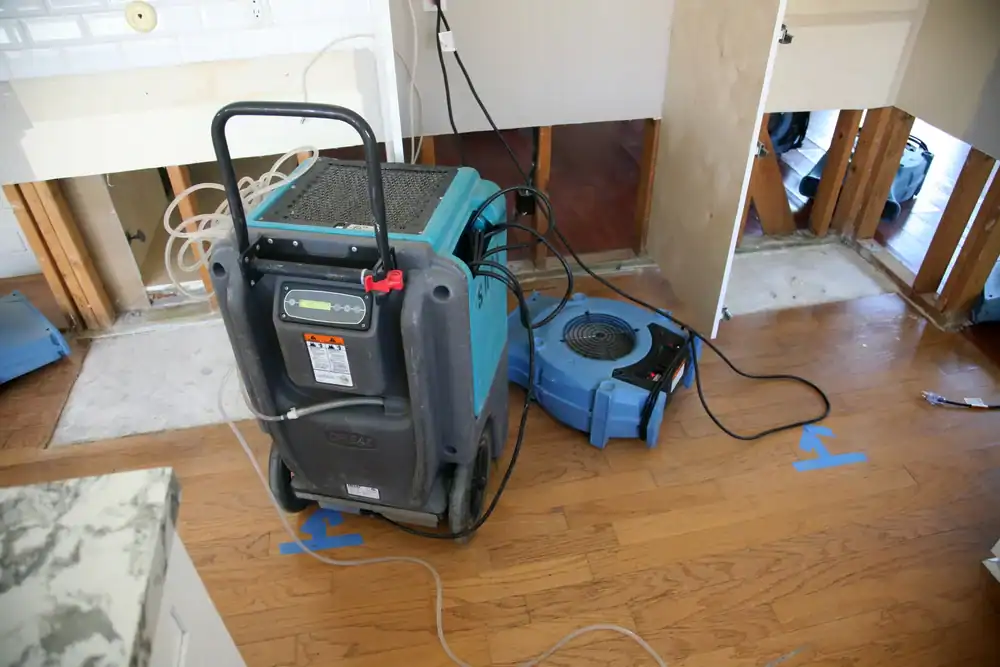
Water extraction comes next, followed by industrial drying equipment — desiccant dehumidifiers and directed air movers that pull moisture out of structural assemblies, not just off surfaces. We also handle mold testing and remediation when needed, and we are fully licensed under New York State’s Mold Law, which requires a separate state-issued license that many operators in Nassau County simply don’t carry. Unlicensed mold work is illegal in New York State and can affect your insurance coverage, so this isn’t a minor detail.
Throughout the process, we document everything for your insurance claim — photos, moisture readings, equipment logs, and a full record of the scope of damage. We work directly with all major carriers and can handle billing on your behalf. For homeowners protecting a property worth close to a million dollars in Garden City, thorough documentation isn’t just helpful — it’s the difference between a claim that covers the full scope of the job and one that doesn’t.
How quickly can we reach a home in Garden City, NY?
Response time depends on when you call and where our nearest crew is positioned, but as a Nassau County-based company, we can reach Garden City significantly faster than a franchise routing calls through a national system. Garden City is accessible via Stewart Avenue and Old Country Road, and we’re familiar with the village’s layout — we’re not navigating it for the first time when we show up at your door.
In a water damage situation, speed is directly tied to outcome. The longer water sits in contact with plaster, wood framing, and original flooring materials, the deeper it penetrates and the harder it becomes to fully extract. Mold can begin developing within 24 to 48 hours, and in Garden City’s older homes, that window closes faster than most homeowners expect. Call us immediately — don’t wait to see if it dries on its own, because in most cases, it won’t.
Does homeowners insurance cover water damage restoration in Garden City, NY?
Most standard homeowners insurance policies cover sudden and accidental water damage — a burst pipe, a washing machine overflow, an appliance failure. What they typically don’t cover is gradual damage that developed over time, or flooding from an external water source like rising groundwater, which requires separate flood insurance. Garden City’s shallow water table and flat terrain mean that during heavy rainfall, groundwater intrusion is a real possibility, and that distinction in your policy matters.
The best thing you can do before your adjuster arrives is have a professional document the damage thoroughly. We photograph everything, log moisture readings, and create a complete record of the scope of damage from the moment we arrive. That documentation is what supports a full claim payout rather than a partial one. We work directly with all major carriers and handle the billing process on your behalf, so you’re not managing that on top of everything else.
Can water damage affect the historic plaster walls in older Garden City homes?
Yes — and it affects them differently than it would modern drywall construction. Original plaster walls, which are common in Garden City’s pre-war homes and in the Victorian-era properties in the A.T. Stewart Era Historic District, are significantly more porous than modern materials. They absorb moisture deeply, they take longer to dry, and they can harbor mold growth inside the wall assembly while the surface still appears intact.
The other issue is that plaster is irreplaceable in the way drywall isn’t. If a plaster wall is damaged beyond repair and simply replaced with drywall, you’ve lost historic fabric that cannot be restored — and in some cases, that work may not comply with the Village of Garden City’s architectural review standards for properties in or adjacent to the historic district. Proper drying of original plaster requires a calibrated approach, not the same protocol used on a 1990s split-level. We adjust our drying strategy based on what’s actually in your walls.
Do I need a permit for water damage repairs in Garden City Village?
If the work goes beyond water extraction and drying — meaning any reconstruction of damaged walls, flooring, or structural elements — then yes, a permit is required. Garden City is an incorporated village with its own Building Department, and its permit requirements are separate from Nassau County’s general framework. That means a contractor who pulls permits in other Nassau County towns but doesn’t account for the village’s specific process may leave you with unpermitted work, which creates problems when you sell or if the work is ever inspected.
We handle the permit filing with the Village of Garden City Building Department as part of the restoration process. For homeowners in the historic sections of the village, there’s an additional layer: the Architecture Design Review process may apply to exterior work or to reconstruction that affects the character of historic properties. We’re familiar with these requirements and factor them in from the start, so nothing gets missed on the back end.
What causes most basement flooding in Garden City during heavy rain?
The most common cause is a combination of Garden City’s flat terrain and shallow water table. The Hempstead Plain doesn’t drain quickly — when a nor’easter or heavy summer storm drops several inches of rain over a short period, the ground saturates fast and groundwater rises. Sump pumps that are working fine under normal conditions can be overwhelmed, and if there’s a power outage during the storm — which happens regularly on Long Island during major weather events — the pump stops entirely at exactly the wrong moment.
Older homes compound the problem. Many of Garden City’s pre-war and mid-century homes lack modern waterproofing membranes, and their foundation walls and floor drains weren’t built to handle the kind of rainfall intensity that’s become more common in recent years. If your basement has flooded before, it’s worth having a conversation about what actually happened structurally — not just cleaning it up and hoping the next storm misses you.
How do I know if there's mold after water damage in my Garden City home?
You often don’t — at least not right away. Mold doesn’t always present as visible growth on a surface. In Garden City’s older homes, where wall cavities may contain original wood lath, horsehair insulation, and plaster that absorbed water during a flood event, mold can establish itself inside the wall assembly and remain invisible for weeks. By the time you see discoloration or smell something musty, the growth is typically well established.
The reliable way to know is professional testing after any significant water event. We use moisture mapping and can identify areas where conditions are favorable for mold growth based on residual moisture readings — before visible mold appears. If remediation is needed, we’re fully licensed under New York State’s 2016 Mold Law, which requires a separate state-issued mold remediation contractor license. That license isn’t optional under state law, and working with a company that doesn’t carry it can affect your insurance coverage and leave you without legal recourse if something goes wrong.