When water gets into a Greeley Square building, you’re not dealing with a simple cleanup you’re dealing with aging pipes, shared walls, and materials that were installed before your grandparents were born. We respond fast and handle the full scope.
I needed a professional consultation explanation of procedure for safe removal of Asbestos in my apartment complex. Without having an account yet, I was very impressed with the caring, knowledgeable and generous advice offered by Jessica, and will look forward to doing business in the future. Thank you so much! I feel much more informed about a sometimes scary endeavor. Peace. Nancy Silva Mineola, NY.
Mia Munoz
Used this company to clean up some water flood in my house. They were fast and easy to work with.very professional, Would recommend to anyone!
Nini Valle
Great company, had a flood and they responded quickly and efficiently. Billed my insurance company directly. I highly recommend this company!
joe colapietro, jr
I had pipe freeze in my basement right before a snow storm and they made to within an hour to help start the clean up process. They we by our side throughout the entire process and even helped with the insurance company. They did such a great job with the cleanup, repair, remidiation, I contracted them to perform the repairs and finishes in the basement. They came with enough manpower and material to get the job done. Leo and Jessica were nothing but a pleasure to deal with!!
Cristian Arredondo c
I had some water damage in my home and Green Island was able to take care of my issue quickly and effectively. I am very pleased with the work they did. They responded quickly and were very professional.
Michael M
Outstanding service! From the office to the field crew everyone was friendly, helpful and responsive. I highly recommend Green Island Group.
The visible water is only part of the problem. In buildings like the ones surrounding Greeley Square structures from the 1910s and 1920s with cast iron pipes, steam heating systems, and layers of original construction water travels through pathways you can’t see. It moves behind plaster walls, under century-old flooring, and into mechanical spaces that were never designed to be dried out quickly. If the moisture isn’t fully mapped and documented, mold starts within 24 to 48 hours.
When the job is done right, you get more than dry walls. You get a written moisture log that satisfies your insurance carrier, documentation that protects you from HPD or DOB violations down the line, and a building that isn’t quietly growing a mold problem behind the drywall. For property managers overseeing multi-tenant commercial spaces near Herald Square or in the surrounding Koreatown area, that paper trail isn’t optional it’s what keeps you out of a compliance conversation you don’t want to have.
The Midtown South rezoning is also bringing residential tenants into buildings that have only ever housed commercial occupants. New plumbing hookups in old structures mean new failure points. Whether you’re managing a conversion project or responding to a burst pipe at 2 a.m., the outcome you need is the same: the water is gone, the building is dry, and you have the documentation to prove it.
We are a New York-based environmental and restoration company serving residential, commercial, and public-sector clients across New York City and Long Island. The buildings around Greeley Square including the 1927 Greeley Square Building on Sixth Avenue and the surrounding Garment District loft structures are exactly the kind of properties we work in regularly. Pre-1980 construction. Known asbestos. Known lead. Plumbing systems that have been patched and re-patched for decades.
We hold the NYC General Contractor license, NYC BIC Trade Waste certification, NYS DOL Mold license, NYS DOL Asbestos license, USEPA Lead certification, and USEPA RRP certification. That’s not a list we put on our website to sound impressive it’s the actual stack of credentials required to legally complete a water damage job in a covered NYC building without creating regulatory exposure for you. When a water event disturbs asbestos pipe wrap or triggers a mold assessment requirement under Local Law 61, we don’t stop work and refer you out. We handle it.
When you call, we move. Customers have confirmed arrival within two hours and in a commercial building near Penn Station or the 34th Street corridor, two hours can be the difference between a contained water event and a mold remediation job that shuts down a tenant space for weeks.
The first thing we do on-site is assess the full scope, not just what’s visible. We use industrial moisture meters and thermal imaging to map where the water actually traveled inside wall cavities, under flooring, into ceiling assemblies above and below the affected floor. In a multi-story building with shared plumbing stacks, water rarely stays where it started. That mapping drives every decision we make from that point forward.
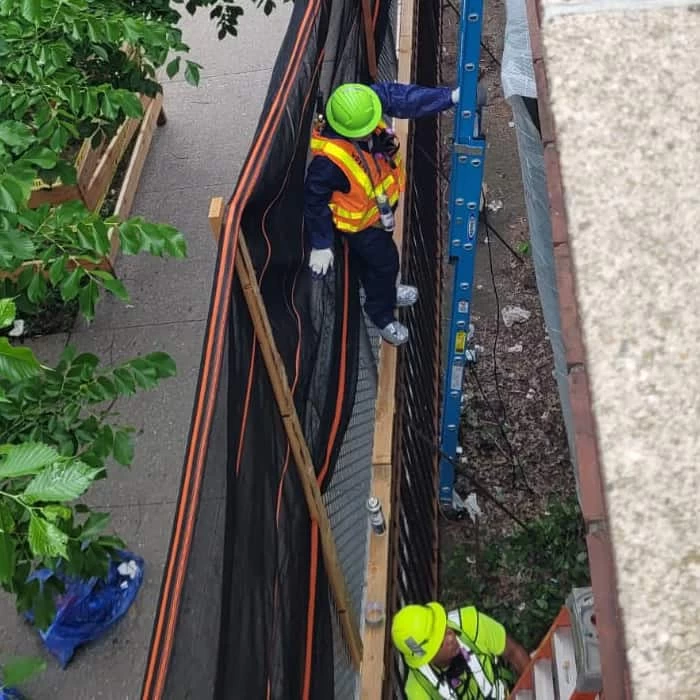
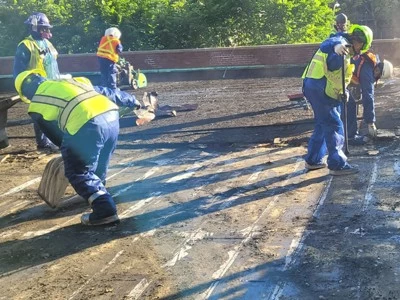
From there, we set up commercial-grade drying equipment and begin structured drying in accordance with IICRC S500 standards. Every moisture reading is logged and dated. If the assessment reveals asbestos-containing materials which is common in any pre-1980 Midtown building we handle abatement under our NYS DOL Asbestos license before restoration continues. No subcontracting. No gap in the timeline. We also coordinate directly with your insurance carrier, providing the Xactimate documentation and progress records they need to process the claim without unnecessary back-and-forth. When the building is dry and verified, you get a complete written record of the entire process.
Water Restoration and Mold Remediation in Greeley Square
One Contractor for Every Layer This Building Has
Water damage in a Greeley Square building rarely comes alone. A burst pipe in a 1920s commercial loft can mean saturated plaster, wet pipe insulation that contains asbestos, lead paint failure on structural elements, and mold risk in wall cavities all from a single event. Most restoration companies can handle the water. Far fewer can legally handle everything that comes with it in a covered New York City building.
Our water damage restoration service covers extraction and emergency water removal, industrial drying and dehumidification, full moisture mapping with written documentation, mold assessment coordination and remediation under our NYS DOL Mold license, asbestos abatement under our NYS DOL Asbestos license when disturbed materials are present, and complete insurance documentation from start to finish. We also hold the NYC BIC Trade Waste certification, which is required to legally remove water-damaged materials from Manhattan buildings something a surprising number of contractors operating in this area don’t have.
For property managers handling multi-tenant buildings between the Garment District and Koreatown, or hospitality operators managing aging hotel infrastructure near Penn Station, the ability to hand one contractor the full scope water, mold, asbestos, lead, waste removal, insurance coordination isn’t a convenience. It’s the only way to keep the timeline intact and the compliance record clean.
Does my building in Greeley Square need a licensed contractor for mold after water damage?
Yes, and the requirement is more specific than most people realize. Under NYC Local Law 61 and Administrative Code Section 24-154, any mold remediation covering more than 10 square feet in a covered building which includes virtually every multi-unit residential and commercial property in Manhattan must be performed by a contractor holding a valid NYS DOL Mold Remediation license. There’s an additional requirement that often catches building owners off guard: the company doing the mold assessment and the company doing the remediation must be two separate entities. You can’t hire one contractor to assess and remediate their own findings.
Property managers in Greeley Square who hire unlicensed contractors to handle post-water-damage mold don’t just risk a bad cleanup they risk HPD violations, DOB violations, and ECB fines, plus potential legal exposure from tenants. We hold the NYS DOL Mold license and work with independent assessors to keep your project fully compliant from the start.
How quickly does mold actually start growing after a water damage event?
Mold can begin germinating within 24 to 48 hours of water exposure under the right conditions and in Manhattan buildings, those conditions are almost always present. Older construction materials like plaster, wood framing, and original insulation absorb moisture quickly and hold it. When you add in the limited airflow common in interior commercial spaces, mold doesn’t need much time to get started.
This is why the response window matters as much as the quality of the work. A water event that gets professional extraction and drying started within a few hours is a very different job than one that sits untreated over a weekend. If you’re managing a building near Herald Square or in the surrounding Midtown South area and you’re not sure whether water damage has already created a mold condition, a professional moisture assessment not just a visual check is the only way to know for certain.
What does water damage restoration actually cost in a Manhattan commercial building?
The honest answer is that it depends heavily on the source, the scope, and what the water disturbed on its way through the building. A straightforward extraction and dry-out in a single commercial space might run a few thousand dollars. A water main break that floods a basement mechanical room, saturates asbestos pipe insulation, and affects multiple floors like the documented break at 1270 Broadway near 33rd Street is a significantly larger project involving abatement, structural drying, and full documentation.
What most commercial property owners in this area don’t realize is that sudden and accidental water damage is typically covered under commercial property insurance policies, which substantially reduces the out-of-pocket exposure. The more important cost question is usually about documentation: a poorly documented restoration job that leaves hidden moisture behind will produce a mold remediation bill months later that dwarfs the original restoration cost. Doing it right the first time with full moisture mapping and written drying logs is where the real cost savings come from.
Can Green Island Group handle water damage in a building that also has asbestos or lead paint?
Yes, and in Greeley Square specifically, this comes up on almost every job in older buildings. Any building constructed before 1980 which covers virtually every structure in the immediate area, including the 1927 Greeley Square Building and the surrounding Garment District lofts is likely to contain asbestos-containing materials and lead paint. When water damage disturbs those materials, standard restoration work has to stop until abatement is completed. For most restoration contractors, that means calling in a separate subcontractor, which adds days to the timeline and creates gaps in the compliance record.
We hold both the NYS DOL Asbestos license and USEPA Lead certification, so when a water event exposes asbestos pipe insulation or causes lead paint failure, we handle abatement in-house and continue the restoration without interruption. That single-contractor continuity matters a lot when you’re managing tenant schedules, insurance timelines, and a building that needs to get back to operational status as quickly as possible.
What's the difference between water extraction and full water damage restoration?
Water extraction is the first step removing standing water with pumps and wet vacuums. It’s necessary, but it’s not the job. Full water damage restoration includes extraction, but it also includes structural drying, moisture mapping, documentation of drying progress over time, and assessment of secondary damage like mold risk and material deterioration. The IICRC S500 standard the industry benchmark for professional water damage restoration requires documented moisture readings throughout the drying process, not just visual confirmation that the floor looks dry.
In a dense commercial building in Midtown Manhattan, the gap between extraction and true restoration is where problems hide. Water that gets extracted from the surface but left to sit inside wall assemblies, under flooring, or in ceiling cavities above a lower floor will cause mold and structural damage that doesn’t show up for weeks. By then, the original contractor is long gone and the building owner is facing a much larger remediation bill. Full restoration means the job isn’t done until the moisture readings confirm it and that confirmation is in writing.
Does water damage from a burst pipe or water main break get covered by insurance in NYC?
Sudden and accidental water damage burst pipes, appliance failures, water main breaks that flood your building is typically covered under standard commercial property insurance policies. What often isn’t covered is gradual damage: a slow leak that’s been seeping behind a wall for months, or a drainage issue that was never addressed. The distinction matters because insurance adjusters will look at the documentation of how and when the damage occurred.
For commercial properties in Greeley Square, the documented water main break near 33rd Street and Broadway is a good example of the kind of event that would typically trigger coverage sudden, external, and clearly not the result of deferred maintenance. The key to a successful claim is documentation: timestamped moisture readings, photos of affected areas, and a written scope of work that aligns with what the carrier’s adjuster needs to see. We manage the insurance documentation process as part of every job, which means your claim is supported by the kind of evidence that moves through the process without unnecessary disputes or delays.