Estate-Level Restoration for Matinecock's Most Complex Homes
When water gets into a Gold Coast estate, the stakes are different. Green Island Group brings certified water damage restoration to Matinecock, NY — with the expertise your property actually demands.
I needed a professional consultation explanation of procedure for safe removal of Asbestos in my apartment complex. Without having an account yet, I was very impressed with the caring, knowledgeable and generous advice offered by Jessica, and will look forward to doing business in the future. Thank you so much! I feel much more informed about a sometimes scary endeavor. Peace. Nancy Silva Mineola, NY.
Mia Munoz
Used this company to clean up some water flood in my house. They were fast and easy to work with.very professional, Would recommend to anyone!
Nini Valle
Great company, had a flood and they responded quickly and efficiently. Billed my insurance company directly. I highly recommend this company!
joe colapietro, jr
I had pipe freeze in my basement right before a snow storm and they made to within an hour to help start the clean up process. They we by our side throughout the entire process and even helped with the insurance company. They did such a great job with the cleanup, repair, remidiation, I contracted them to perform the repairs and finishes in the basement. They came with enough manpower and material to get the job done. Leo and Jessica were nothing but a pleasure to deal with!!
Cristian Arredondo c
I had some water damage in my home and Green Island was able to take care of my issue quickly and effectively. I am very pleased with the work they did. They responded quickly and were very professional.
Michael M
Outstanding service! From the office to the field crew everyone was friendly, helpful and responsive. I highly recommend Green Island Group.
Most homeowners in Matinecock don’t discover water damage during a flood. They find it weeks later — a soft spot in the floor, a smell that won’t go away, a stain that keeps coming back. That’s because the homes here weren’t built yesterday. Older estate construction means thick plaster walls, original hardwood floors, and crawl spaces that hold moisture long after the surface looks fine. Water doesn’t just sit on top — it moves through materials, follows gravity, and settles into places you can’t see without the right equipment.
When water damage is addressed correctly, you’re not just drying out a room. You’re stopping a chain reaction. Mold can begin growing inside wall cavities within 24 to 48 hours of water intrusion — and in a home with aging plumbing and wooded lot drainage, it often starts where no one’s looking. Getting ahead of it means your floors stay intact, your walls don’t have to be rebuilt, and your insurance claim holds up under scrutiny.
Matinecock’s wooded terrain and large lot sizes also create drainage patterns that work against you after heavy rain. The North Shore’s nor’easters and the kind of flash flooding Nassau County saw in August 2024 can overwhelm even well-maintained estate properties. When restoration is done right, you’re not just recovering from what happened — you’re walking away with a clear picture of your home’s condition, documentation your insurance carrier will accept, and the confidence that nothing was left behind.
Water Restoration Companies Serving Matinecock, NY
Long Island-Based, Not Franchised From Somewhere Else
Green Island Group is a Long Island-based water damage restoration company — not a national franchise routing your call through a distant dispatch center. When you reach us, you’re reaching a team that actually works in Nassau County and knows Matinecock’s estate properties intimately. We’ve restored homes throughout the North Shore communities surrounding Matinecock, including the estate villages along Duck Pond Road and Oyster Bay Road.
That matters more than it sounds. A lot of the companies showing up in your search results for Matinecock are either franchise operations with no real local presence or Suffolk County-based operators who can’t honestly deliver on a 30-minute response time to this village. We can — because this is our service area, not a territory we’re stretching to cover.
We’re IICRC certified, fully licensed under New York State’s mold laws, and we work directly with all major insurance carriers. Every job gets a named project manager, consistent crew, and documentation that meets the standard your adjuster will expect on a property of this value.
No Guesswork — Here's Exactly How We Restore Your Home
The first thing we do when we arrive is assess the full scope of what you’re dealing with — not just the visible damage, but what’s happening inside the walls, beneath the flooring, and in any adjacent structures on your property. On a Matinecock estate, that might mean checking a carriage house, a lower-level utility space, or areas near the property’s natural drainage corridors. We use thermal imaging cameras and calibrated moisture meters to find water that eyes can’t catch. This step is what separates a real restoration from a surface fix that fails three months later.
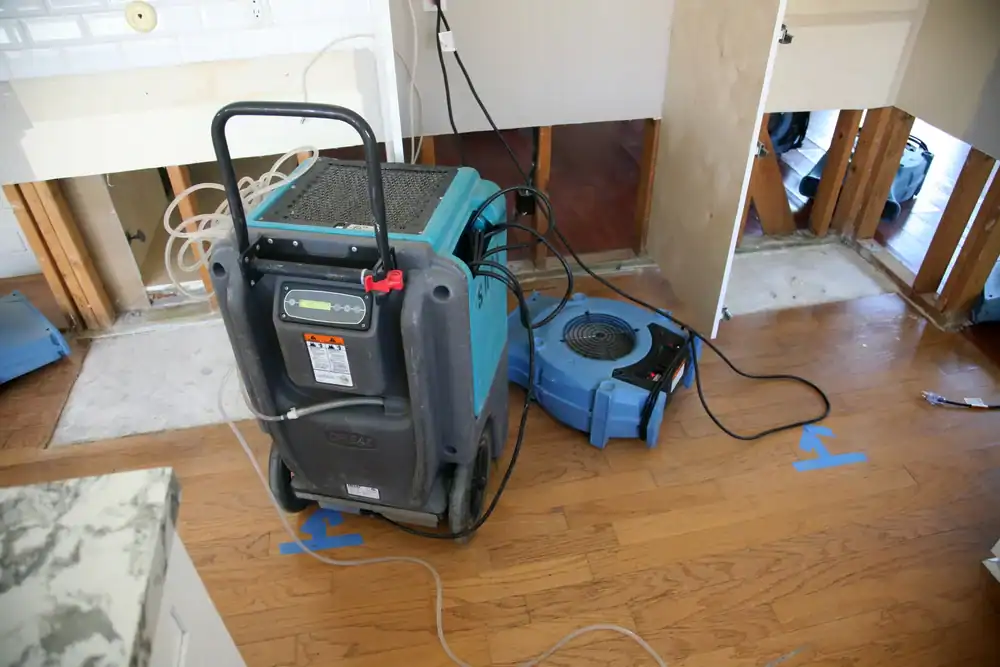
Once we know the full picture, we extract standing water and deploy industrial-grade drying equipment — desiccant dehumidifiers and high-velocity air movers that pull moisture out of structural assemblies, not just the air in the room. Consumer dehumidifiers don’t reach inside wall cavities or beneath subfloor systems. Ours do. We also assess whether any affected areas fall within 100 feet of a freshwater wetland boundary, which is relevant on many Matinecock lots and can affect both the restoration approach and permit requirements under the village’s own municipal code.
Drying is validated with moisture readings — we don’t call a job complete because it looks dry. We call it complete when the numbers confirm it. From there, we handle the documentation your insurance carrier needs, communicate directly with your adjuster, and walk you through what was found, what was done, and what the final condition of your home is. No mystery, no surprises.
Water Restoration Services for Matinecock, NY Homes
Built for Homes Where Getting It Wrong Isn't an Option
Water damage restoration in Matinecock isn’t a one-size situation. These are large, older homes — many built in the early to mid-twentieth century during the Gold Coast era — with plaster walls, original millwork, antique hardwood floors, and architectural details that can’t be sourced from a big-box store. The way you approach drying and restoration in a home like this is fundamentally different from how you’d handle a 1980s colonial in a standard subdivision. We know the difference, and it shows in how we work.
Every job includes full moisture mapping of the affected area, thermal imaging, water extraction, structural drying, and clearance documentation that meets IICRC S500 standards — the same benchmark your insurance company uses to evaluate whether restoration was done correctly. If mold is present or at risk of developing, we handle assessment and remediation under our New York State mold licenses, which is a legal requirement that many smaller operators in Nassau County simply don’t meet.
We also handle the insurance side completely. For a high-value claim on a Matinecock estate — where finishes are expensive, materials are often period-specific, and the square footage involved can be significant — having someone who knows how to document and present that claim makes a real difference in what you recover. We work with all major carriers and communicate directly with adjusters so you don’t have to manage that process on top of everything else.
How quickly can you respond to a water damage emergency in Matinecock, NY?
We respond 24 hours a day, seven days a week, and we dispatch from within Nassau County — not from Suffolk County or through a national call center. That distinction matters when you’re on Duck Pond Road at 2 a.m. with a burst pipe. Several competitors appearing in Matinecock search results use 631 area codes, which means they’re based in Suffolk County and can’t honestly promise the same response time to a North Shore Nassau County address that we can.
When you call, you reach someone who can actually dispatch a crew to your property — not someone reading from a script who then routes your call to a third-party franchise. Response time in water damage situations directly affects cost and outcome. Every hour water sits in a structure, it moves further into materials, raises the risk of mold colonization, and increases what restoration will ultimately require. Getting someone on-site fast isn’t just a selling point — it’s the most important variable in how well this goes for you.
Will my homeowners insurance cover water damage restoration in Matinecock?
Most standard homeowners insurance policies cover sudden and accidental water damage — a burst pipe, an appliance failure, a roof leak from a storm. What they typically don’t cover is damage that resulted from long-term neglect or a gradual leak that went unaddressed. That distinction matters in Matinecock, where older estate plumbing can develop slow leaks inside walls that go unnoticed for weeks. The sooner damage is documented and reported, the stronger your coverage position.
We work with all major insurance carriers and handle the documentation process from start to finish. On a high-value Matinecock property, that means photographing and cataloging high-end finishes, period-appropriate materials, and structural details in a way that supports a full and accurate settlement — not a lowball offer based on generic replacement costs. We communicate directly with your adjuster and make sure the claim reflects the actual cost of restoring your home to its pre-damage condition. You don’t have to manage that conversation while also managing a disrupted household.
What are the signs of hidden water damage in an older North Shore estate home?
In a home built in the early to mid-twentieth century — which describes much of Matinecock’s housing stock — hidden water damage tends to show up in specific ways. A persistent musty smell in a basement or lower level, soft or slightly springy spots in hardwood floors, paint or plaster that’s bubbling or separating from the wall, and unexplained increases in your water bill are all worth taking seriously. These homes were built with thick plaster walls and complex structural configurations that can hold moisture for a long time before it becomes visible.
The challenge with older construction is that the materials are dense and the cavities are deep. Water that enters through a foundation crack, a failed pipe fitting, or a slow roof leak can travel significant distances before it shows up anywhere you’d notice. Thermal imaging is the most reliable way to find it — it detects temperature differentials caused by moisture inside wall assemblies and beneath flooring without requiring demolition. If something feels off in your home and you can’t identify the source, that’s worth a professional assessment before it becomes a much larger problem.
Does water damage restoration in Matinecock require any village permits or approvals?
It depends on the scope of the work. Water extraction, drying, and non-structural restoration typically don’t require a building permit. But if restoration involves structural repairs — replacing framing, significant wall reconstruction, or any work near a freshwater wetland boundary — the Village of Matinecock has specific requirements that apply. The village’s municipal code regulates freshwater wetlands and requires a village wetlands permit for any work within 100 feet of a wetland boundary, which is relevant on many of the large estate lots throughout Matinecock given the North Shore’s natural drainage landscape.
The village also has a permit fee schedule for construction work that reflects the high-value nature of building in this community — minimum construction costs are set at $250 per square foot for single-family dwelling work. If your restoration crosses into structural repair territory, we’ll identify that early and make sure the work is permitted correctly. Operating without required permits on a Matinecock property isn’t just a code issue — it can create complications with your insurance claim and with any future sale of the property.
How do I know when water damage restoration is actually complete?
The honest answer is that visual inspection isn’t enough — and any company that tells you otherwise is cutting corners. Surfaces can look and feel completely dry while moisture remains trapped inside wall assemblies, beneath subfloor systems, or within the thick plaster and masonry construction common in Matinecock’s older estate homes. That trapped moisture is what leads to mold growth, structural degradation, and callbacks months after a “completed” restoration.
We validate every drying job with calibrated moisture meter readings taken at multiple points throughout the affected area. We don’t issue a completion sign-off until those readings confirm that all materials have returned to acceptable moisture levels — which the IICRC S500 standard defines specifically, and which your insurance carrier will reference if the claim is ever questioned. You’ll receive documentation showing the before and after readings, the drying timeline, and the equipment used. That paper trail protects you, supports your claim, and gives you a clear record of your home’s condition after the work is done.
What makes water damage worse in Matinecock compared to other Long Island towns?
A few things converge in Matinecock that don’t apply the same way in most other Long Island communities. The housing stock is significantly older — estate homes built in the early twentieth century with original or partially-updated plumbing systems, galvanized pipes that corrode from the inside out over decades, and complex configurations across multiple structures on a single property. A pipe failure in a carriage house or guest cottage can go undetected far longer than it would in a smaller, simpler home. By the time it’s found, the damage can be extensive.
The terrain adds another layer. Matinecock’s wooded, rolling North Shore landscape creates drainage patterns that direct stormwater toward foundations during heavy rain events — and the village’s own municipal code acknowledges that improper drainage leads to flooding on adjacent properties. Many estate lots also sit near or include freshwater wetlands, which keeps groundwater levels elevated after prolonged rain and puts chronic pressure on basement walls and sump systems. Add the age of the construction and the scale of the properties, and you have conditions where water damage moves faster, spreads further, and hides more effectively than in a standard suburban home elsewhere on Long Island.