When a Pipe Bursts on the Sixth Floor, Every Unit Below Pays for It
Water damage in a Washington Heights apartment building doesn’t stay in one unit. We respond fast with every NYC license required to finish the job legally and completely.
I needed a professional consultation explanation of procedure for safe removal of Asbestos in my apartment complex. Without having an account yet, I was very impressed with the caring, knowledgeable and generous advice offered by Jessica, and will look forward to doing business in the future. Thank you so much! I feel much more informed about a sometimes scary endeavor. Peace. Nancy Silva Mineola, NY.
Mia Munoz
Used this company to clean up some water flood in my house. They were fast and easy to work with.very professional, Would recommend to anyone!
Nini Valle
Great company, had a flood and they responded quickly and efficiently. Billed my insurance company directly. I highly recommend this company!
joe colapietro, jr
I had pipe freeze in my basement right before a snow storm and they made to within an hour to help start the clean up process. They we by our side throughout the entire process and even helped with the insurance company. They did such a great job with the cleanup, repair, remidiation, I contracted them to perform the repairs and finishes in the basement. They came with enough manpower and material to get the job done. Leo and Jessica were nothing but a pleasure to deal with!!
Cristian Arredondo c
I had some water damage in my home and Green Island was able to take care of my issue quickly and effectively. I am very pleased with the work they did. They responded quickly and were very professional.
Michael M
Outstanding service! From the office to the field crew everyone was friendly, helpful and responsive. I highly recommend Green Island Group.
Dry Walls Don't Tell the Whole Story in Pre-War Buildings Around Washington Bridge
In a modern drywall home, water damage is bad enough. In the pre-war plaster construction that defines most buildings in Washington Heights and Morris Heights near the Washington Bridge, it’s a different problem entirely. Water doesn’t just sit on the surface it absorbs deep into the plaster substrate, into the masonry behind it, and into the floor structure below. By the time a wall looks dry, the moisture has already moved somewhere you can’t see. That’s where mold starts, and in buildings this old, mold rarely comes alone.
The buildings near the Washington Bridge were built between 1900 and 1940. That means steam heating systems, cast iron pipes, and materials that almost certainly contain asbestos or lead paint. When water damage disturbs those materials and it almost always does you’re not just dealing with a restoration job. You’re dealing with a legally regulated hazmat situation that most restoration companies aren’t licensed to handle. They stop work, refer out, and leave your building exposed while the clock keeps running.
When the job is done right, you get more than dry walls. You get a building that’s been properly assessed, legally remediated, and documented in a way that holds up to HPD review and insurance scrutiny. That’s the difference between a closed claim and a reopened problem six months from now.
Licensed Water Restoration Companies in Washington Bridge
One Company That Can Actually Finish the Job in Washington Bridge
We are a New York-based environmental and restoration contractor not a franchise, not an out-of-market company figuring out NYC on the fly. We hold the full license stack required to perform water damage restoration legally in New York City: NYC General Contractor, NYC BIC Trade Waste, NYS DOL Mold, NYS DOL Asbestos, USEPA Lead, and USEPA RRP certifications. Every one of those credentials matters in a neighborhood like Washington Heights near the Washington Bridge, where the building stock makes encountering asbestos or lead paint a near-certainty, not a remote possibility.
We serve both sides of the Washington Bridge Washington Heights in Manhattan and Morris Heights in the Bronx without jurisdictional gaps or referral delays. When a building owner on Amsterdam Avenue or University Avenue calls at 2 AM, we’re already familiar with what these buildings look like, how they’re built, and what NYC requires before, during, and after restoration work begins. That’s not something you get from a national brand dispatching a crew from outside the borough.
Water Damage Restoration Service Near Washington Bridge
What Actually Happens From Your First Call to a Finished Building
The first call triggers a 24/7 response. A technician is typically on-site within two hours which matters enormously in a six-story walk-up where a failed steam riser or burst pipe is actively moving water through every ceiling below it. The first priority is stopping the source and extracting standing water before it reaches the next floor down or saturates structural materials beyond recovery.
From there, we map moisture using professional detection equipment not a visual inspection, not a guess. In Washington Heights buildings, this step is critical because plaster walls and masonry construction hold moisture in ways that standard consumer tools miss entirely. Once the full moisture picture is clear, industrial-grade drying equipment goes in: high-capacity dehumidifiers and air movers sized for the actual square footage, not a one-size-fits-all setup.
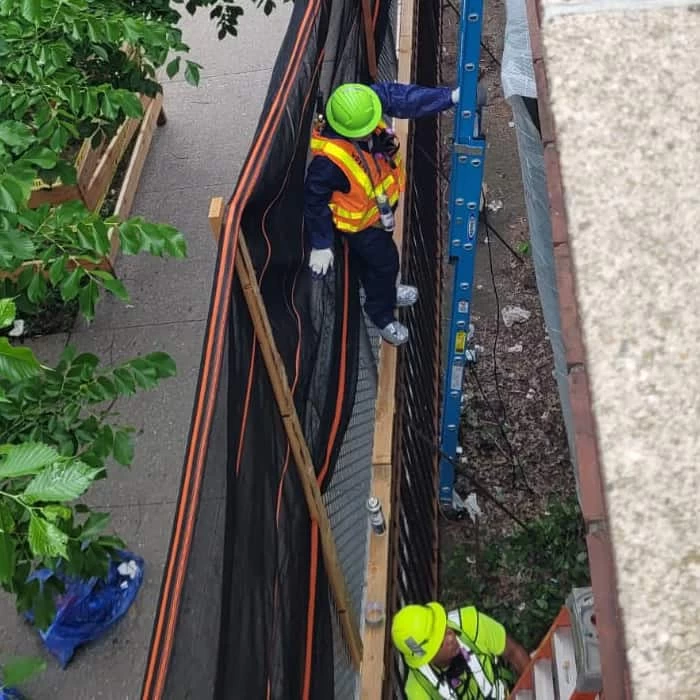
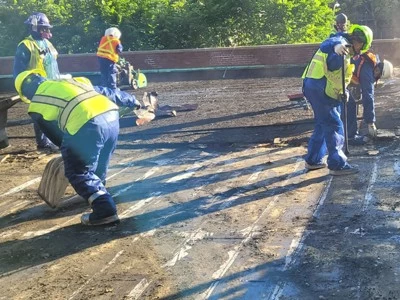
Before any demolition or material removal begins, we conduct the asbestos assessment required by NYC DOB for any building constructed before April 1, 1987 which covers nearly every residential building in this neighborhood. If asbestos or lead-containing materials are present, we handle abatement in-house under our NYS DOL and USEPA licenses, without stopping work and waiting for a separate contractor. The job moves from water extraction through drying, abatement if needed, mold remediation, and reconstruction under one roof, with documentation prepared for both your insurance carrier and any HPD review.
Water Restoration Service Near Washington Bridge, NY
Built for NYC Buildings Not Suburban Single-Family Homes
Most water damage restoration companies are designed around single-family homes. The work we do near Washington Bridge is fundamentally different. Multi-family apartment buildings in Washington Heights and Morris Heights mean multiple affected units, multiple tenants, multiple insurance policies, and HPD oversight all at the same time. The restoration process here requires building-wide coordination, not just a single-unit dry-out.
Every job includes water extraction and structural drying with industrial equipment, moisture mapping across all affected units and floors, asbestos assessment in compliance with NYC DOB requirements, mold remediation under NYS DOL Mold licensure, lead-safe work practices under USEPA RRP certification, debris removal under NYC BIC Trade Waste licensure, and insurance documentation prepared to carrier standards. For building owners managing rent-stabilized properties, we also understand the HPD notification and violation landscape so the documentation we produce isn’t just for the insurance claim. It’s the kind of paperwork that protects you if a tenant files a complaint or an inspector shows up.
If reconstruction is needed after remediation drywall, plaster repair, flooring, structural work that’s handled under the same NYC General Contractor license, by our team, without handing the project off to someone else.
Does water damage restoration in Washington Bridge require an asbestos inspection first?
In most cases, yes. New York City DOB regulations require an asbestos assessment documented on an ACP-5 form before any renovation or demolition work begins in buildings constructed before April 1, 1987. The overwhelming majority of residential buildings in Washington Heights and Morris Heights near the Washington Bridge were built before 1950, which means this requirement applies to almost every water damage job in the area. This isn’t a formality. Pipe insulation, floor tiles, ceiling materials, and joint compounds in buildings of this era routinely contain asbestos, and water damage almost always disturbs those materials during the drying and demolition phase.
A contractor who isn’t licensed for asbestos work under NYS DOL requirements has to stop the job when asbestos is found and it will be found. That means your building sits partially open while you wait for a separate abatement company to schedule, mobilize, and complete their work. We hold the NYS DOL Asbestos license and handle assessment and abatement in-house, so the job keeps moving without gaps or handoffs.
How fast does mold actually grow after a pipe bursts in an apartment building near Washington Bridge?
Mold can begin growing within 24 to 48 hours of water exposure and in the pre-war plaster construction common throughout Washington Heights near the Washington Bridge, that window is even more unforgiving. Plaster walls absorb and retain moisture differently than modern drywall. Water moves deep into the substrate and into the masonry behind it, creating hidden moisture pockets that stay wet long after the surface feels dry. Those hidden pockets are exactly where mold colonizes first, and by the time it’s visible, it’s already been growing for days.
In a multi-family building, this compounds fast. A pipe failure on the fifth floor doesn’t just threaten that unit it creates moisture conditions across every floor below it, multiplying the mold risk across multiple households simultaneously. The only way to get ahead of it is professional moisture mapping and industrial drying equipment deployed within the first few hours. Consumer fans and box dehumidifiers don’t move enough air volume to dry out a plaster wall in a pre-war building. They buy time, but they don’t solve the problem.
My landlord isn't responding to the water damage in my Washington Heights apartment. What can I do?
You have real options. In New York City, landlords are legally required to maintain buildings in good repair, and water damage especially if it’s creating mold conditions is a serious housing maintenance violation under the NYC Housing Maintenance Code. You can file a complaint directly with HPD (the Department of Housing Preservation and Development) online or by calling 311, and an inspector can be dispatched to document the conditions and issue a violation against the building owner.
From a practical standpoint, documenting the damage thoroughly and immediately is in your best interest. Photographs with timestamps, written communication to your landlord (email or text so there’s a record), and a professional assessment of the damage all strengthen your position whether you’re dealing with an HPD complaint, a renter’s insurance claim, or a future dispute over habitability. We can assess and document water damage in your unit in a way that holds up to HPD and insurance review, regardless of whether your landlord has authorized the full restoration yet.
What NYC licenses should a water damage restoration company have before I hire them?
This is one of the most important questions you can ask, and most people don’t ask it until something goes wrong. In New York City, a water damage restoration contractor needs an NYC General Contractor license to perform renovation and repair work legally. They need an NYC BIC Trade Waste license to remove and dispose of construction debris. If mold is present and it almost always is after water damage in an older building they need a NYS DOL Mold Remediation license. If asbestos-containing materials are disturbed, they need a NYS DOL Asbestos license. And if the building was constructed before 1978, USEPA Lead and RRP certifications are required for any work that disturbs painted surfaces.
In Washington Heights and Morris Heights, where virtually every residential building predates 1960, all of these credentials are relevant on nearly every job. A company that holds only one or two of them will hit a wall mid-project and either stop work or proceed without the required license both of which create problems for you as the building owner or tenant. We hold every credential listed above, and they’re all verifiable.
Can water damage restoration be done in an occupied apartment building near Washington Bridge?
Yes, and it’s done regularly in Washington Heights and Morris Heights because the alternative displacing tenants from a rent-stabilized building creates its own legal and financial complications. The process requires careful coordination: establishing contained work zones to limit dust and debris exposure, scheduling access with individual tenants, maintaining building egress and fire safety compliance throughout the job, and communicating clearly with everyone affected.
In a building where multiple units are impacted by the same water event, this coordination becomes more complex. Each affected unit may have its own insurance policy, its own timeline expectations, and its own level of damage. A restoration company that’s only worked in single-family homes often struggles with this environment. We have experience managing multi-unit, occupied building restoration jobs the kind of work that requires as much organizational competence as technical skill. The goal is always to minimize disruption while moving fast enough to stay ahead of mold growth across all affected floors.
Does homeowner or renter's insurance cover water damage restoration in a New York City apartment?
It depends on the source of the water and who holds which policy. Generally speaking, sudden and accidental water damage a burst pipe, a failed appliance, an overflowing tub in the unit above yours is covered under most standard homeowner and renter’s insurance policies. Gradual leaks or maintenance-related failures that the owner knew about and ignored are typically excluded. In a multi-family building in Washington Heights, the question of who pays can get complicated quickly: the building owner’s policy, the affected tenant’s renter’s insurance, and potentially the tenant in the unit where the leak originated may all be involved simultaneously.
The most important thing you can do immediately after a water event is document everything before any cleanup begins. Photographs, moisture readings, and a professional written assessment create the paper trail that insurance adjusters need to process a claim fully. Incomplete documentation is the most common reason claims get reduced or disputed. We document water damage from the first hour of response in a format that supports full claims across multiple policies which matters a lot when you’re dealing with a building-wide event that affects several households at once.