Summary:
Most people who find mold in their basement do the same thing: they wipe it down, hope it’s nothing, and move on. Sometimes it stays gone. More often, it comes back — and by the time it does, it’s usually spread further than what’s visible on the surface.
If you’re in Nassau County and your basement has a persistent musty smell, dark spots creeping along the walls, or a family member who can’t seem to shake a cough or sinus issue, there’s a real chance mold is the reason. Understanding what you’re dealing with — and when it crosses the line from nuisance to health hazard — can make a significant difference for your household.
What Are the Real Health Risks of Basement Mold?
Mold produces allergens, irritants, and in certain species, toxic substances called mycotoxins. You don’t have to be allergic to mold to be affected by it — prolonged exposure can cause symptoms in people who’ve never had an allergic reaction in their lives.
The most common symptoms are respiratory: nasal congestion, coughing, wheezing, and throat irritation. Eye and skin irritation are also common. For people with asthma or existing respiratory conditions, those symptoms can escalate quickly. Research published in the International Journal of Hygiene and Environmental Health found that nearly 11% of children in mold-exposed homes developed asthma, compared to 7% in mold-free homes — a gap that’s hard to ignore if you have kids at home.
What most people don’t realize is that basement mold doesn’t stay in the basement. Air naturally rises through a home — a phenomenon called the stack effect — carrying mold spores upward through stairwells, HVAC systems, and gaps in flooring. The air your family breathes in the living room and bedrooms is directly affected by what’s happening two floors below.
Mold on Basement Ceilings: Why That Location Makes the Health Risk Worse
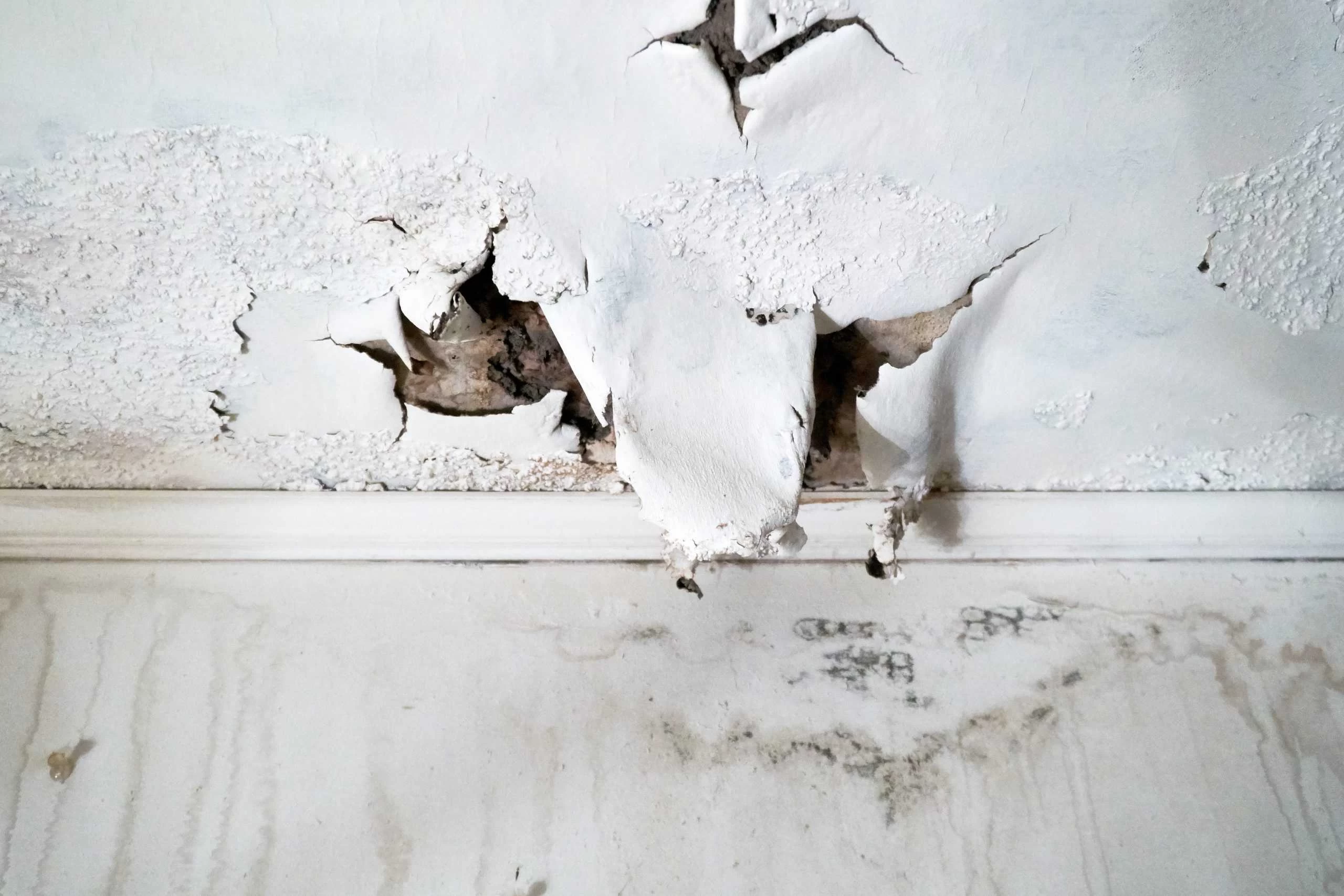
If the mold in your basement is on the ceiling rather than the walls or floor, that detail matters. Ceiling mold typically points to moisture coming from above — a slow plumbing leak, condensation from poorly insulated pipes, or moisture migrating through the subfloor from the living space above. It also means spores are releasing directly into the air at head height, in a space where people walk through, do laundry, or store belongings.
Mold on ceiling surfaces in a basement tends to go unnoticed longer than wall mold, especially in finished basements where ceiling tiles or drywall conceal what’s happening behind them. By the time it’s visible, the growth behind the surface is often significantly more advanced than what you can see.
From a health standpoint, mold on ceiling areas is particularly concerning for anyone who spends time in the basement — kids playing, someone working from home in a finished lower level, or a family member using a basement bedroom. The exposure is more direct and more sustained than it would be from mold tucked behind a wall panel.
Certain mold species that commonly appear on basement ceilings — including Stachybotrys chartarum, the species most people call black mold — have been identified by environmental health consultants as cytotoxic and neurotoxic at high concentrations. That means potential cell damage and adverse effects on the nervous system with prolonged exposure. That’s not meant to alarm you unnecessarily, but it is a reason not to treat ceiling mold as a cosmetic issue or a DIY weekend project.
The EPA recommends calling a professional for any mold area larger than 10 square feet. Basement ceiling mold almost always exceeds that threshold by the time it’s discovered, and in New York State, any contractor performing mold remediation for compensation is legally required to hold a valid NYS DOL license under Article 32. That law exists specifically to protect homeowners from contractors who clean the surface without addressing what’s behind it — which guarantees the problem comes back.
How Quickly Does Basement Mold Become a Health Problem?
Faster than most people expect. Under the right conditions — warmth, darkness, and moisture — mold can begin growing within 24 to 48 hours of water exposure. That’s not a worst-case scenario; that’s the standard timeline. A basement that floods on a Monday can have active mold colonies by Wednesday, even if everything looks dry to the naked eye.
The symptoms that follow don’t always announce themselves dramatically. More often, it’s gradual: a family member who seems to have a persistent cold that never fully resolves, recurring headaches that nobody can explain, or a child whose asthma has gotten worse without any obvious trigger. These patterns are easy to attribute to something else — seasonal allergies, a bug going around school, dry winter air. Mold exposure often gets ruled out last, when it should be considered early.
One of the more serious — and underdiagnosed — conditions associated with prolonged mold exposure is hypersensitivity pneumonitis, a type of lung inflammation that’s frequently mistaken for common pneumonia. It doesn’t respond to antibiotics. Symptoms typically appear within 2 to 8 hours of exposure and, with repeated exposure over time, can lead to permanent lung scarring. It’s more common in people with prolonged, unaddressed mold exposure in their living environment — exactly the situation that develops when basement mold goes undetected for months.
Elderly residents and young children are at the highest risk for serious health effects, and immunocompromised individuals — anyone on certain medications, undergoing treatment, or managing a chronic condition — should avoid spending time in a mold-affected space entirely until it’s been professionally remediated. If someone in your household fits any of those descriptions, the timeline for acting isn’t “when it’s convenient.” It’s now.
Does Home Insurance Cover Mold from Water Damage in Nassau County?
This is one of the most common questions we hear, and the honest answer is: it depends on how the water got there. Standard homeowners insurance policies typically cover mold remediation when it results from a “sudden and accidental” covered event — a burst pipe, an appliance overflow, or a roof leak from a storm. What they generally don’t cover is mold that developed from a slow leak, chronic basement seepage, or water intrusion that went unaddressed over time.
Most standard policies cap mold coverage somewhere between $1,000 and $10,000 — which often falls well short of what remediation actually costs. That gap is worth understanding before you file a claim, because how the damage is documented and presented to your adjuster can make a real difference in what gets approved.
Nassau County Homeowners: What Your Policy Likely Does — and Doesn't — Cover
Nassau County’s flood risk adds a layer of complexity that homeowners in other parts of the state don’t always face. According to First Street Foundation data, roughly 31% of properties in Nassau County face severe flooding risk over the next 30 years, with nearly 78,000 properties likely to be significantly affected. That’s not an abstract statistic for anyone who lives on the South Shore — in Long Beach, Freeport, Oceanside, Merrick, or Baldwin, flooding is a real and recurring reality.
Here’s where it gets complicated: standard homeowners insurance does not cover flooding from rising water. That’s a separate policy — flood insurance through the National Flood Insurance Program (NFIP) — and it has its own rules around mold coverage. If your basement flooded during a storm event and you don’t have a separate flood policy, you may be looking at remediation costs that come entirely out of pocket.
For homeowners in Nassau County’s FEMA-designated flood zones, this distinction is especially important. Post-Sandy, many South Shore homes were rebuilt or elevated, but some of those properties still carry underlying moisture issues from the original flood event or from vulnerabilities introduced during reconstruction. A standard policy won’t cover mold that traces back to flood damage — even if the visible growth didn’t appear until years later.
What does tend to be covered: a pipe bursts in your basement, water damages the walls and flooring, and mold develops as a result. If you act quickly, document the damage thoroughly, and the cause is clearly sudden and accidental, most policies will cover at least partial remediation costs. The key word is documentation. Adjusters need specific evidence — photos, moisture readings, a clear timeline — and the way that evidence is gathered and presented matters. We work directly with insurance adjusters on claims like this, which is one of the reasons homeowners who call us early tend to have a smoother claims process than those who try to navigate it alone.
When Should Nassau County Homeowners Call a Professional Instead of Handling It Themselves?
The EPA draws the line at 10 square feet. Anything smaller than roughly a 3-by-3-foot area on a non-porous surface — a small patch of tile grout, for example — can be cleaned with appropriate protective gear and the right products. Anything larger than that, or any mold on porous materials like drywall, wood framing, or insulation, requires professional remediation.
In practice, most basement mold situations in Nassau County exceed that threshold by the time a homeowner notices them. Basements here aren’t always finished or well-lit, which means growth can spread behind walls and under flooring for months before it’s visible. The musty smell usually comes first. By the time you can see the mold, the affected area is almost always larger than it appears.
There’s also a practical reason DIY approaches fail: bleach cleans the surface but doesn’t penetrate porous materials. Mold grows roots — called hyphae — into drywall, wood, and insulation. Wiping down the surface kills what’s on top but leaves the root system intact. That’s why mold cleaned with store-bought products almost always comes back within weeks. The moisture source hasn’t been addressed, and the root system hasn’t been removed.
In New York State, there’s a legal dimension to this as well. Under NYS Article 32, any contractor performing mold remediation for compensation must hold a valid NYS DOL license. The same company that remediates cannot also perform the post-remediation assessment — those must be done by separate licensed parties. That conflict-of-interest rule is a consumer protection measure, and it’s worth asking about when you’re evaluating contractors. An unlicensed operator working in Nassau County is breaking state law and has no legal obligation to meet the standards that protect you and your family.
Nassau County’s older housing stock — much of it built in the post-war boom of the 1940s through 1960s, particularly in Levittown, Hempstead, and the established villages of the North Shore — creates conditions where mold can spread more quickly and more extensively than in newer construction. Aging plumbing, outdated ventilation, and less effective moisture barriers mean that what starts as a small problem in the corner of a basement can become a structural issue within a single humid Long Island summer.
Basement Mold in Nassau County: What to Do Next
If you’ve read this far, you probably already suspect you have a problem. The most important thing to know is that mold doesn’t resolve on its own. It spreads — through walls, through air, through your home — and the longer it goes unaddressed, the more expensive and disruptive the remediation becomes.
The good news is that caught early, basement mold is a manageable problem. The damage can be contained, the moisture source can be fixed, and your home can be brought back to a safe condition with the right approach and the right equipment.
We’ve been handling mold remediation across Nassau County for over 12 years, with more than 5,000 completed restoration projects on Long Island. We’re NYS Licensed Mold Remediation Contractors, fully insured, and available 24/7 for emergency response. If cost is a concern, we offer financing up to $200,000 at 0% APR — because the health of your household shouldn’t have to wait on a budget. Reach out to us directly to get a clear picture of what you’re dealing with and what it will take to fix it.