Summary:
Finding mold in your attic is unsettling. You’re not sure how long it’s been there, whether your family has been breathing it in, or what fixing it is actually going to cost. Those are fair concerns — and the answers matter. Attic mold is one of the more common problems we see in Nassau County homes, and it rarely shows up alone. Poor ventilation, old insulation, a slow roof leak, or years of coastal humidity can all set the stage quietly before you ever notice a thing. This page walks through what causes it, what it does to your health, what remediation actually involves, and — for older homes especially — why the insulation in your attic may complicate things more than you’d expect.
What Causes Mold in Attic Spaces — and Why Nassau County Homes Are Especially Vulnerable
Mold needs three things to grow: moisture, warmth, and something organic to feed on. Your attic has all three. Wood sheathing, rafters, and insulation provide the food source. The warmth takes care of itself. The moisture is where Nassau County’s geography comes into play.
The county sits surrounded by water on three sides — the Atlantic to the south, the Long Island Sound to the north, Jamaica Bay to the west. From June through September, outdoor humidity regularly climbs above 60%, and that moisture finds its way into homes, especially older ones that weren’t built with airtight construction in mind. What we sometimes call the “bottom-up breathing” effect is particularly relevant here: moisture from basements, bathrooms, and kitchens rises through the home and concentrates in the attic, where it has nowhere to go if ventilation is inadequate.
Beyond humidity, the most common causes we find in Nassau County attics are blocked or insufficient soffit and ridge vents, bathroom or dryer exhaust fans that vent directly into the attic instead of outside, slow roof leaks that go undetected for months, and ice dams in winter that force water under shingles and into the sheathing. Any one of these can create the sustained moisture conditions mold needs to take hold — and once it does, it can spread visibly within 24 to 48 hours under the right conditions.
Signs of Mold in Your Attic You Might Be Missing
The tricky thing about attic mold is that it usually develops out of sight and out of mind. Most homeowners don’t go up there regularly, which means a problem can grow for months — sometimes years — before anyone notices. By the time there’s a musty smell drifting down into the living space, the colony is typically well established.
The earliest visible sign is often not mold itself but dark rings or halos forming around nail heads in the roof sheathing. Metal fasteners conduct cold, so condensation collects on them first, before it spreads across the wood. If you go up into your attic and see those halos, that’s a ventilation problem showing itself before the mold does.
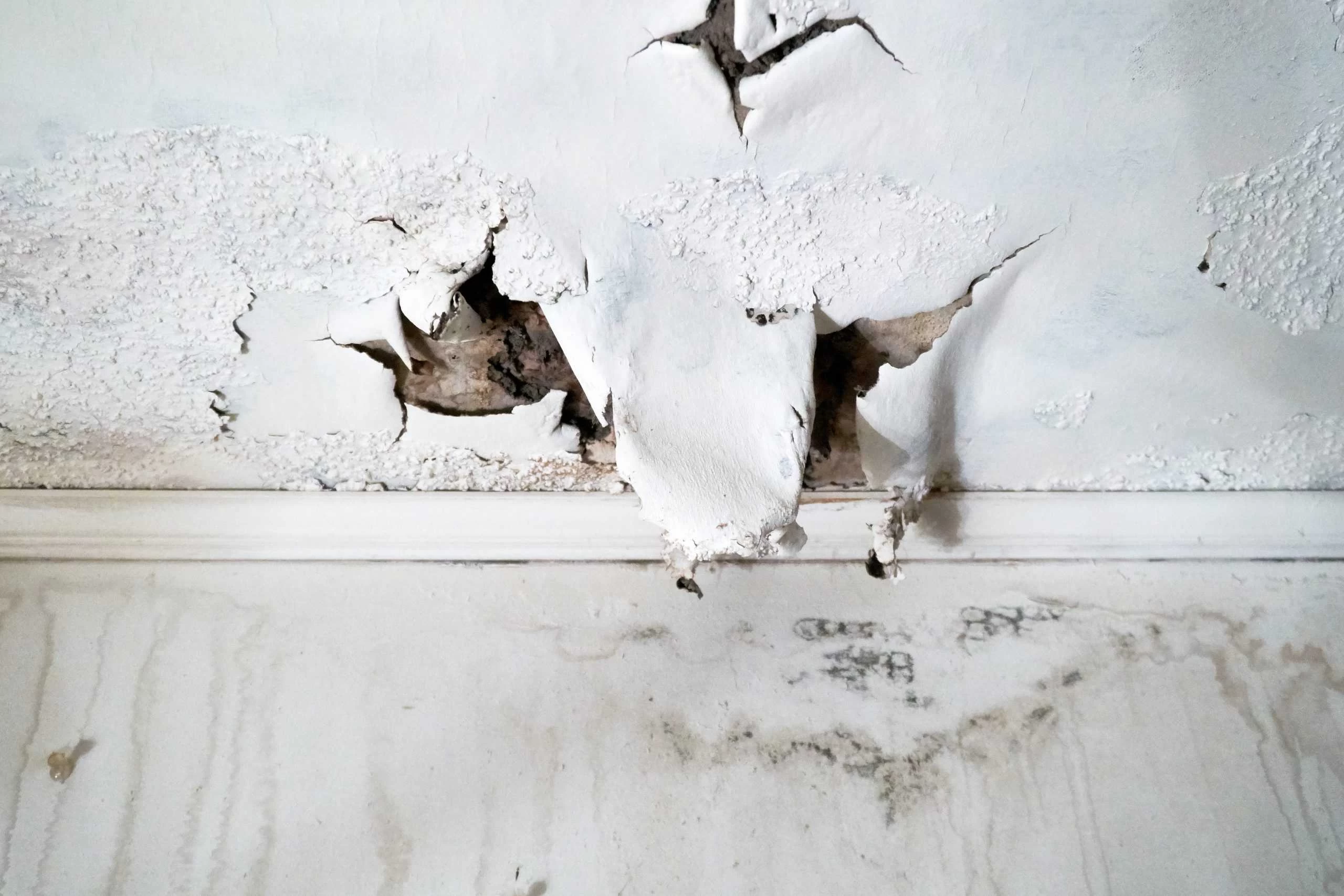
From there, look for dark discoloration — gray, green, or black — on the underside of the roof deck or along the rafters. White or powdery patches on wood surfaces can be Cladosporium, a common attic mold species. Greenish-black staining that looks slimy is more likely Stachybotrys — what most people call black mold — and it requires the highest level of remediation. Aspergillus, another common type, can appear in shades of green or gray and is often found on insulation and wood in damp, nutrient-rich environments.
What you can’t always see matters just as much as what you can. If your attic insulation looks compressed, discolored, or wet to the touch, it’s likely been holding moisture — and mold may be growing within it or beneath it. Wet insulation loses its R-value and can’t be salvaged. It has to come out. For Nassau County homeowners in pre-1980 homes, that’s where the situation can get more complicated, and we’ll come back to that shortly.
One thing worth saying plainly: if the affected area is larger than 10 square feet — roughly a 3-by-3-foot patch — professional remediation is necessary. At that scale, containment, air filtration, and proper disposal become essential to avoid spreading spores through the rest of the house.
How Nassau County's Post-War Housing Stock Changes the Equation
This is the part of the conversation that doesn’t come up enough. Nassau County contains one of the largest concentrations of post-World War II suburban housing in the country. Levittown — built between 1947 and 1951 — was the first mass-produced suburb in American history, and it set the template for thousands of similar developments across the county. East Meadow, Hicksville, Westbury, Elmont, Uniondale — the majority of homes in these communities were built between 1945 and 1975.
Homes built before 1980 frequently contain asbestos-containing materials. In attics specifically, that means old insulation — particularly vermiculite, which was commonly used from the 1950s through the 1980s. Approximately 70% of all vermiculite sold in the U.S. came from a mine in Libby, Montana that was contaminated with tremolite asbestos. If your attic has a gray, pebble-like insulation that looks like small chunks of gravel, there’s a reasonable chance it contains asbestos fibers.
Here’s why this matters for mold remediation: when a contractor enters an older Nassau County attic to remove mold-damaged insulation, they may be disturbing asbestos-containing materials. A mold-only company isn’t licensed to handle that. They have to stop, bring in a separate asbestos abatement contractor, coordinate schedules, and manage two separate scopes of work — which adds cost, time, and confusion for the homeowner.
We hold both mold remediation and asbestos abatement credentials, which means we can assess what’s actually in your attic before anything gets disturbed, and handle the full scope in one project if asbestos is present. For older homes in Garden City, Freeport, Massapequa, or Levittown, that’s not a minor detail — it’s often the deciding factor in how the job gets done safely and legally.
Mold Health Risks and Why Professional Removal Is the Safer Call
Mold in your attic isn’t just a structural problem. It’s an air quality problem. Mold releases spores continuously, and those spores move through your home — through gaps in the attic floor, through HVAC systems, through any path warm air takes as it rises. You don’t have to be standing in the attic to be breathing them.
The health effects range from mild to serious depending on the species, the level of exposure, and the sensitivity of the people in the home. Common symptoms include persistent sneezing, runny nose, eye irritation, skin rash, coughing, and worsening asthma. Children, elderly adults, and anyone with a compromised immune system are at higher risk. Research cited by the CDC suggests that early mold exposure may be a risk factor for the development of asthma in school-aged children — a finding that tends to change how quickly parents want to act once they understand it.
Getting it handled properly — not painted over, not bleached, not temporarily masked — is what actually protects your family.
Attic Mold Removal Cost: What to Expect and What Drives the Price
Cost is the question most homeowners have before they’re ready to ask anything else, and it’s a fair one. Attic mold removal typically runs between $1,000 and $7,000 for most residential jobs in Nassau County. When there’s extensive damage — saturated insulation that needs full replacement, structural wood that requires sanding or removal, limited attic access that slows the work — costs can climb to $6,000 or $15,000. In cases involving significant structural degradation or asbestos abatement alongside remediation, the total can go higher.
Per-square-foot pricing in 2025 generally runs between $3.50 and $7.50, depending on the scope and complexity of the job. Insulation replacement adds roughly $1.20 to $2.00 per square foot on top of that. Clearance testing — which is a required step under New York State law, not optional — typically adds a few hundred dollars but is essential for insurance documentation and real estate transactions.
Several factors push Nassau County jobs toward the higher end of the range. The coastal climate means moisture problems tend to be more entrenched. The prevalence of older housing stock means asbestos assessments are more frequently needed. And the density of the housing market means jobs often involve more complex access and tighter working conditions than a standard suburban attic.
One thing we hear often: homeowners who tried to handle it themselves first — with bleach, encapsulation paint, or a rented air scrubber — usually end up paying more in the end. Bleach doesn’t kill mold on porous wood. The chlorine evaporates off the surface while the water soaks in and feeds the colony. It looks like it worked, and then three months later the mold is back, often worse. A proper job done once costs less than a partial job done twice.
We also offer financing up to $200,000 at 0% APR, which removes a real barrier for families facing unexpected remediation costs.
What Attic Mold Remediation Actually Involves — Step by Step
Remediation and removal aren’t the same thing, even though the words get used interchangeably. Removal is one part of the process. Remediation is the whole thing — done properly, it addresses the mold, the conditions that caused it, and the verification that it’s actually gone.
Here’s how a properly executed attic mold remediation job works. It starts with a licensed assessment. Under New York State’s Article 32 of the Labor Law — which has been in effect since 2016 — any mold work on an area larger than 10 square feet requires a licensed mold assessor and a licensed remediation contractor. This isn’t bureaucratic red tape. It’s a legal requirement that protects you, and it ensures that whoever is doing the work has been trained and tested to a state standard. Hiring an unlicensed contractor in New York for mold work isn’t just risky — it can invalidate insurance claims and create legal exposure for the homeowner.
After the assessment, the work area gets contained using 6-mil polyethylene sheeting sealed at the perimeter. HEPA air scrubbers run continuously to maintain negative air pressure inside the containment zone — meaning air flows in rather than out, so spores can’t migrate to the rest of the house. Workers wear full PPE: respirators, full-body suits, gloves, eye protection.
Contaminated materials — insulation, severely affected wood — are removed and disposed of properly. All surfaces are HEPA-vacuumed, then treated with EPA-registered antimicrobial fungicides that penetrate porous wood rather than just sitting on the surface. If asbestos-containing insulation is present, that gets handled under a separate but coordinated abatement protocol before the mold work proceeds.
The final step is clearance testing — an independent post-remediation assessment confirming that mold levels have been reduced to acceptable standards. This documentation matters for insurance claims, for real estate closings, and for your own peace of mind. A job without clearance testing isn’t finished. It’s just stopped.
Preventing Attic Mold From Coming Back in Nassau County Homes
The most important thing to understand about attic mold is that treating it without fixing what caused it is a temporary solution. If the moisture source — a slow roof leak, a bathroom exhaust fan venting into the attic, blocked soffit vents — isn’t corrected, mold will return. It’s not a question of if. It’s a question of when.
After remediation, keeping attic humidity below 55% relative humidity is the primary prevention goal. That means ensuring soffit and ridge vents are clear and functioning, verifying that all exhaust fans vent to the exterior, addressing any roof penetrations or flashing issues, and scheduling annual attic inspections — especially after storm seasons. For south shore communities like Freeport, Oceanside, and Long Beach that sit in FEMA flood zones and took the brunt of Hurricane Sandy, that post-storm inspection habit is especially important.
If you’ve found mold in your attic — or you’re not sure what you’re looking at — we’ve been handling this work across Nassau County since 2012. We’re licensed, fully insured, and one of the few companies in the area equipped to manage both mold remediation and asbestos abatement under one roof. Reach out to us directly for a straight answer about what you’re dealing with and what it will actually take to fix it.